



 Chat with AI
Exam 2: Pediatric

Exam 1: Medicine2 k Questions
Exam 2: Pediatric723 Questions
Exam 3: Psychiatry336 Questions
Exam 4: Surgery563 Questions
Exam 5: Obstetrics & Gynecology469 Questions
Select questions type


A previously healthy 1-year-old girl is brought in for a routine evaluation. She drinks 6 glasses of whole milk a day but is a very picky eater. The girl is otherwise developmentally appropriate. She lives with her parents and pet dog in a house built in 2008. The patient's height and weight are at the 50th percentile for her age and sex. Temperature is 37 C (98.6 F), pulse is 118/min, and respirations are 21/min. Her physical examination is unremarkable. Complete blood count results are as follows: 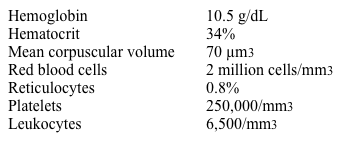 Which of the following is the most appropriate next step in management of this child?
 (Multiple Choice)
5.0/5  (85)
(85) A 4-year-old boy is brought to the office for evaluation of a rash. His mother states that "pinpoint" bruises have appeared all over his body during the past 24 hours. The patient has had no bleeding or recent trauma. Three weeks ago, he had an upper respiratory tract infection that resolved uneventfully. The patient takes no medications, he has no allergies, and his immunizations are up to date. There is no family history of bleeding or clotting disorders. Vital signs are normal for age. Physical examination shows a cooperative, well-appearing child with scattered petechiae on the trunk and extremities. Oral mucosa appears normal. There is no lymphadenopathy or splenomegaly. Laboratory results are as follows:  Peripheral smear shows few platelets; the platelets are of normal size and morphology. Which of the following is the best next step in management of this patient?
 (Multiple Choice)
4.9/5 (83)
(83) A 23-hour-old girl is evaluated for jaundice in the newborn nursery. The infant was born at term via cesarean delivery to a 33-year-old mother, gravida 2 para 2. The pregnancy was complicated by systemic lupus erythematosus and end-stage renal disease, for which the mother received regular hemodialysis. The delivery was complicated by intraamniotic infection and arrest of labor, necessitating cesarean delivery. Apgar scores were 8 and 9 at 1 and 5 minutes, respectively. The infant was prescribed ampicillin and cefotaxime shortly after delivery. The patient is exclusively breastfeeding and has lost 3% of her body weight. She has urinated twice and stooled once. Physical examination shows jaundice on the face and upper trunk but is otherwise unremarkable. Laboratory results are as follows:  Which of the following is the most likely explanation for this patient's elevated creatinine level?
 (Multiple Choice)
4.7/5 (71)
(71) A 13-year-old girl is brought to the clinic for a routine health maintenance examination. She recently immigrated from Southeast Asia and has no known health concerns. Medical history includes a febrile illness a year ago that was followed by development of pain and swelling in the knees and wrists. At that time, the patient was treated with nonsteroidal anti-inflammatory medications, and her symptoms resolved. Her last physical examination, 2 years ago, was prior to her immigration and was normal. She plays soccer and swims every weekend. Blood pressure is 110/70 mm Hg and pulse is 70/min and regular. Cardiac examination reveals a diminished S1 and a grade 2/6, high-pitched, holosystolic murmur that is loudest at the apex and radiates to the left axilla. The lungs are clear to auscultation. The abdomen is soft, nontender, and has no hepatosplenomegaly. Echocardiogram demonstrates mild mitral regurgitation. Which of the following is the most appropriate treatment for this patient?
(Multiple Choice)
4.9/5 (92)
(92) A 58-year-old right-handed man is brought to the emergency department with sudden onset of severe difficulty speaking and weakness that developed over a few seconds while he was at work. His other medical problems include hypertension, hyperlipidemia, severe left atrial enlargement (seen on previous echocardiogram), mild bilateral carotid disease with recent carotid ultrasound showing <30% stenosis, type 2 diabetes mellitus, and autosomal dominant polycystic kidney disease. He is not compliant with his medication regimen. The patient smokes a pack of cigarettes a day and drinks alcohol occasionally. His blood pressure is 156/96 mm Hg and pulse is 124/min and irregularly irregular. His body mass index is 35 kg/m2. There are no carotid bruits. The patient speaks in very short sentences and has difficulty finding words while trying to speak. He is awake and alert but has difficulty following simple commands. There is a forced conjugate gaze preference to the left, neglect of the right visual field, and severe right lower facial droop. He has marked weakness and sensory loss in the right arm and mild weakness and sensory loss in the right leg. His fingerstick glucose value is 345 mg/dL. Which of the following is the most likely cause of this patient's current condition?
(Multiple Choice)
4.8/5 (78)
(78) A 38-year-old woman comes to the emergency department due to 2 hours of left leg weakness and numbness. Over the last 3 months, the patient has had several similar episodes in which her left foot tingles and becomes numb and her entire left foot becomes limp, causing her to trip. The symptoms resolve spontaneously within a few hours. Her right leg has never displayed similar symptoms. The patient has no significant medical history but does have a family history of multiple sclerosis. She does not use tobacco, alcohol, or illicit drugs. The patient has experienced major psychosocial stress after losing her job 6 months ago, but this has tempered somewhat since she joined a meditation group. Vital signs are within normal limits. Physical examination shows diminished pinprick sensation over the dorsum of the left foot and weakness of the left big toe on extension. The patient is able to walk on her left toes but not on her left heel. Which of the following is the most likely cause of this patient's current symptoms?
(Multiple Choice)
4.7/5 (74)
(74) A 47-year-old man is brought to the emergency department due to a fall down a flight of stairs. The patient was inebriated and missed a step. He did not lose consciousness but had neck and shoulder pain afterward. The patient also reports numbness and weakness of the left upper extremity. He has no prior medical conditions and takes no medications. Temperature is 37 C (98.6 F), blood pressure is 144/88 mm Hg, and pulse is 94/min. Physical examination reveals neck tenderness. There is mild, left-sided weakness of elbow extension and wrist flexion, with decreased pain sensation of the index and middle fingers. Lower extremity muscle strength and sensation are intact. Plantar reflex is down going bilaterally. CT scan of the cervical spine is shown in the exhibit. 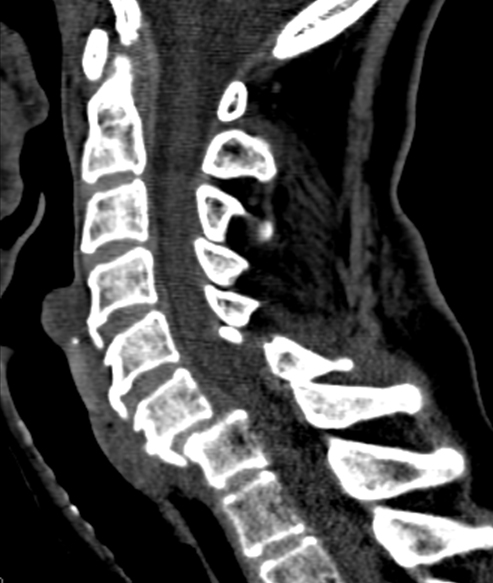 Which of the following is the most likely diagnosis?
 (Multiple Choice)
4.9/5 (77)
(77) A 69-year-old man is brought to the office by his wife due to recent changes in behavior. Despite years of managing the family's finances, over the previous 12 months the patient has failed to pay a number of important bills. He has become more withdrawn and no longer enjoys social gatherings. When he does socialize now, he is often irritable and offensive. The patient used to smoke a quarter pack of cigarettes a day but has increased to a pack a day over the previous 12 months. He also now insists on eating the same thing for breakfast every morning and gets very upset if a different meal is prepared. The patient denies having any problems and seems indifferent to his wife's concern. Medical history includes hypertension and type 2 diabetes mellitus. There is a family history of Alzheimer disease. Temperature is 36.7 C (98 F), blood pressure is 144/86 mm Hg, pulse is 62/min, and respirations are 14/min. The patient scores a 24 out of 30 on the Montreal Cognitive Assessment (normal ≥26). Which of the following is the most likely diagnosis in this patient?
(Multiple Choice)
4.9/5 (82)
(82) A 2-year-old girl is brought to the clinic due to irritability for 2 weeks. She has also had intermittent fevers and poor appetite. The patient has had no cough, rhinorrhea, vomiting, or diarrhea. She has no chronic medical conditions and takes no medications. Her parents have a history of cold sores but have had no recent outbreaks. The family recently went camping but has not traveled internationally. Temperature is 36.7 C (98 F), blood pressure is 90/50 mm Hg, pulse is 104/min, and respirations are 22/min. On examination, the patient is tired-appearing and pale. The right upper eyelid is drooping and the right pupil is constricted. When the patient cries, only the left side of the face appears flushed. Cardiopulmonary examination is unremarkable. The abdomen is soft, nontender, and nondistended with no palpable masses. She has no dysmetria when reaching for objects and has full strength in all extremities. MRI reveals a cervical paravertebral mass. Which of the following is the most likely diagnosis?
(Multiple Choice)
5.0/5 (67)
(67) A 5-year-old girl is brought to the office by her mother and the mother's boyfriend due to leg pain. One week ago, the boyfriend saw the patient fall onto the living room floor after climbing on a couch. Since the incident, she has had persistent leg pain that appears to be worse at night, and for the last 2 days she has been refusing to walk, asking her mother to carry her. The patient has no chronic medical conditions but has had a mild, nonproductive cough for the past month. Temperature is 38.3 C (100.9 F); all other vital signs are normal. Height and weight are at the 20th percentile. Examination shows a pale child. The abdomen is nontender and the liver is palpated 3 cm below the costal margin. Palpation of the bilateral anterior proximal tibias elicits pain. There are a few scattered bruises across the chest and back. The remainder of the examination shows no abnormalities. Complete blood count results are as follows:  Which of the following is the most likely cause of this patient's symptoms?
 (Multiple Choice)
4.8/5 (80)
(80) A 68-year-old woman comes to the office for evaluation of lower extremity weakness. The patient was hospitalized due to pneumonia and septic shock a month ago. She was intubated for respiratory failure at the time of admission and was treated in the intensive care unit for several days. After adequate improvement in her respiratory status, she was discharged to a physical rehabilitation facility. Since that time, the patient has had worsening lower extremity weakness that has failed to improve despite physical therapy. She also has had frequent occipital headaches and numbness and tingling in the hands and feet. The patient has a history of rheumatoid arthritis, hypertension, hypothyroidism, and right total knee replacement. She is a former smoker with a 20-pack-year history and does not drink alcohol. Blood pressure is 136/82 mm Hg and pulse is 72/min. Physical examination shows chronic joint deformities in both hands, clear lungs, normal heart sounds, and a nontender abdomen. Neurological examination reveals decreased lower extremity muscle strength, hyperactive knee reflexes, and decreased proprioception in the feet. Rapidly flicking the nail of the middle finger elicits flexion of the ipsilateral thumb. Which of the following is the most likely cause of this patient's current symptoms?
(Multiple Choice)
4.7/5 (81)
(81) A 3-week-old boy is brought to the emergency department due to a seizure. The patient was born at term to a 23-year-old woman who had no prenatal care and delivered him at home. The mother states that he was healthy until this morning, when he developed a low-grade fever. The patient has been very fussy and refused to nurse at his last feed. Subsequently, he experienced a 4-minute, generalized tonic-clonic seizure with mild perioral cyanosis. Temperature is 38.3 C (100.9 F). The patient is lethargic but arouses to painful stimuli. Pupils are equal and reactive; the anterior fontanel is full. The remainder of the physical examination is normal. Blood and urine samples are obtained and a lumbar puncture is performed, with results pending. Brain imaging reveals patchy areas of increased attenuation in the cerebral cortex and edema and hemorrhage in the left temporal lobe and brainstem; no intracranial calcifications are seen. Vertical transmission of which of the following is the most likely cause of this patient's presentation?
(Multiple Choice)
4.8/5 (93)
(93) A 67-year-old man is brought to the office due to progressively worsening insomnia and impaired concentration and judgment for 2 months. Medical history is significant for early-stage non-small cell lung cancer that was resected 5 years ago. The patient currently takes no medications. Vitals signs are within normal limits. On examination, he is alert and oriented. The patient has limited language and difficulty remembering objects and names. Horizontal nystagmus is present. Mild spasticity, myoclonus, and hyperreflexia are present. Gait is wide based and unsteady. Cardiopulmonary and abdominal examinations show no abnormalities. MRI of the head reveals cerebral atrophy and diffuse bright signals in the cortical white matter and portions of the basal ganglia; there are no mass lesions. Which of the following is the most likely diagnosis?
(Multiple Choice)
4.9/5 (69)
(69) A 6-year-old girl is brought to the clinic by her parents after multiple falls while running in the past few months. Over the past month, the patient has also had intermittent headaches, with increased frequency in the past 2 weeks. The headaches are worse in the morning and have occasionally been accompanied by nausea and vomiting. Examination shows a tired-appearing young girl. The patient walks with a wide-based gait and has difficulty with heel-to-toe walking. Eye examination reveals bilateral abducens nerve palsies and papilledema. The remainder of the cranial nerve examination is normal. Strength is 5/5 in bilateral upper and lower extremities. Sensation is intact, and reflexes are 2+ bilaterally. Babinski testing reveals plantar flexion of the toes. Which of the following is most likely responsible for this patient's symptoms?
(Multiple Choice)
4.8/5 (78)
(78) A 60-year-old woman comes to the office for follow-up of chronic tension-type headaches. Her headaches have not improved after several trials of medications, including those recommended by a neurologist specializing in the management of headaches. The patient says, "I'm really not surprised that this last medication didn't work either. All these drug companies just want to make money. I doubt that anything will help." When asked if she would consider pursuing biofeedback, relaxation training, or stress management therapy, she responds, "There's no point-how can I relax or do therapy when my head is pounding?" The patient's other medical problems include hypertension and hypercholesterolemia, which are well controlled with medication. She has a history of depression following her divorce in her 40s but was unwilling to take an antidepressant or see a counselor at that time. Which of the following statements is the most appropriate response to this patient's concerns?
(Multiple Choice)
4.8/5 (74)
(74) A 26-year-old man comes to the office for follow-up related to painless progressive visual loss in the right eye. Recent ophthalmological evaluation revealed macular edema due to 2 retinal lesions consistent with capillary hemangioblastoma. He underwent laser photocoagulation treatment, and the vision in his right eye has improved. The patient has no other medical conditions. His father died from a cerebral hemorrhage at age 52. MRI of the brain with gadolinium reveals 2 small, cystic, enhancing nodules in the cerebellum. Renal ultrasonography reveals multiple cysts in both kidneys. Which of the following is the most likely diagnosis?
(Multiple Choice)
4.9/5 (75)
(75) A 7-year-old boy is brought to the emergency department due to right leg pain. His mother says that he was running around the house and fell on the carpet an hour ago. The patient has been crying and experiencing thigh pain since the fall. He did not hit his head or lose consciousness. Medical history is notable for 3 fractures after seemingly minor injuries. Temperature is 36.7 C (98 F), blood pressure is 100/60 mm Hg, pulse is 148/min, and respirations are 20/min. On physical examination, the patient is crying but is alert and cooperative. His teeth appear translucent and gray but he otherwise appears well-kept. There is hyperlaxity of the joints of the hands, and upper extremity strength is 5/5 bilaterally. The right thigh is markedly tender to palpation with obvious deformity. X-ray demonstrates fracture of the proximal femur and does not involve the growth plate, which appears normal. Which of the following is most likely diagnosis in this patient?
(Multiple Choice)
4.9/5 (84)
(84) A 7-year-old boy is brought to the office due to urinary dribbling for the past 2 months. Symptoms occur during the day as well as overnight. Review of systems is positive for chronic constipation. He has no other chronic medical problems and takes no medications. Temperature is 37.2 C (99 F), blood pressure is 100/60 mm Hg, pulse is 80/min, and respirations are 16/min. Growth parameters are normal. Physical examination shows a tuft of hair above the gluteal cleft and is otherwise normal. Urinalysis is normal. Which is the most appropriate next step in management of this patient?
(Multiple Choice)
4.8/5 (83)
(83) A 5-year-old, previously healthy, girl is brought to the emergency department due to lethargy and altered mental status. The patient was in her usual state of health until 5 days ago, when she developed a fever, malaise, headache, cough, and nasal discharge. The fever resolved with over-the-counter medications, and the patient was feeling better until this morning, when she developed nausea, vomiting, and lethargy. She has no chronic medical conditions and takes no prescription medications. Temperature is 36.8 C (98.2 F), blood pressure is 98/60 mm Hg, pulse is 110/min, and respirations are 20/min. The patient is not oriented to person, place, or time. Cardiopulmonary examination shows no abnormalities. Hepatomegaly is present; there is no splenomegaly. CT scan of the head reveals diffuse cerebral edema. Which of the following is the most likely cause of this patient's imaging findings?
(Multiple Choice)
4.8/5 (72)
(72) A 32-year-old woman, gravida 1 para 0, at 20 weeks gestation comes to the clinic for a routine prenatal anatomy ultrasound. Recent genetic testing was normal, and the patient has no concerns. She has no chronic medical conditions, and her only medication is a daily prenatal vitamin. Vital signs are normal. BMI is 24 kg/m2. Transabdominal ultrasound reveals a female fetus in breech position. Cardiopulmonary and abdominal examinations are normal. Examination of both lower extremities during fetal movement shows that the plantar surface of each foot is maintained in the same plane as the tibia and fibula, findings consistent with a clubfoot deformity. The amniotic fluid is normal and there is a fundal placenta. The remainder of the ultrasound is normal. After delivery, the infant will require which of the following interventions?
(Multiple Choice)
4.9/5 (76)
(76) 
Filters
- Essay(0)
- Multiple Choice(0)
- Short Answer(0)
- True False(0)
- Matching(0)