Multiple Choice
A 7-year-old boy is brought to the office due to "yellow eyes" over the past few months. His parents state that he has been tired, pale, and frequently uninterested in playing. The boy's father has had similar symptoms throughout his life. The patient takes no daily medications. Physical examination shows a tired-appearing boy with pale conjunctivae, scleral icterus, and generalized jaundice. The tip of the spleen is palpable. Laboratory results are as follows: 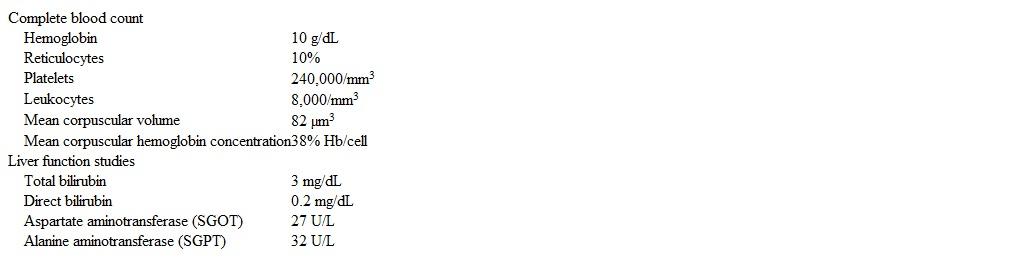 Peripheral smear shows anisocytosis, spherocytes, and polychromatophilia. Direct and indirect antiglobulin (Coombs) tests are negative. Which of the following laboratory tests is the best next step in evaluation of this patient?
A) Bone marrow evaluation
B) Eosin-5-maleimide binding
C) Erythrocyte CD55 and CD59 protein testing
D) Glucose-6-phosphate dehydrogenase activity
E) Hemoglobin electrophoresis
F) Serum B12 level
G) Serum iron level
Correct Answer:

Verified
Correct Answer:
Verified
Q585: A 2-year-old boy is brought to the
Q586: A term newborn is undergoing routine evaluation
Q587: A 10-week-old girl is brought to the
Q588: A 17-year-old boy is brought to the
Q589: A 56-year-old woman is evaluated for a
Q591: A 14-year-old boy is brought to the
Q592: A 17-year-old boy is hospitalized with an
Q593: A 16-year-old girl comes to the office
Q594: A 3-year-old boy is brought to the
Q595: A 17-year-old boy comes to the office