



 Chat with AI
Exam 24: The History of Life on Earth

Exam 1: Studying Life246 Questions
Exam 2: Small Molecules and the Chemistry of Life246 Questions
Exam 3: Proteins, Carbohydrates, and Lipids246 Questions
Exam 4: Nucleic Acids and the Origin of Life246 Questions
Exam 5: Cells: the Working Units of Life248 Questions
Exam 6: Cell Membranes246 Questions
Exam 7: Cell Communication and Multicellularity246 Questions
Exam 8: Energy, Enzymes, and Metabolism246 Questions
Exam 9: Pathways That Harvest Chemical Energy246 Questions
Exam 10: Photosynthesis: Energy From Sunlight242 Questions
Exam 11: The Cell Cycle and Cell Division260 Questions
Exam 12: Inheritance, Genes, and Chromosomes250 Questions
Exam 13: Dna and Its Role in Heredity257 Questions
Exam 14: From Dna to Protein: Gene Expression252 Questions
Exam 15: Gene Mutation and Molecular Medicine251 Questions
Exam 16: Regulation of Gene Expression245 Questions
Exam 17: Genomes249 Questions
Exam 18: Recombinant Dna and Biotechnology243 Questions
Exam 20: Mechanisms of Evolution243 Questions
Exam 21: Reconstructing and Using Phylogenies246 Questions
Exam 22: Speciation247 Questions
Exam 23: Evolution of Genes and Genomes252 Questions
Exam 24: The History of Life on Earth246 Questions
Exam 25: Bacteria, Archaea, and Viruses262 Questions
Exam 26: The Origin and Diversification of Eukaryotes252 Questions
Exam 27: Plants Without Seeds: From Water to Land251 Questions
Exam 28: The Evolution of Seed Plants259 Questions
Exam 29: The Evolution and Diversity of Fungi261 Questions
Exam 30: Animal Origins and the Evolution of Body Plans248 Questions
Exam 31: Protostome Animals244 Questions
Exam 32: Deuterostome Animals246 Questions
Exam 33: The Plant Body243 Questions
Exam 34: Transport in Plants248 Questions
Exam 35: Plant Nutrition247 Questions
Exam 36: Regulation of Plant Growth246 Questions
Exam 37: Reproduction in Flowering Plants247 Questions
Exam 38: Plant Responses to Environmental Challenges246 Questions
Exam 39: Physiology, Homeostasis, and Temperature Regulation258 Questions
Exam 40: Animal Hormones249 Questions
Exam 41: Immunology: Animal Defense Systems265 Questions
Exam 42: Animal Reproduction261 Questions
Exam 43: Animal Development261 Questions
Exam 44: Neurons, Glia, and Nervous Systems250 Questions
Exam 45: Sensory Systems249 Questions
Exam 46: The Mammalian Nervous System: Structure and Higher Functions254 Questions
Exam 47: Musculoskeletal Systems259 Questions
Exam 48: Gas Exchange247 Questions
Exam 49: Circulatory Systems252 Questions
Exam 50: Nutrition, Digestion, and Absorption259 Questions
Exam 51: Salt and Water Balance and Nitrogen Excretion251 Questions
Exam 52: Animal Behavior249 Questions
Exam 53: The Physical Environment and Biogeography of Life248 Questions
Exam 54: Populations259 Questions
Exam 55: Species Interactions254 Questions
Exam 56: Communities247 Questions
Exam 57: Ecosystems238 Questions
Exam 58: A Changing Biosphere222 Questions
Select questions type


Refer to the graph showing variations in oxygen levels during Earth's history. 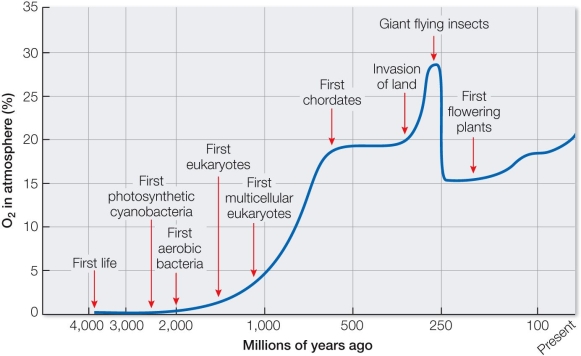 Based on the graph, what is the most logical conclusion about the abundance of plant life in the time interval about 250 million years ago?
 (Multiple Choice)
4.9/5  (79)
(79) A pure radioactive substance has a mass of 30 micrograms but had a mass of 240 micrograms 48 years ago.Assuming that the only changes in mass are due to radioactive decay, the half-life of the substance is _______ years.
(Multiple Choice)
4.7/5 (76)
(76) At the global level, changing environmental conditions are currently characterized by a(n) increase in temperature caused by increased levels of _______ in the atmosphere.
(Short Answer)
4.8/5 (84)
(84) Refer to the figure depicting a layer of Iridium at the Cretaceous-Tertiary (K/T) boundary between strata from two different periods in Earth's history. 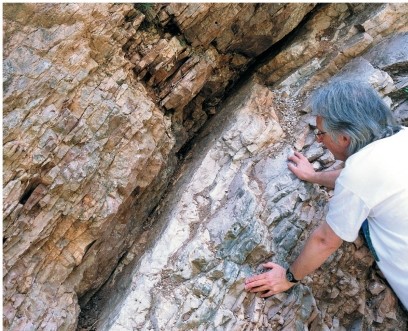 Explain the significance of the globally distributed iridium layer found in strata with an age of approximately 65.5 million years.Explain which kinds of species went extinct at this time, and why (be as specific as possible).
 (Essay)
4.8/5 (74)
(74) In undisturbed sedimentary rock, strata from the _______ are immediately above rocks from the Ordovician.
(Multiple Choice)
4.9/5 (90)
(90) Based on the results of experiments raising flies at higher levels of oxygen, which of the following statements is most probable?
(Multiple Choice)
4.8/5 (91)
(91) At very small population densities, local extinctions can be caused by accidents such as not being able to find a mate.Examples of such phenomena are referred to collectively as the _______ effect.
(Short Answer)
4.8/5 (92)
(92) If 50 mg of a radioactive substance becomes 12.5 mg in 2,600 years, the half-life of the substance is _______ years.
(Short Answer)
4.9/5 (81)
(81) Among terrestrial species, those adapted to _______ conditions (such as higher elevations) are expected to be particularly vulnerable to climate change.
(Short Answer)
4.8/5 (92)
(92) You have discovered a nonavian dinosaur fossil in a sedimentary stratum with a nearby igneous intrusion.Based on this description, which type of analysis would not be appropriate for this sample?
(Multiple Choice)
4.9/5 (76)
(76) The Ottawa-Bonnechere Graben is a region in Canada characterized by two continental plates moving away from one another.The resulting geological feature is called a _______.
(Short Answer)
4.8/5 (82)
(82) Refer to the figure.  The figure shows the _______ era, during which atmospheric O2 levels were almost equal to that of the present, and hard-bodied invertebrates were abundant and diverse in the sea.
 (Multiple Choice)
4.8/5 (91)
(91) Refer to the figure, which illustrates changes in sea level over time.Asterisks indicate mass extinctions of marine organisms. 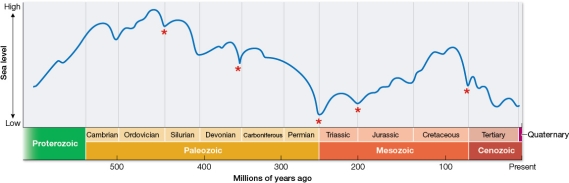 Which statement is supported by the figure?
 (Multiple Choice)
4.9/5 (84)
(84) Refer to the figure, which shows an imaginary name scheme for an undisturbed site with distinct fossil assemblages in the top five layers of strata. 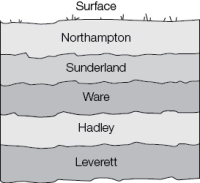 Imagine that the Ware layer contains abundant and diverse shellfish and other marine fauna, while Sunderland contains the flora and fauna associated with lowland swamps. Which hypothesis is the most logical explanation to account for this?
 (Multiple Choice)
4.9/5 (75)
(75) Over geologic time, the concentration of O2 in Earth's atmosphere has increased.However, at the end of the _______ period, the O2 concentration decreased significantly and was associated with _______.
(Multiple Choice)
4.9/5 (80)
(80) Which of the following is in the corrrect order, from largest to smallest?
(Multiple Choice)
4.7/5 (87)
(87) Vertebrates with well-protected eggs that can be laid in dry places originated during the Carboniferous period.These animals are known as
(Multiple Choice)
4.8/5 (85)
(85) 
Filters
- Essay(0)
- Multiple Choice(0)
- Short Answer(0)
- True False(0)
- Matching(0)