



 Chat with AI
Exam 24: The History of Life on Earth

Exam 1: Studying Life246 Questions
Exam 2: Small Molecules and the Chemistry of Life246 Questions
Exam 3: Proteins, Carbohydrates, and Lipids246 Questions
Exam 4: Nucleic Acids and the Origin of Life246 Questions
Exam 5: Cells: the Working Units of Life248 Questions
Exam 6: Cell Membranes246 Questions
Exam 7: Cell Communication and Multicellularity246 Questions
Exam 8: Energy, Enzymes, and Metabolism246 Questions
Exam 9: Pathways That Harvest Chemical Energy246 Questions
Exam 10: Photosynthesis: Energy From Sunlight242 Questions
Exam 11: The Cell Cycle and Cell Division260 Questions
Exam 12: Inheritance, Genes, and Chromosomes250 Questions
Exam 13: Dna and Its Role in Heredity257 Questions
Exam 14: From Dna to Protein: Gene Expression252 Questions
Exam 15: Gene Mutation and Molecular Medicine251 Questions
Exam 16: Regulation of Gene Expression245 Questions
Exam 17: Genomes249 Questions
Exam 18: Recombinant Dna and Biotechnology243 Questions
Exam 20: Mechanisms of Evolution243 Questions
Exam 21: Reconstructing and Using Phylogenies246 Questions
Exam 22: Speciation247 Questions
Exam 23: Evolution of Genes and Genomes252 Questions
Exam 24: The History of Life on Earth246 Questions
Exam 25: Bacteria, Archaea, and Viruses262 Questions
Exam 26: The Origin and Diversification of Eukaryotes252 Questions
Exam 27: Plants Without Seeds: From Water to Land251 Questions
Exam 28: The Evolution of Seed Plants259 Questions
Exam 29: The Evolution and Diversity of Fungi261 Questions
Exam 30: Animal Origins and the Evolution of Body Plans248 Questions
Exam 31: Protostome Animals244 Questions
Exam 32: Deuterostome Animals246 Questions
Exam 33: The Plant Body243 Questions
Exam 34: Transport in Plants248 Questions
Exam 35: Plant Nutrition247 Questions
Exam 36: Regulation of Plant Growth246 Questions
Exam 37: Reproduction in Flowering Plants247 Questions
Exam 38: Plant Responses to Environmental Challenges246 Questions
Exam 39: Physiology, Homeostasis, and Temperature Regulation258 Questions
Exam 40: Animal Hormones249 Questions
Exam 41: Immunology: Animal Defense Systems265 Questions
Exam 42: Animal Reproduction261 Questions
Exam 43: Animal Development261 Questions
Exam 44: Neurons, Glia, and Nervous Systems250 Questions
Exam 45: Sensory Systems249 Questions
Exam 46: The Mammalian Nervous System: Structure and Higher Functions254 Questions
Exam 47: Musculoskeletal Systems259 Questions
Exam 48: Gas Exchange247 Questions
Exam 49: Circulatory Systems252 Questions
Exam 50: Nutrition, Digestion, and Absorption259 Questions
Exam 51: Salt and Water Balance and Nitrogen Excretion251 Questions
Exam 52: Animal Behavior249 Questions
Exam 53: The Physical Environment and Biogeography of Life248 Questions
Exam 54: Populations259 Questions
Exam 55: Species Interactions254 Questions
Exam 56: Communities247 Questions
Exam 57: Ecosystems238 Questions
Exam 58: A Changing Biosphere222 Questions
Select questions type


The movement of plates arises from heat generated by _______ coming from the _______.
(Multiple Choice)
4.8/5  (84)
(84) Which group of organisms has been most affected by periods of increased glaciations?
(Multiple Choice)
4.8/5 (76)
(76) Relative to the number of described species that are currently alive on Earth, there are about _______ as many described fossil species.As a result, scientists conclude that many species have evolved and gone extinct without being documented.
(Multiple Choice)
5.0/5 (91)
(91) In what way was the evolution of eukaryotic cells linked to the increase in the oxygen concentration in the atmosphere that occurred during the Precambrian?
(Essay)
4.7/5 (77)
(77) At the end of the Permian, populations of organisms likely be the most vulnerable to changing climatic conditions
(Multiple Choice)
4.7/5 (79)
(79) Refer to the figure. 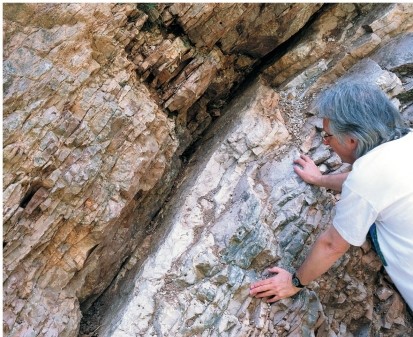 The figure depicts a layer of iridium at the Cretaceous-Tertiary (K/T) boundary between strata from two different periods in Earth's history.The only _______ fossils found above the K/T boundary are those of birds.
 (Multiple Choice)
4.9/5 (95)
(95) Which of the following is not considered a plausible hypothesis for the causes of mass extinctions?
(Multiple Choice)
4.9/5 (95)
(95) Fruit flies grow larger after several generations of being raised in _______ conditions.
(Short Answer)
4.9/5 (79)
(79) Which of the following gases have opposing effects on Earth's climate?
(Multiple Choice)
4.8/5 (77)
(77) Fossils found in lower strata of undisturbed sedimentary rocks are _______ and _______ similar to modern-day organisms than those found in higher strata.
(Multiple Choice)
4.9/5 (79)
(79) The formation of the single giant continent _______ about 275 million years ago caused massive volcanic eruptions.
(Short Answer)
5.0/5 (80)
(80) The diversification of multicellular lineages associated with what has been called "the Cambrian explosion" started _______ the Cambrian period.
(Multiple Choice)
4.9/5 (86)
(86) If the half-life of a radioactive substance is 600 years, what fraction of the original material would be left after 1,800 years?
(Multiple Choice)
4.8/5 (71)
(71) Great evolutionary radiations of corals and shelled squid (like cephalopods) occurred during the _______ period.
(Short Answer)
4.8/5 (95)
(95) Which atmospheric gas is most closely associated with an increase in average global temperatures?
(Multiple Choice)
4.9/5 (74)
(74) A fossil lies buried in Laurasia during the Jurassic period.During its lifetime as a member of the Permian biota, it would most likely have lived in the _______ part of _______.
(Multiple Choice)
4.9/5 (84)
(84) The most dramatic mass extinction in Earth's history, which destroyed about 96 percent of the species,
(Multiple Choice)
4.9/5 (88)
(88) A group of oxygen-generating bacteria, the _______, form rocklike structures known as stromatolites.
(Short Answer)
4.7/5 (83)
(83) 
Filters
- Essay(0)
- Multiple Choice(0)
- Short Answer(0)
- True False(0)
- Matching(0)