



 Chat with AI
Exam 24: The History of Life on Earth

Exam 1: Studying Life246 Questions
Exam 2: Small Molecules and the Chemistry of Life246 Questions
Exam 3: Proteins, Carbohydrates, and Lipids246 Questions
Exam 4: Nucleic Acids and the Origin of Life246 Questions
Exam 5: Cells: the Working Units of Life248 Questions
Exam 6: Cell Membranes246 Questions
Exam 7: Cell Communication and Multicellularity246 Questions
Exam 8: Energy, Enzymes, and Metabolism246 Questions
Exam 9: Pathways That Harvest Chemical Energy246 Questions
Exam 10: Photosynthesis: Energy From Sunlight242 Questions
Exam 11: The Cell Cycle and Cell Division260 Questions
Exam 12: Inheritance, Genes, and Chromosomes250 Questions
Exam 13: Dna and Its Role in Heredity257 Questions
Exam 14: From Dna to Protein: Gene Expression252 Questions
Exam 15: Gene Mutation and Molecular Medicine251 Questions
Exam 16: Regulation of Gene Expression245 Questions
Exam 17: Genomes249 Questions
Exam 18: Recombinant Dna and Biotechnology243 Questions
Exam 20: Mechanisms of Evolution243 Questions
Exam 21: Reconstructing and Using Phylogenies246 Questions
Exam 22: Speciation247 Questions
Exam 23: Evolution of Genes and Genomes252 Questions
Exam 24: The History of Life on Earth246 Questions
Exam 25: Bacteria, Archaea, and Viruses262 Questions
Exam 26: The Origin and Diversification of Eukaryotes252 Questions
Exam 27: Plants Without Seeds: From Water to Land251 Questions
Exam 28: The Evolution of Seed Plants259 Questions
Exam 29: The Evolution and Diversity of Fungi261 Questions
Exam 30: Animal Origins and the Evolution of Body Plans248 Questions
Exam 31: Protostome Animals244 Questions
Exam 32: Deuterostome Animals246 Questions
Exam 33: The Plant Body243 Questions
Exam 34: Transport in Plants248 Questions
Exam 35: Plant Nutrition247 Questions
Exam 36: Regulation of Plant Growth246 Questions
Exam 37: Reproduction in Flowering Plants247 Questions
Exam 38: Plant Responses to Environmental Challenges246 Questions
Exam 39: Physiology, Homeostasis, and Temperature Regulation258 Questions
Exam 40: Animal Hormones249 Questions
Exam 41: Immunology: Animal Defense Systems265 Questions
Exam 42: Animal Reproduction261 Questions
Exam 43: Animal Development261 Questions
Exam 44: Neurons, Glia, and Nervous Systems250 Questions
Exam 45: Sensory Systems249 Questions
Exam 46: The Mammalian Nervous System: Structure and Higher Functions254 Questions
Exam 47: Musculoskeletal Systems259 Questions
Exam 48: Gas Exchange247 Questions
Exam 49: Circulatory Systems252 Questions
Exam 50: Nutrition, Digestion, and Absorption259 Questions
Exam 51: Salt and Water Balance and Nitrogen Excretion251 Questions
Exam 52: Animal Behavior249 Questions
Exam 53: The Physical Environment and Biogeography of Life248 Questions
Exam 54: Populations259 Questions
Exam 55: Species Interactions254 Questions
Exam 56: Communities247 Questions
Exam 57: Ecosystems238 Questions
Exam 58: A Changing Biosphere222 Questions
Select questions type


The period during which most of Earth's land was divided into two large land masses and in which lizards, several groups of mammals, and flowering plants first appeared was the
(Multiple Choice)
4.8/5  (75)
(75) If the Earth's mantle had somewhat less radioactive material, there would be _______ heat generated and likely _______ plate tectonic activity.
(Multiple Choice)
5.0/5 (72)
(72) The primary reason that dragonflies grew so much larger 300 million years ago than they do today is that
(Multiple Choice)
5.0/5 (71)
(71) The _______ of an isotope is the time it takes for a fixed fraction of radioactive material to change from one form to another.
(Short Answer)
4.9/5 (83)
(83) The mass extinction responsible for the demise of the nonavian dinosaurs occurred about 65 million years ago at the end of the _______ period.
(Short Answer)
4.8/5 (66)
(66) Which of the following radioactive substances is commonly used to date very ancient (older than the Cenozoic) fossils and events in the history of life?
(Multiple Choice)
4.9/5 (91)
(91) In undisturbed sedimentary rock, strata from the _______ period are immediately below rocks from the Ordovician period.
(Multiple Choice)
4.9/5 (87)
(87) The first plants to produce seeds appeared in the _______ period.
(Short Answer)
4.9/5 (83)
(83) Which of the following was not known to eighteenth- and nineteenth-century geologists?
(Multiple Choice)
5.0/5 (80)
(80) The half-life of 14C, a radioactive element of carbon, is 5,700 years.The ratio of 14C to 12C in a fossil 28,500 years old would be about _______ that of a living organism today.
(Multiple Choice)
4.9/5 (70)
(70) Giant insects have not appeared in the fossil record since the end of the _______ period, due at least in part to declines in the concentration of oxygen in the atmosphere that followed the mass death of swamp vegetation around the globe.
(Short Answer)
5.0/5 (77)
(77) If you could go back in time and walk in a Permian forest, you would not expect to encounter
(Multiple Choice)
5.0/5 (77)
(77) Refer to the figure. 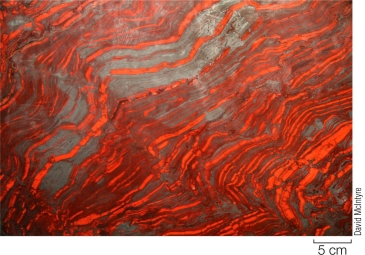 The bands of sediment shown contain iron oxide in sediments dated to an age of 2.25 billion years.Explain the significance of this with respect to the evolution of life on Earth.
 (Essay)
4.8/5 (75)
(75) Which of the following is not considered evidence that large meteors struck Earth in the past?
(Multiple Choice)
4.8/5 (73)
(73) For terrestrial animals and plants, the most recent mass extinction event that occurred prior to the evolution of humans took place approximately _______ million years ago.
(Short Answer)
4.8/5 (90)
(90) Which of the following eras in Earth's history is the longest?
(Multiple Choice)
4.8/5 (85)
(85) Ecologists have coined a new term for the current era.The "Anthropocene" is named after humans because we are currently living in an age of mass _______ brought about by human activity such as overharvesting, habitat destruction, and pollution.
(Short Answer)
4.9/5 (81)
(81) Evidence that meteorites collided with Earth at times of mass extinctions comes from the presence of _______, a metal that is rare on Earth but common in some meteorites.
(Short Answer)
4.8/5 (81)
(81) What do scientists call the long-term average expectations of temperature and precipitation over the various seasons at a given location?
(Multiple Choice)
4.8/5 (93)
(93) 
Filters
- Essay(0)
- Multiple Choice(0)
- Short Answer(0)
- True False(0)
- Matching(0)