



 Chat with AI
Exam 24: The History of Life on Earth

Exam 1: Studying Life246 Questions
Exam 2: Small Molecules and the Chemistry of Life246 Questions
Exam 3: Proteins, Carbohydrates, and Lipids246 Questions
Exam 4: Nucleic Acids and the Origin of Life246 Questions
Exam 5: Cells: the Working Units of Life248 Questions
Exam 6: Cell Membranes246 Questions
Exam 7: Cell Communication and Multicellularity246 Questions
Exam 8: Energy, Enzymes, and Metabolism246 Questions
Exam 9: Pathways That Harvest Chemical Energy246 Questions
Exam 10: Photosynthesis: Energy From Sunlight242 Questions
Exam 11: The Cell Cycle and Cell Division260 Questions
Exam 12: Inheritance, Genes, and Chromosomes250 Questions
Exam 13: Dna and Its Role in Heredity257 Questions
Exam 14: From Dna to Protein: Gene Expression252 Questions
Exam 15: Gene Mutation and Molecular Medicine251 Questions
Exam 16: Regulation of Gene Expression245 Questions
Exam 17: Genomes249 Questions
Exam 18: Recombinant Dna and Biotechnology243 Questions
Exam 20: Mechanisms of Evolution243 Questions
Exam 21: Reconstructing and Using Phylogenies246 Questions
Exam 22: Speciation247 Questions
Exam 23: Evolution of Genes and Genomes252 Questions
Exam 24: The History of Life on Earth246 Questions
Exam 25: Bacteria, Archaea, and Viruses262 Questions
Exam 26: The Origin and Diversification of Eukaryotes252 Questions
Exam 27: Plants Without Seeds: From Water to Land251 Questions
Exam 28: The Evolution of Seed Plants259 Questions
Exam 29: The Evolution and Diversity of Fungi261 Questions
Exam 30: Animal Origins and the Evolution of Body Plans248 Questions
Exam 31: Protostome Animals244 Questions
Exam 32: Deuterostome Animals246 Questions
Exam 33: The Plant Body243 Questions
Exam 34: Transport in Plants248 Questions
Exam 35: Plant Nutrition247 Questions
Exam 36: Regulation of Plant Growth246 Questions
Exam 37: Reproduction in Flowering Plants247 Questions
Exam 38: Plant Responses to Environmental Challenges246 Questions
Exam 39: Physiology, Homeostasis, and Temperature Regulation258 Questions
Exam 40: Animal Hormones249 Questions
Exam 41: Immunology: Animal Defense Systems265 Questions
Exam 42: Animal Reproduction261 Questions
Exam 43: Animal Development261 Questions
Exam 44: Neurons, Glia, and Nervous Systems250 Questions
Exam 45: Sensory Systems249 Questions
Exam 46: The Mammalian Nervous System: Structure and Higher Functions254 Questions
Exam 47: Musculoskeletal Systems259 Questions
Exam 48: Gas Exchange247 Questions
Exam 49: Circulatory Systems252 Questions
Exam 50: Nutrition, Digestion, and Absorption259 Questions
Exam 51: Salt and Water Balance and Nitrogen Excretion251 Questions
Exam 52: Animal Behavior249 Questions
Exam 53: The Physical Environment and Biogeography of Life248 Questions
Exam 54: Populations259 Questions
Exam 55: Species Interactions254 Questions
Exam 56: Communities247 Questions
Exam 57: Ecosystems238 Questions
Exam 58: A Changing Biosphere222 Questions
Select questions type


Mass extinctions in the fossil record have often accompanied major _______ in sea level.Such extinctions have particularly affected _______ animals.
(Multiple Choice)
4.9/5  (76)
(76) Which organisms represent the source of our petroleum oil products?
(Multiple Choice)
4.7/5 (76)
(76) Refer to the figure to interpret the relative contribution of various risk factors toward the possible local extinction of a species. 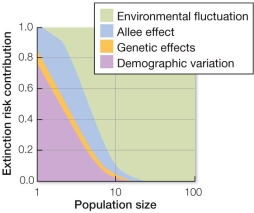 Which of the following would be most likely to cause the local extinction of a population of kelp with fewer than three individuals?
 (Multiple Choice)
5.0/5 (82)
(82) Experiments with Drosophila grown under higher-than-normal levels of oxygen evolve
(Multiple Choice)
4.9/5 (78)
(78) The biogeographical isolation of Australia at a crucial time in mammalian evolution resulted in its being populated with a diverse array of marsupial mammals. Shortly before that, at the time of the mass extinction at the Cretaceous-Tertiary (K/T) boundary, Australia was
(Multiple Choice)
4.8/5 (73)
(73) During the _______ period, the biota recovered after a major mass extinction, the species richness of invertebrate groups increased, the first turtles and frogs appeared, and a large radiation of reptiles began.
(Multiple Choice)
4.9/5 (87)
(87) Refer to the figure, which illustrates a particular period in the fossil record. 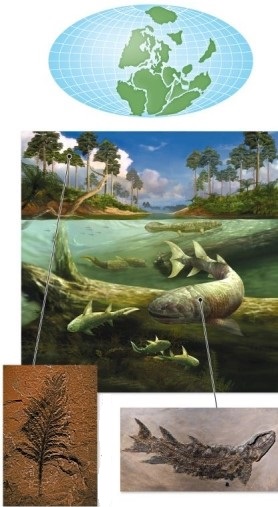 Based on the fossil record, the period that corresponds to figure is the _______.
 (Short Answer)
4.9/5 (69)
(69) The nonavian dinosaurs were one group among many that did not survive the Cretaceous mass extinction.What factor(s) most likely contributed to this event?
(Multiple Choice)
4.8/5 (86)
(86) The geological process of subduction (characterized by one plate sliding under another) accounts for
(Multiple Choice)
5.0/5 (79)
(79) During the most recent geological era, the _______, certain plants such as legumes formed symbioses with nitrogen-fixing bacteria.
(Short Answer)
4.9/5 (89)
(89) The period beginning with the Cambrian and up to the present represents the _______ eon, which spans approximately 500 million years.
(Short Answer)
4.8/5 (74)
(74) Which of the following was the most likely cause of the limited diversity of multicellular eukaryotes for much of their early existence?
(Multiple Choice)
4.8/5 (85)
(85) Which of the following represents a correct chronological ordering of Earth's geological history, from earliest to latest?
(Multiple Choice)
4.8/5 (82)
(82) The half-life of a particular radioactive isotope of element X is 100 years.If you know that 400 years ago a fossil contained 10 mg of this isotope, you would expect to find about _______ mg in that fossil today.
(Multiple Choice)
4.8/5 (77)
(77) Suppose life is found on another planet, and you are part of a team assigned to assess the relative ages of different assemblages of fossils: Hadley, Leverett, Northampton, Sunderland, and Ware.In location A, the Hadley assemblage is found below the Ware assemblage and above the Leverett assemblage.In location B, the Northampton assemblage is found above the Sunderland assemblage.In location C, Ware is found below Sunderland.In location D, Hadley is found below Ware.Assume that the rocks are undisturbed in all locations.Construct a diagram showing the relative positions of all five strata.
(Essay)
4.8/5 (65)
(65) 
Filters
- Essay(0)
- Multiple Choice(0)
- Short Answer(0)
- True False(0)
- Matching(0)