



 Chat with AI
Exam 24: The History of Life on Earth

Exam 1: Studying Life246 Questions
Exam 2: Small Molecules and the Chemistry of Life246 Questions
Exam 3: Proteins, Carbohydrates, and Lipids246 Questions
Exam 4: Nucleic Acids and the Origin of Life246 Questions
Exam 5: Cells: the Working Units of Life248 Questions
Exam 6: Cell Membranes246 Questions
Exam 7: Cell Communication and Multicellularity246 Questions
Exam 8: Energy, Enzymes, and Metabolism246 Questions
Exam 9: Pathways That Harvest Chemical Energy246 Questions
Exam 10: Photosynthesis: Energy From Sunlight242 Questions
Exam 11: The Cell Cycle and Cell Division260 Questions
Exam 12: Inheritance, Genes, and Chromosomes250 Questions
Exam 13: Dna and Its Role in Heredity257 Questions
Exam 14: From Dna to Protein: Gene Expression252 Questions
Exam 15: Gene Mutation and Molecular Medicine251 Questions
Exam 16: Regulation of Gene Expression245 Questions
Exam 17: Genomes249 Questions
Exam 18: Recombinant Dna and Biotechnology243 Questions
Exam 20: Mechanisms of Evolution243 Questions
Exam 21: Reconstructing and Using Phylogenies246 Questions
Exam 22: Speciation247 Questions
Exam 23: Evolution of Genes and Genomes252 Questions
Exam 24: The History of Life on Earth246 Questions
Exam 25: Bacteria, Archaea, and Viruses262 Questions
Exam 26: The Origin and Diversification of Eukaryotes252 Questions
Exam 27: Plants Without Seeds: From Water to Land251 Questions
Exam 28: The Evolution of Seed Plants259 Questions
Exam 29: The Evolution and Diversity of Fungi261 Questions
Exam 30: Animal Origins and the Evolution of Body Plans248 Questions
Exam 31: Protostome Animals244 Questions
Exam 32: Deuterostome Animals246 Questions
Exam 33: The Plant Body243 Questions
Exam 34: Transport in Plants248 Questions
Exam 35: Plant Nutrition247 Questions
Exam 36: Regulation of Plant Growth246 Questions
Exam 37: Reproduction in Flowering Plants247 Questions
Exam 38: Plant Responses to Environmental Challenges246 Questions
Exam 39: Physiology, Homeostasis, and Temperature Regulation258 Questions
Exam 40: Animal Hormones249 Questions
Exam 41: Immunology: Animal Defense Systems265 Questions
Exam 42: Animal Reproduction261 Questions
Exam 43: Animal Development261 Questions
Exam 44: Neurons, Glia, and Nervous Systems250 Questions
Exam 45: Sensory Systems249 Questions
Exam 46: The Mammalian Nervous System: Structure and Higher Functions254 Questions
Exam 47: Musculoskeletal Systems259 Questions
Exam 48: Gas Exchange247 Questions
Exam 49: Circulatory Systems252 Questions
Exam 50: Nutrition, Digestion, and Absorption259 Questions
Exam 51: Salt and Water Balance and Nitrogen Excretion251 Questions
Exam 52: Animal Behavior249 Questions
Exam 53: The Physical Environment and Biogeography of Life248 Questions
Exam 54: Populations259 Questions
Exam 55: Species Interactions254 Questions
Exam 56: Communities247 Questions
Exam 57: Ecosystems238 Questions
Exam 58: A Changing Biosphere222 Questions
Select questions type


The principles of stratigraphy are often used to determine the relative ages of fossils.Which statement is an important assumption of this method?
(Multiple Choice)
4.8/5  (77)
(77) In undisturbed sedimentary rock, strata from which period would be immediately below rocks from the Ordovician?
(Multiple Choice)
4.9/5 (77)
(77) Suppose the half-life of a radioactive isotope is 900 years.Of the total amount of that element assimilated by living organisms into their tissues, 0.002 percent consists of the radioactive isotope.If you were to find a skeleton of an organism that had 0.0005 percent of the element as the radioactive isotope, it would be estimated to be _______ years old.
(Short Answer)
4.9/5 (71)
(71) A fossil of a marine crab, suspected to be 500 million years old, is discovered in South America.Which of the following is the most accurate way of determining the age of the fossil?
(Multiple Choice)
4.9/5 (78)
(78) During the _______ period, fishes diversified and evolved jaws; club mosses, horsetails, and tree ferns became common; the earliest insects and terrestrial vertebrates arose; and there was a mass extinction at the end of the period that may have been caused by meteorites.
(Multiple Choice)
4.8/5 (98)
(98) The time interval spanning four billion years across three eons is the
(Multiple Choice)
4.8/5 (74)
(74) Refer to the figure. 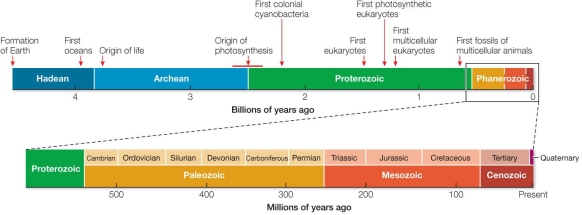 The diversification of multicellular lineages associated with the Cambrian explosion lasted about _______ percent of the span of time during which life existed before the Cambrian explosion.
 (Multiple Choice)
4.8/5 (82)
(82) The experiment in which Drosophila flies were raised at a higher-than-normal oxygen concentration led to which of the following conclusions?
(Multiple Choice)
4.7/5 (67)
(67) Much of the _______ we now use for energy consists largely of the remains of plants that grew in swamps during the Carboniferous period.
(Short Answer)
4.7/5 (81)
(81) The current geological period, the Quaternary is divided into two epochs: the _______ and the Holocene.
(Short Answer)
5.0/5 (91)
(91) What is the most likely factor constraining body size in Drosophila at current levels of oxygen?
(Multiple Choice)
4.8/5 (83)
(83) Insects are _______ represented in the fossil record because they_______.
(Multiple Choice)
4.9/5 (89)
(89) As a result of continental drift, the continent of _______ (which was attached to Antarctica when most other continents were part of Gondwana and Laurasia) has its own unique fauna compared to the rest of the modern terrestrial world.
(Short Answer)
4.8/5 (83)
(83) Refer to the figure to interpret the relative contribution of various risk factors toward the possible local extinction of a species. 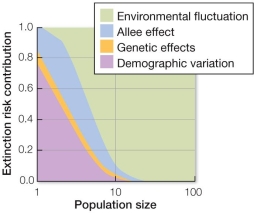 Which of the following would be most likely to cause the local extinction of a population of kelp with 100 individuals?
 (Multiple Choice)
4.9/5 (82)
(82) Which sample would not be appropriate for dating by means of radioactive potassium?
(Multiple Choice)
4.8/5 (68)
(68) The mass extinction at the end of the Ordovician period was probably caused by
(Multiple Choice)
4.9/5 (88)
(88) Which statement about the principles of stratigraphy is true?
(Multiple Choice)
4.8/5 (74)
(74) In undisturbed strata of sedimentary rock, the oldest rocks
(Multiple Choice)
4.8/5 (81)
(81) 
Filters
- Essay(0)
- Multiple Choice(0)
- Short Answer(0)
- True False(0)
- Matching(0)