



 Chat with AI
Exam 24: The History of Life on Earth

Exam 1: Studying Life246 Questions
Exam 2: Small Molecules and the Chemistry of Life246 Questions
Exam 3: Proteins, Carbohydrates, and Lipids246 Questions
Exam 4: Nucleic Acids and the Origin of Life246 Questions
Exam 5: Cells: the Working Units of Life248 Questions
Exam 6: Cell Membranes246 Questions
Exam 7: Cell Communication and Multicellularity246 Questions
Exam 8: Energy, Enzymes, and Metabolism246 Questions
Exam 9: Pathways That Harvest Chemical Energy246 Questions
Exam 10: Photosynthesis: Energy From Sunlight242 Questions
Exam 11: The Cell Cycle and Cell Division260 Questions
Exam 12: Inheritance, Genes, and Chromosomes250 Questions
Exam 13: Dna and Its Role in Heredity257 Questions
Exam 14: From Dna to Protein: Gene Expression252 Questions
Exam 15: Gene Mutation and Molecular Medicine251 Questions
Exam 16: Regulation of Gene Expression245 Questions
Exam 17: Genomes249 Questions
Exam 18: Recombinant Dna and Biotechnology243 Questions
Exam 20: Mechanisms of Evolution243 Questions
Exam 21: Reconstructing and Using Phylogenies246 Questions
Exam 22: Speciation247 Questions
Exam 23: Evolution of Genes and Genomes252 Questions
Exam 24: The History of Life on Earth246 Questions
Exam 25: Bacteria, Archaea, and Viruses262 Questions
Exam 26: The Origin and Diversification of Eukaryotes252 Questions
Exam 27: Plants Without Seeds: From Water to Land251 Questions
Exam 28: The Evolution of Seed Plants259 Questions
Exam 29: The Evolution and Diversity of Fungi261 Questions
Exam 30: Animal Origins and the Evolution of Body Plans248 Questions
Exam 31: Protostome Animals244 Questions
Exam 32: Deuterostome Animals246 Questions
Exam 33: The Plant Body243 Questions
Exam 34: Transport in Plants248 Questions
Exam 35: Plant Nutrition247 Questions
Exam 36: Regulation of Plant Growth246 Questions
Exam 37: Reproduction in Flowering Plants247 Questions
Exam 38: Plant Responses to Environmental Challenges246 Questions
Exam 39: Physiology, Homeostasis, and Temperature Regulation258 Questions
Exam 40: Animal Hormones249 Questions
Exam 41: Immunology: Animal Defense Systems265 Questions
Exam 42: Animal Reproduction261 Questions
Exam 43: Animal Development261 Questions
Exam 44: Neurons, Glia, and Nervous Systems250 Questions
Exam 45: Sensory Systems249 Questions
Exam 46: The Mammalian Nervous System: Structure and Higher Functions254 Questions
Exam 47: Musculoskeletal Systems259 Questions
Exam 48: Gas Exchange247 Questions
Exam 49: Circulatory Systems252 Questions
Exam 50: Nutrition, Digestion, and Absorption259 Questions
Exam 51: Salt and Water Balance and Nitrogen Excretion251 Questions
Exam 52: Animal Behavior249 Questions
Exam 53: The Physical Environment and Biogeography of Life248 Questions
Exam 54: Populations259 Questions
Exam 55: Species Interactions254 Questions
Exam 56: Communities247 Questions
Exam 57: Ecosystems238 Questions
Exam 58: A Changing Biosphere222 Questions
Select questions type


In the upper atmosphere, the bombardment of nitrogen-14 with neutrons varies somewhat over time.If in the past this rate had been higher, objects dated by _______ dating would now appear _______ than they really are.
(Multiple Choice)
4.8/5  (69)
(69) Refer to the figure, which shows an imaginary name scheme for an undisturbed site with distinct fossil assemblages in the top five layers of strata. 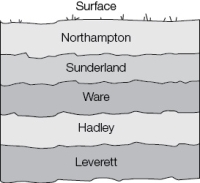 Your research team is excited to find (through comparison with other sites around the globe) that these assemblages correspond to some of the known historical periods on Earth.Specifically, the "Leverett" assemblage contains only microscopic life forms, while the "Hadley" stratum contains diverse marine invertebrate animals but no evidence of terrestrial life.Based on this information, which eon in Earth's history contains the "Hadley" stratum?
 (Multiple Choice)
4.9/5 (86)
(86) Refer to the figure, which shows a series of stromatolite fossil formations from Shark Bay, Australia. 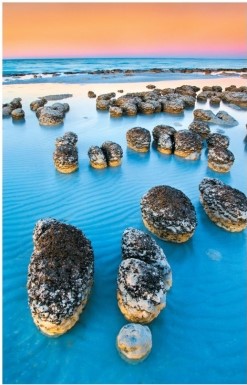 What is the historical significance of these fossils?
 (Essay)
4.9/5 (83)
(83) Which of the following is the most likely cause of extinction for a large population of organisms?
(Multiple Choice)
4.8/5 (69)
(69) The first terrestrial arthropods began to occupy land during the
(Multiple Choice)
4.8/5 (75)
(75) Which of the following represents a correct chronological ordering of Earth's geological history, from earliest to latest?
(Multiple Choice)
4.8/5 (70)
(70) Oxygen-generating cyanobacteria liberated enough O2 to open the door to _______ reactions in metabolic pathways, leading to the evolution of _______ cells.
(Multiple Choice)
5.0/5 (79)
(79) About _______ years ago, prokaryotes probably first added adequate quantities of oxygen to the atmosphere to allow for the evolution of aerobic cellular metabolism.
(Multiple Choice)
4.9/5 (84)
(84) Refer to the graph showing the decay of a radioactive substance. 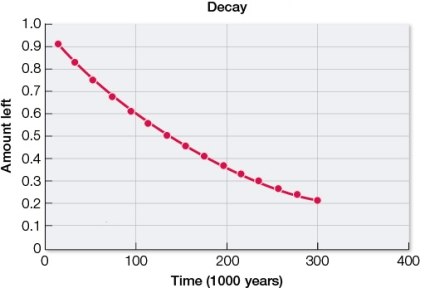 If this substance started decaying 280,000 years ago, and 4 mg of it remains, there was roughly _______ mg of the original substance.
 (Multiple Choice)
4.9/5 (88)
(88) At the end of the _______ period, atmospheric oxygen concentrations decreased from about 30 percent to 15 percent due to plant death associated with the widespread drying of swamps.
(Multiple Choice)
4.9/5 (93)
(93) In the upper atmosphere, the bombardment of neutrons with nitrogen-14 varies somewhat over time.If in the past this rate had been lower, objects dated by _______ dating would now appear _______ than they really are.
(Multiple Choice)
4.9/5 (85)
(85) Which statement about patterns or processes in the evolution of life is false?
(Multiple Choice)
4.8/5 (67)
(67) Coal is the fossilized remains of _______ from the Carboniferous period.
(Multiple Choice)
4.8/5 (73)
(73) The oldest known _______ were found in the Triassic fossil assemblage.
(Multiple Choice)
4.8/5 (75)
(75) Scientists estimate that most species have never been named because approximately _______ living species and _______ fossil species have been described.
(Multiple Choice)
4.7/5 (78)
(78) Which of the following could not be dated by means of radioactive carbon?
(Multiple Choice)
4.7/5 (72)
(72) Place the following organisms in chronological order, according to when they appeared in the fossil record.
(Multiple Choice)
4.8/5 (82)
(82) Which group is documented in fossils from the Proterozoic eon?
(Multiple Choice)
4.8/5 (80)
(80) 
Filters
- Essay(0)
- Multiple Choice(0)
- Short Answer(0)
- True False(0)
- Matching(0)