



 Chat with AI
Exam 30: Animal Origins and the Evolution of Body Plans

Exam 1: Studying Life246 Questions
Exam 2: Small Molecules and the Chemistry of Life246 Questions
Exam 3: Proteins, Carbohydrates, and Lipids246 Questions
Exam 4: Nucleic Acids and the Origin of Life246 Questions
Exam 5: Cells: the Working Units of Life248 Questions
Exam 6: Cell Membranes246 Questions
Exam 7: Cell Communication and Multicellularity246 Questions
Exam 8: Energy, Enzymes, and Metabolism246 Questions
Exam 9: Pathways That Harvest Chemical Energy246 Questions
Exam 10: Photosynthesis: Energy From Sunlight242 Questions
Exam 11: The Cell Cycle and Cell Division260 Questions
Exam 12: Inheritance, Genes, and Chromosomes250 Questions
Exam 13: Dna and Its Role in Heredity257 Questions
Exam 14: From Dna to Protein: Gene Expression252 Questions
Exam 15: Gene Mutation and Molecular Medicine251 Questions
Exam 16: Regulation of Gene Expression245 Questions
Exam 17: Genomes249 Questions
Exam 18: Recombinant Dna and Biotechnology243 Questions
Exam 20: Mechanisms of Evolution243 Questions
Exam 21: Reconstructing and Using Phylogenies246 Questions
Exam 22: Speciation247 Questions
Exam 23: Evolution of Genes and Genomes252 Questions
Exam 24: The History of Life on Earth246 Questions
Exam 25: Bacteria, Archaea, and Viruses262 Questions
Exam 26: The Origin and Diversification of Eukaryotes252 Questions
Exam 27: Plants Without Seeds: From Water to Land251 Questions
Exam 28: The Evolution of Seed Plants259 Questions
Exam 29: The Evolution and Diversity of Fungi261 Questions
Exam 30: Animal Origins and the Evolution of Body Plans248 Questions
Exam 31: Protostome Animals244 Questions
Exam 32: Deuterostome Animals246 Questions
Exam 33: The Plant Body243 Questions
Exam 34: Transport in Plants248 Questions
Exam 35: Plant Nutrition247 Questions
Exam 36: Regulation of Plant Growth246 Questions
Exam 37: Reproduction in Flowering Plants247 Questions
Exam 38: Plant Responses to Environmental Challenges246 Questions
Exam 39: Physiology, Homeostasis, and Temperature Regulation258 Questions
Exam 40: Animal Hormones249 Questions
Exam 41: Immunology: Animal Defense Systems265 Questions
Exam 42: Animal Reproduction261 Questions
Exam 43: Animal Development261 Questions
Exam 44: Neurons, Glia, and Nervous Systems250 Questions
Exam 45: Sensory Systems249 Questions
Exam 46: The Mammalian Nervous System: Structure and Higher Functions254 Questions
Exam 47: Musculoskeletal Systems259 Questions
Exam 48: Gas Exchange247 Questions
Exam 49: Circulatory Systems252 Questions
Exam 50: Nutrition, Digestion, and Absorption259 Questions
Exam 51: Salt and Water Balance and Nitrogen Excretion251 Questions
Exam 52: Animal Behavior249 Questions
Exam 53: The Physical Environment and Biogeography of Life248 Questions
Exam 54: Populations259 Questions
Exam 55: Species Interactions254 Questions
Exam 56: Communities247 Questions
Exam 57: Ecosystems238 Questions
Exam 58: A Changing Biosphere222 Questions
Select questions type


Filter feeders differ from predators in that filter feeders
(Multiple Choice)
4.9/5  (73)
(73) Refer to the table, which compares 27 amino acid positions for ten different species. 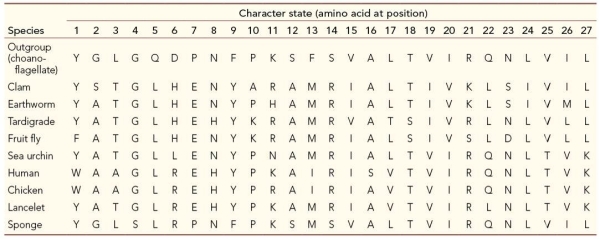 Which character has states that facilitate phylogenetic analysis among species within protostomes?
 (Multiple Choice)
4.8/5 (85)
(85) Refer to the figure. 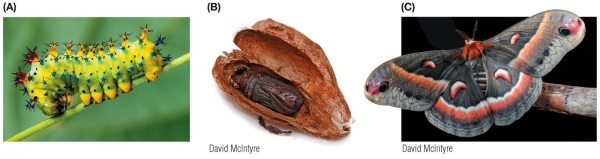 The figure shows the different stages (A, B, and C) in the life cycle of the cecropia moth.Would you identify these stages as evidence for direct development or complete metamorphosis? Justify your answer.
 (Essay)
4.9/5 (71)
(71) An animal whose gut contains enzymes that digest tough, fibrous plant tissues would be classified as a(n) _______.
(Short Answer)
4.8/5 (79)
(79) All of the following are used by predators in locating, capturing, and subduing prey except
(Multiple Choice)
4.9/5 (95)
(95) Which is not a characteristic feature of the life cycle of an endoparasite?
(Multiple Choice)
4.9/5 (78)
(78) Bilaterally symmetrical animals can be divided into two major groups that separated during the Cambrian.These two lineages differ fundamentally in their
(Multiple Choice)
4.8/5 (73)
(73) Animals most likely arose from colonial flagellated protists as a result of division of labor among their aggregated cells.Among animal groups living today, the _______ bear the strongest similarity to the most recent common ancestor of animals.
(Short Answer)
4.9/5 (70)
(70) Fungi, such as mushrooms, can be distinguished from animals because only animals
(Multiple Choice)
4.9/5 (78)
(78) Among the _______, the mouth arises from the blastopore, an embryonic feature that is a synapomorphy of the group.
(Short Answer)
4.8/5 (80)
(80) Ctenophores are eumetazoans that lack most of the Hox genes found in all other eumetazoans.They have a radially symmetrical body plan, are diploblastic, and have cells organized into tissues.Based on this information, which of the following is the most appropriate group in which to classify the ctenophores?
(Multiple Choice)
4.9/5 (80)
(80) _______ obtain energy and nutrients by living on the outside of other living organisms.
(Multiple Choice)
4.9/5 (87)
(87) Which of the following does not contribute to evidence that animals have a common ancestor?
(Multiple Choice)
4.8/5 (76)
(76) Refer to the figure. 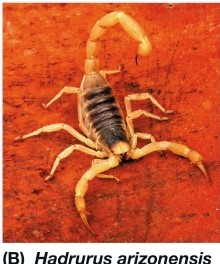 In the animal shown, movement of the body depends on all of the following except
 (Multiple Choice)
4.8/5 (79)
(79) 
Filters
- Essay(0)
- Multiple Choice(0)
- Short Answer(0)
- True False(0)
- Matching(0)