



 Chat with AI
Exam 30: Animal Origins and the Evolution of Body Plans

Exam 1: Studying Life246 Questions
Exam 2: Small Molecules and the Chemistry of Life246 Questions
Exam 3: Proteins, Carbohydrates, and Lipids246 Questions
Exam 4: Nucleic Acids and the Origin of Life246 Questions
Exam 5: Cells: the Working Units of Life248 Questions
Exam 6: Cell Membranes246 Questions
Exam 7: Cell Communication and Multicellularity246 Questions
Exam 8: Energy, Enzymes, and Metabolism246 Questions
Exam 9: Pathways That Harvest Chemical Energy246 Questions
Exam 10: Photosynthesis: Energy From Sunlight242 Questions
Exam 11: The Cell Cycle and Cell Division260 Questions
Exam 12: Inheritance, Genes, and Chromosomes250 Questions
Exam 13: Dna and Its Role in Heredity257 Questions
Exam 14: From Dna to Protein: Gene Expression252 Questions
Exam 15: Gene Mutation and Molecular Medicine251 Questions
Exam 16: Regulation of Gene Expression245 Questions
Exam 17: Genomes249 Questions
Exam 18: Recombinant Dna and Biotechnology243 Questions
Exam 20: Mechanisms of Evolution243 Questions
Exam 21: Reconstructing and Using Phylogenies246 Questions
Exam 22: Speciation247 Questions
Exam 23: Evolution of Genes and Genomes252 Questions
Exam 24: The History of Life on Earth246 Questions
Exam 25: Bacteria, Archaea, and Viruses262 Questions
Exam 26: The Origin and Diversification of Eukaryotes252 Questions
Exam 27: Plants Without Seeds: From Water to Land251 Questions
Exam 28: The Evolution of Seed Plants259 Questions
Exam 29: The Evolution and Diversity of Fungi261 Questions
Exam 30: Animal Origins and the Evolution of Body Plans248 Questions
Exam 31: Protostome Animals244 Questions
Exam 32: Deuterostome Animals246 Questions
Exam 33: The Plant Body243 Questions
Exam 34: Transport in Plants248 Questions
Exam 35: Plant Nutrition247 Questions
Exam 36: Regulation of Plant Growth246 Questions
Exam 37: Reproduction in Flowering Plants247 Questions
Exam 38: Plant Responses to Environmental Challenges246 Questions
Exam 39: Physiology, Homeostasis, and Temperature Regulation258 Questions
Exam 40: Animal Hormones249 Questions
Exam 41: Immunology: Animal Defense Systems265 Questions
Exam 42: Animal Reproduction261 Questions
Exam 43: Animal Development261 Questions
Exam 44: Neurons, Glia, and Nervous Systems250 Questions
Exam 45: Sensory Systems249 Questions
Exam 46: The Mammalian Nervous System: Structure and Higher Functions254 Questions
Exam 47: Musculoskeletal Systems259 Questions
Exam 48: Gas Exchange247 Questions
Exam 49: Circulatory Systems252 Questions
Exam 50: Nutrition, Digestion, and Absorption259 Questions
Exam 51: Salt and Water Balance and Nitrogen Excretion251 Questions
Exam 52: Animal Behavior249 Questions
Exam 53: The Physical Environment and Biogeography of Life248 Questions
Exam 54: Populations259 Questions
Exam 55: Species Interactions254 Questions
Exam 56: Communities247 Questions
Exam 57: Ecosystems238 Questions
Exam 58: A Changing Biosphere222 Questions
Select questions type


Fluid-filled internal body cavities function as hydrostatic skeletons that facilitate movement.Which animal has a body cavity that functions as a hydrostatic skeleton?
(Multiple Choice)
4.8/5  (83)
(83) Refer to the table. 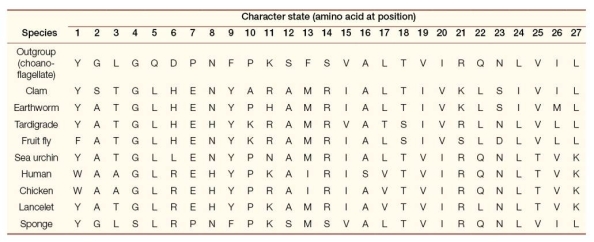 The character states of characters 25 and 27 are shared and derived for which of the following clades?
 (Multiple Choice)
4.9/5 (70)
(70) Which statement best distinguishes herbivores from predators?
(Multiple Choice)
4.9/5 (70)
(70) Why is bilateral symmetry most beneficial for mobile organisms?
(Multiple Choice)
4.9/5 (67)
(67) The probable ancestor of the animal clade resembled modern _______, which have similarities to modern _______.
(Multiple Choice)
4.9/5 (81)
(81) Which of the following features is a synapomorphy of the bilaterians?
(Multiple Choice)
4.9/5 (75)
(75) Imagine you are a scientist who has discovered a new organism on a scientific expedition.What specific characteristics would you investigate in order to determine if it is an animal?
(Essay)
4.9/5 (80)
(80) A major threat to coral reefs is overgrowth of algae that eventually smother the corals.This overgrowth results from
(Multiple Choice)
4.9/5 (75)
(75) A radially symmetrical, sessile animal that possesses some sort of straining device would most likely be a(n)
(Multiple Choice)
4.8/5 (72)
(72) Refer to the table, which compares 27 amino acid positions for ten different species. 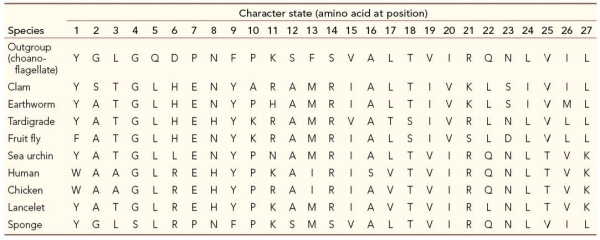 Which of the following characters have shared, derived character states for deuterostomes?
 (Multiple Choice)
4.7/5 (86)
(86) Which of the following is/are not an adaptation for predatory feeding?
(Multiple Choice)
4.8/5 (90)
(90) An animal, such as a snake, that waits in one spot for food is an example of a(n)
(Multiple Choice)
4.9/5 (74)
(74) Refer to the figure. 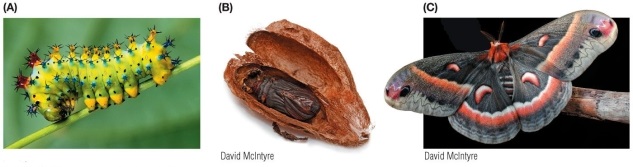 Which form of the insect (cecropia moth) shown is best adapted for dispersal and reproduction?
 (Multiple Choice)
4.9/5 (82)
(82) Suppose that you obtain a sample of seawater and observe it under a microscope.You identify some single-celled structures that you think may be animals but are unable to ascertain whether they are developmental stages or adults.Develop a hypothesis to determine the stage of the life cycle you are observing, and identify three characteristics you would examine to support your hypothesis.
(Essay)
4.9/5 (85)
(85) 
Filters
- Essay(0)
- Multiple Choice(0)
- Short Answer(0)
- True False(0)
- Matching(0)