



 Chat with AI
Exam 30: Animal Origins and the Evolution of Body Plans

Exam 1: Studying Life246 Questions
Exam 2: Small Molecules and the Chemistry of Life246 Questions
Exam 3: Proteins, Carbohydrates, and Lipids246 Questions
Exam 4: Nucleic Acids and the Origin of Life246 Questions
Exam 5: Cells: the Working Units of Life248 Questions
Exam 6: Cell Membranes246 Questions
Exam 7: Cell Communication and Multicellularity246 Questions
Exam 8: Energy, Enzymes, and Metabolism246 Questions
Exam 9: Pathways That Harvest Chemical Energy246 Questions
Exam 10: Photosynthesis: Energy From Sunlight242 Questions
Exam 11: The Cell Cycle and Cell Division260 Questions
Exam 12: Inheritance, Genes, and Chromosomes250 Questions
Exam 13: Dna and Its Role in Heredity257 Questions
Exam 14: From Dna to Protein: Gene Expression252 Questions
Exam 15: Gene Mutation and Molecular Medicine251 Questions
Exam 16: Regulation of Gene Expression245 Questions
Exam 17: Genomes249 Questions
Exam 18: Recombinant Dna and Biotechnology243 Questions
Exam 20: Mechanisms of Evolution243 Questions
Exam 21: Reconstructing and Using Phylogenies246 Questions
Exam 22: Speciation247 Questions
Exam 23: Evolution of Genes and Genomes252 Questions
Exam 24: The History of Life on Earth246 Questions
Exam 25: Bacteria, Archaea, and Viruses262 Questions
Exam 26: The Origin and Diversification of Eukaryotes252 Questions
Exam 27: Plants Without Seeds: From Water to Land251 Questions
Exam 28: The Evolution of Seed Plants259 Questions
Exam 29: The Evolution and Diversity of Fungi261 Questions
Exam 30: Animal Origins and the Evolution of Body Plans248 Questions
Exam 31: Protostome Animals244 Questions
Exam 32: Deuterostome Animals246 Questions
Exam 33: The Plant Body243 Questions
Exam 34: Transport in Plants248 Questions
Exam 35: Plant Nutrition247 Questions
Exam 36: Regulation of Plant Growth246 Questions
Exam 37: Reproduction in Flowering Plants247 Questions
Exam 38: Plant Responses to Environmental Challenges246 Questions
Exam 39: Physiology, Homeostasis, and Temperature Regulation258 Questions
Exam 40: Animal Hormones249 Questions
Exam 41: Immunology: Animal Defense Systems265 Questions
Exam 42: Animal Reproduction261 Questions
Exam 43: Animal Development261 Questions
Exam 44: Neurons, Glia, and Nervous Systems250 Questions
Exam 45: Sensory Systems249 Questions
Exam 46: The Mammalian Nervous System: Structure and Higher Functions254 Questions
Exam 47: Musculoskeletal Systems259 Questions
Exam 48: Gas Exchange247 Questions
Exam 49: Circulatory Systems252 Questions
Exam 50: Nutrition, Digestion, and Absorption259 Questions
Exam 51: Salt and Water Balance and Nitrogen Excretion251 Questions
Exam 52: Animal Behavior249 Questions
Exam 53: The Physical Environment and Biogeography of Life248 Questions
Exam 54: Populations259 Questions
Exam 55: Species Interactions254 Questions
Exam 56: Communities247 Questions
Exam 57: Ecosystems238 Questions
Exam 58: A Changing Biosphere222 Questions
Select questions type


The complex life cycles of parasites provide an evolutionary advantage by
(Multiple Choice)
4.7/5  (76)
(76) Which characteristic is not associated with the cnidarians?
(Multiple Choice)
5.0/5 (84)
(84) Which structural parts of a sponge are responsible for creating water currents and capturing food?
(Multiple Choice)
4.9/5 (83)
(83) Refer to the figure. 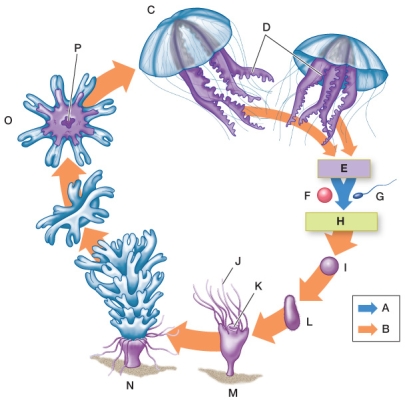 In the typical life cycle shown in the figure, identify the diploid and haploid stages, identify the processes occurring in the boxes (mitosis, meiosis, fertilization, or fusion), and label the identified structures.
 (Short Answer)
4.9/5 (82)
(82) A bird that lives in a hole in a tree and eats fruit or seeds as an adult while feeding insects to its young is
(Multiple Choice)
4.9/5 (92)
(92) Animals that undergo radical changes between larval and adult stages are described as undergoing _______.
(Short Answer)
4.7/5 (81)
(81) Refer to the figure.
In the figure, identify the following groups: protostomes, deuterostomes, arrow worms, calcareous sponges, chordates, cnidarians, ctenophores, demosponges, ecdysozoans, echinoderms, glass sponges, hemichordates, lophotrochozoans, and placozoans.Additionally, identify these distinguishing traits marked with dots on the phylogenetic tree: bilateral symmetry along an anterior-posterior axis, three embryonic cell layers, centralized nervous system; blasotopore develops into mouth; blastopore develops into anus; choanocytes and spicules; exoskeleton molting; notochord; radial symmetry, silicaceous spicules; unique cell junctions, collagen and proteoglycans in extracellular matrix; nerve nets (listed twice); distinct organ systems. 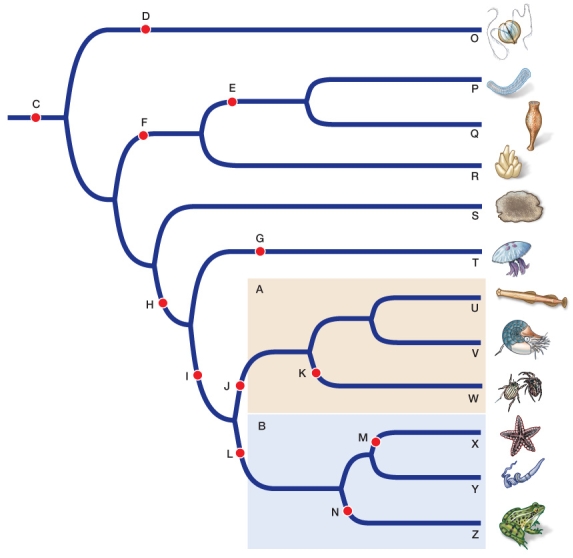
(Essay)
4.8/5 (81)
(81) Sea pens are colonial anthozoans, while _______ are solitary anthozoans.
(Short Answer)
4.7/5 (85)
(85) Which statement about bilaterally symmetrical animals is true?
(Multiple Choice)
4.8/5 (84)
(84) Which of the following statements about embryonic development is false?
(Multiple Choice)
4.9/5 (86)
(86) Refer to the table. 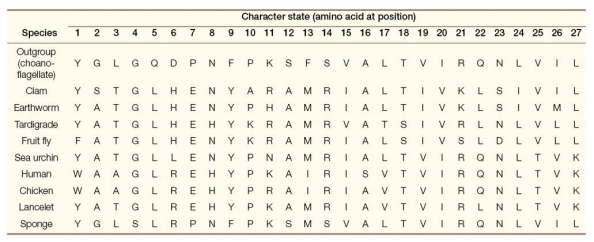 Which species has/have the largest number of unique character states?
 (Multiple Choice)
4.8/5 (73)
(73) Refer to the figure. 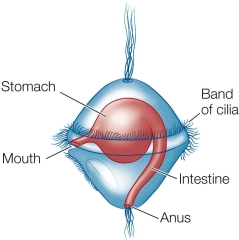 The trochophore shown is the larval form of
 (Multiple Choice)
4.8/5 (80)
(80) The organisms that make up the sister group of all bilaterally symmetrical animals (protostomes and deuterostomes) are the _______.
(Short Answer)
4.9/5 (66)
(66) Herbivory could evolve from a predatory feeding strategy through
(Multiple Choice)
4.9/5 (77)
(77) 
Filters
- Essay(0)
- Multiple Choice(0)
- Short Answer(0)
- True False(0)
- Matching(0)