



 Chat with AI
Exam 30: Animal Origins and the Evolution of Body Plans

Exam 1: Studying Life246 Questions
Exam 2: Small Molecules and the Chemistry of Life246 Questions
Exam 3: Proteins, Carbohydrates, and Lipids246 Questions
Exam 4: Nucleic Acids and the Origin of Life246 Questions
Exam 5: Cells: the Working Units of Life248 Questions
Exam 6: Cell Membranes246 Questions
Exam 7: Cell Communication and Multicellularity246 Questions
Exam 8: Energy, Enzymes, and Metabolism246 Questions
Exam 9: Pathways That Harvest Chemical Energy246 Questions
Exam 10: Photosynthesis: Energy From Sunlight242 Questions
Exam 11: The Cell Cycle and Cell Division260 Questions
Exam 12: Inheritance, Genes, and Chromosomes250 Questions
Exam 13: Dna and Its Role in Heredity257 Questions
Exam 14: From Dna to Protein: Gene Expression252 Questions
Exam 15: Gene Mutation and Molecular Medicine251 Questions
Exam 16: Regulation of Gene Expression245 Questions
Exam 17: Genomes249 Questions
Exam 18: Recombinant Dna and Biotechnology243 Questions
Exam 20: Mechanisms of Evolution243 Questions
Exam 21: Reconstructing and Using Phylogenies246 Questions
Exam 22: Speciation247 Questions
Exam 23: Evolution of Genes and Genomes252 Questions
Exam 24: The History of Life on Earth246 Questions
Exam 25: Bacteria, Archaea, and Viruses262 Questions
Exam 26: The Origin and Diversification of Eukaryotes252 Questions
Exam 27: Plants Without Seeds: From Water to Land251 Questions
Exam 28: The Evolution of Seed Plants259 Questions
Exam 29: The Evolution and Diversity of Fungi261 Questions
Exam 30: Animal Origins and the Evolution of Body Plans248 Questions
Exam 31: Protostome Animals244 Questions
Exam 32: Deuterostome Animals246 Questions
Exam 33: The Plant Body243 Questions
Exam 34: Transport in Plants248 Questions
Exam 35: Plant Nutrition247 Questions
Exam 36: Regulation of Plant Growth246 Questions
Exam 37: Reproduction in Flowering Plants247 Questions
Exam 38: Plant Responses to Environmental Challenges246 Questions
Exam 39: Physiology, Homeostasis, and Temperature Regulation258 Questions
Exam 40: Animal Hormones249 Questions
Exam 41: Immunology: Animal Defense Systems265 Questions
Exam 42: Animal Reproduction261 Questions
Exam 43: Animal Development261 Questions
Exam 44: Neurons, Glia, and Nervous Systems250 Questions
Exam 45: Sensory Systems249 Questions
Exam 46: The Mammalian Nervous System: Structure and Higher Functions254 Questions
Exam 47: Musculoskeletal Systems259 Questions
Exam 48: Gas Exchange247 Questions
Exam 49: Circulatory Systems252 Questions
Exam 50: Nutrition, Digestion, and Absorption259 Questions
Exam 51: Salt and Water Balance and Nitrogen Excretion251 Questions
Exam 52: Animal Behavior249 Questions
Exam 53: The Physical Environment and Biogeography of Life248 Questions
Exam 54: Populations259 Questions
Exam 55: Species Interactions254 Questions
Exam 56: Communities247 Questions
Exam 57: Ecosystems238 Questions
Exam 58: A Changing Biosphere222 Questions
Select questions type


The fluid-filled internal body cavities of animals sometimes function as _______ skeletons for locomotion.
(Short Answer)
4.8/5  (82)
(82) Cnidarians have the type of symmetry known as _______ symmetry.
(Multiple Choice)
5.0/5 (77)
(77) In reptiles, the presence of a large body of acellular yolk within the fertilized egg creates a(n) _______ cleavage pattern in which the dividing cells form an embryo on top of the yolk mass.
(Multiple Choice)
4.9/5 (73)
(73) In complete metamorphosis, the immature life stage of some organisms before they assume their adult form is called the _______.
(Short Answer)
4.8/5 (81)
(81) An infinite number of planes passing through the central point can divide an organism into mirror-image halves in
(Multiple Choice)
4.8/5 (98)
(98) Diploblastic marine animals with mesoglea between the two cell layers, a complete gut, and locomotion provided by beating cilia are
(Multiple Choice)
4.9/5 (84)
(84) There are three major groups of cnidarians: the anthozoans (which include sessile colonial corals), the scyphozoans (jellyfish), and the _______.
(Short Answer)
4.9/5 (60)
(60) Which taxa is considered the sister group of all other animals?
(Multiple Choice)
4.8/5 (73)
(73) Of the more than 9,000 species of sponges, _______ live in fresh water.
(Multiple Choice)
4.8/5 (68)
(68) Which of the following is false regarding some species of hydrozoans?
(Multiple Choice)
4.8/5 (85)
(85) Refer to the table. 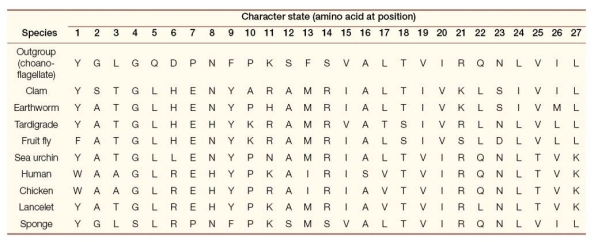 Which pairs of characters have states that support deuterostomes as a monophyletic group?
 (Multiple Choice)
4.8/5 (84)
(84) The body cavity of a coelomate organism would act as a hydrostatic skeleton because
(Multiple Choice)
4.9/5 (80)
(80) What are some of the limitations imposed by a hydrostatic skeleton? Are the limitations the same for aquatic and terrestrial animals?
(Essay)
4.8/5 (70)
(70) Segmentation of animals is important evolutionarily because it
(Multiple Choice)
4.9/5 (86)
(86) 
Filters
- Essay(0)
- Multiple Choice(0)
- Short Answer(0)
- True False(0)
- Matching(0)