



 Chat with AI
Exam 16: Regulation of Gene Expression

Exam 1: Studying Life246 Questions
Exam 2: Small Molecules and the Chemistry of Life246 Questions
Exam 3: Proteins, Carbohydrates, and Lipids246 Questions
Exam 4: Nucleic Acids and the Origin of Life246 Questions
Exam 5: Cells: the Working Units of Life248 Questions
Exam 6: Cell Membranes246 Questions
Exam 7: Cell Communication and Multicellularity246 Questions
Exam 8: Energy, Enzymes, and Metabolism246 Questions
Exam 9: Pathways That Harvest Chemical Energy246 Questions
Exam 10: Photosynthesis: Energy From Sunlight242 Questions
Exam 11: The Cell Cycle and Cell Division260 Questions
Exam 12: Inheritance, Genes, and Chromosomes250 Questions
Exam 13: Dna and Its Role in Heredity257 Questions
Exam 14: From Dna to Protein: Gene Expression252 Questions
Exam 15: Gene Mutation and Molecular Medicine251 Questions
Exam 16: Regulation of Gene Expression245 Questions
Exam 17: Genomes249 Questions
Exam 18: Recombinant Dna and Biotechnology243 Questions
Exam 20: Mechanisms of Evolution243 Questions
Exam 21: Reconstructing and Using Phylogenies246 Questions
Exam 22: Speciation247 Questions
Exam 23: Evolution of Genes and Genomes252 Questions
Exam 24: The History of Life on Earth246 Questions
Exam 25: Bacteria, Archaea, and Viruses262 Questions
Exam 26: The Origin and Diversification of Eukaryotes252 Questions
Exam 27: Plants Without Seeds: From Water to Land251 Questions
Exam 28: The Evolution of Seed Plants259 Questions
Exam 29: The Evolution and Diversity of Fungi261 Questions
Exam 30: Animal Origins and the Evolution of Body Plans248 Questions
Exam 31: Protostome Animals244 Questions
Exam 32: Deuterostome Animals246 Questions
Exam 33: The Plant Body243 Questions
Exam 34: Transport in Plants248 Questions
Exam 35: Plant Nutrition247 Questions
Exam 36: Regulation of Plant Growth246 Questions
Exam 37: Reproduction in Flowering Plants247 Questions
Exam 38: Plant Responses to Environmental Challenges246 Questions
Exam 39: Physiology, Homeostasis, and Temperature Regulation258 Questions
Exam 40: Animal Hormones249 Questions
Exam 41: Immunology: Animal Defense Systems265 Questions
Exam 42: Animal Reproduction261 Questions
Exam 43: Animal Development261 Questions
Exam 44: Neurons, Glia, and Nervous Systems250 Questions
Exam 45: Sensory Systems249 Questions
Exam 46: The Mammalian Nervous System: Structure and Higher Functions254 Questions
Exam 47: Musculoskeletal Systems259 Questions
Exam 48: Gas Exchange247 Questions
Exam 49: Circulatory Systems252 Questions
Exam 50: Nutrition, Digestion, and Absorption259 Questions
Exam 51: Salt and Water Balance and Nitrogen Excretion251 Questions
Exam 52: Animal Behavior249 Questions
Exam 53: The Physical Environment and Biogeography of Life248 Questions
Exam 54: Populations259 Questions
Exam 55: Species Interactions254 Questions
Exam 56: Communities247 Questions
Exam 57: Ecosystems238 Questions
Exam 58: A Changing Biosphere222 Questions
Select questions type


What is the difference between a prophage and a provirus, based on what you know about HIV and bacteriophage ?
(Multiple Choice)
4.8/5  (60)
(60) Imagine that the promoter for gene X becomes highly methylated.How will this affect the expression of gene X?
(Multiple Choice)
4.9/5 (83)
(83) By adding ubiquitin to p53, HPV is affecting gene expression at the level of
(Multiple Choice)
4.9/5 (79)
(79) A loss-of-function mutation occurs in one of the late genes in a lytic bacteriophage.Which change is least likely?
(Multiple Choice)
4.8/5 (81)
(81) Which gene would most likely be under inducible expression control?
(Multiple Choice)
4.9/5 (83)
(83) You are tasked with mapping the position of chromatin modifications within the genome of a eukaryotic chromosome.Where would you most likely encounter regions of high DNA methylation?
(Multiple Choice)
4.8/5 (78)
(78) Reduction of tat in HIV would lead to a(n) (reduction/increase) _______ in transcription elongation.
(Short Answer)
4.8/5 (86)
(86) Imagine that gene X is in a chromosome region where the histones are highly acetylated.How will this affect its expression?
(Multiple Choice)
4.7/5 (80)
(80) The virus that causes chicken pox can also cause shingles later in life.This is because the virus enters into a _______ phase.
(Short Answer)
4.8/5 (82)
(82) Working in the laboratory, you infect host cells with a virus that is known to have both lytic and lysogenic life phases.Which result would definitively confirm that the virus has indeed entered a lysogenic phase?
(Multiple Choice)
4.9/5 (72)
(72) An operon that would be controlled by both presence of lactose and low levels of glucose would need two control mechanisms: first, a(n) _______ system to turn on genes to use lactose when it is present, and then a positive regulation system to only turn on lactose metabolism genes in the absence of glucose.
(Short Answer)
4.8/5 (72)
(72) Co-repressors are usually present in _______ systems, which tend to be found in _______ pathways.
(Multiple Choice)
4.9/5 (82)
(82) A "riboswitch" is an mRNA that alters production of protein by binding a small molecule.A riboswitch is most likely involved in regulation at the _______ level.
(Multiple Choice)
4.9/5 (78)
(78) If the gene encoding the trp repressor is mutated such that the repressor can no longer bind tryptophan but can still bind the operon, will transcription of the trp operon occur?
(Multiple Choice)
4.9/5 (72)
(72) Refer to the figure showing the potential points for the regulation of gene expression. 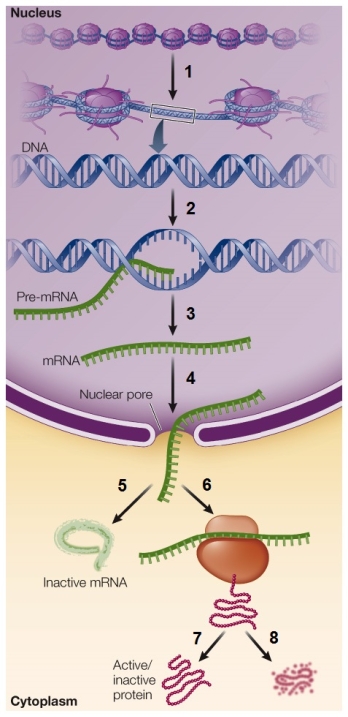 Blocking which point would be considered transcriptional control?
 (Multiple Choice)
4.8/5 (69)
(69) Ubiquitin forms a complex with proteins and then binds with _______, forming a sort of "molecular chamber of doom" where proteins are digested into small peptides and amino acids.
(Multiple Choice)
5.0/5 (77)
(77) When E.coli is grown in a medium with low levels of lactose,
(Multiple Choice)
4.9/5 (72)
(72) In bacterial cells, the concentration of cAMP is _______ correlated with the concentration of glucose; hence, glucose concentrations should _______ correlated with the amount of transcription in the lac operon (assuming that lactose is abundant).
(Multiple Choice)
4.8/5 (81)
(81) 
Filters
- Essay(0)
- Multiple Choice(0)
- Short Answer(0)
- True False(0)
- Matching(0)