



 Chat with AI
Exam 16: Regulation of Gene Expression

Exam 1: Studying Life246 Questions
Exam 2: Small Molecules and the Chemistry of Life246 Questions
Exam 3: Proteins, Carbohydrates, and Lipids246 Questions
Exam 4: Nucleic Acids and the Origin of Life246 Questions
Exam 5: Cells: the Working Units of Life248 Questions
Exam 6: Cell Membranes246 Questions
Exam 7: Cell Communication and Multicellularity246 Questions
Exam 8: Energy, Enzymes, and Metabolism246 Questions
Exam 9: Pathways That Harvest Chemical Energy246 Questions
Exam 10: Photosynthesis: Energy From Sunlight242 Questions
Exam 11: The Cell Cycle and Cell Division260 Questions
Exam 12: Inheritance, Genes, and Chromosomes250 Questions
Exam 13: Dna and Its Role in Heredity257 Questions
Exam 14: From Dna to Protein: Gene Expression252 Questions
Exam 15: Gene Mutation and Molecular Medicine251 Questions
Exam 16: Regulation of Gene Expression245 Questions
Exam 17: Genomes249 Questions
Exam 18: Recombinant Dna and Biotechnology243 Questions
Exam 20: Mechanisms of Evolution243 Questions
Exam 21: Reconstructing and Using Phylogenies246 Questions
Exam 22: Speciation247 Questions
Exam 23: Evolution of Genes and Genomes252 Questions
Exam 24: The History of Life on Earth246 Questions
Exam 25: Bacteria, Archaea, and Viruses262 Questions
Exam 26: The Origin and Diversification of Eukaryotes252 Questions
Exam 27: Plants Without Seeds: From Water to Land251 Questions
Exam 28: The Evolution of Seed Plants259 Questions
Exam 29: The Evolution and Diversity of Fungi261 Questions
Exam 30: Animal Origins and the Evolution of Body Plans248 Questions
Exam 31: Protostome Animals244 Questions
Exam 32: Deuterostome Animals246 Questions
Exam 33: The Plant Body243 Questions
Exam 34: Transport in Plants248 Questions
Exam 35: Plant Nutrition247 Questions
Exam 36: Regulation of Plant Growth246 Questions
Exam 37: Reproduction in Flowering Plants247 Questions
Exam 38: Plant Responses to Environmental Challenges246 Questions
Exam 39: Physiology, Homeostasis, and Temperature Regulation258 Questions
Exam 40: Animal Hormones249 Questions
Exam 41: Immunology: Animal Defense Systems265 Questions
Exam 42: Animal Reproduction261 Questions
Exam 43: Animal Development261 Questions
Exam 44: Neurons, Glia, and Nervous Systems250 Questions
Exam 45: Sensory Systems249 Questions
Exam 46: The Mammalian Nervous System: Structure and Higher Functions254 Questions
Exam 47: Musculoskeletal Systems259 Questions
Exam 48: Gas Exchange247 Questions
Exam 49: Circulatory Systems252 Questions
Exam 50: Nutrition, Digestion, and Absorption259 Questions
Exam 51: Salt and Water Balance and Nitrogen Excretion251 Questions
Exam 52: Animal Behavior249 Questions
Exam 53: The Physical Environment and Biogeography of Life248 Questions
Exam 54: Populations259 Questions
Exam 55: Species Interactions254 Questions
Exam 56: Communities247 Questions
Exam 57: Ecosystems238 Questions
Exam 58: A Changing Biosphere222 Questions
Select questions type


Some cancer development is due to misregulation of tumor suppressor genes.Thus a drug to increase the activity of a(n) _______ could be a pharmaceutical target.
(Short Answer)
4.8/5  (84)
(84) Which situation is least likely to occur in a non-mutant bacterial cell?
(Multiple Choice)
4.9/5 (73)
(73) In a hypothetical bacterial operon, genes A, C, and D are expressed when "substance r" is present but not when it is absent.Mutations in gene A cause protein 1 not to be produced, but they only affect production of protein 1.Mutations in gene C cause protein 2 not to be produced.Mutations in gene D cause protein 3 not to be produced.Gene B, which has been shown to be near the other genes, does not code for a protein.Mutations in gene B cause genes A, C, and D to be expressed all the time regardless of the presence or absence of substance r.Gene E produces protein 4.Mutations in gene E (which is not near A, B, C, or D) cause genes A, C, and D to be expressed all the time regardless of the presence or absence of substance r.Is this an inducible or repressible operon?
(Short Answer)
5.0/5 (81)
(81) Consider the following statement: Histone deacetylases tend to decrease transcription from particular genes.Is it true or false, and for what reason?
(Multiple Choice)
4.7/5 (90)
(90) In a stained preparation of epithelial cells from a female mammal, the highly condensed chromosome observable in interphase nuclei is the inactive X chromosome known as a _______.
(Short Answer)
4.8/5 (76)
(76) A bacterial gene (gene A) ordinarily makes a protein that binds to DNA.A mutation of gene A causes an increase in the expression of gene B.We can conclude that
(Multiple Choice)
4.8/5 (90)
(90) When it is on a transcriptionally active X chromosome, Xist will be _______ active and _______ methylated than when it is on a transcriptionally inactive X.
(Multiple Choice)
4.8/5 (90)
(90) If a mutation causes a decrease in the activity of histone acetyltransferases, histones will most likely have a _______ affinity for DNA, and there will be _______ in transcription rates.
(Multiple Choice)
4.8/5 (81)
(81) A particular protein binds to DNA and decreases transcription.This is a case of _______ regulation.
(Short Answer)
4.8/5 (76)
(76) How does regulation of stress response proteins in plants differ from regulation of enzymes produced from a bacterial operon?
(Multiple Choice)
4.8/5 (83)
(83) In eukaryotic gene regulation, a(n) _______ is similar in structure but opposite in function to a silencer.
(Multiple Choice)
5.0/5 (95)
(95) Refer to the figure showing the initiation of transcription in eukaryotes. 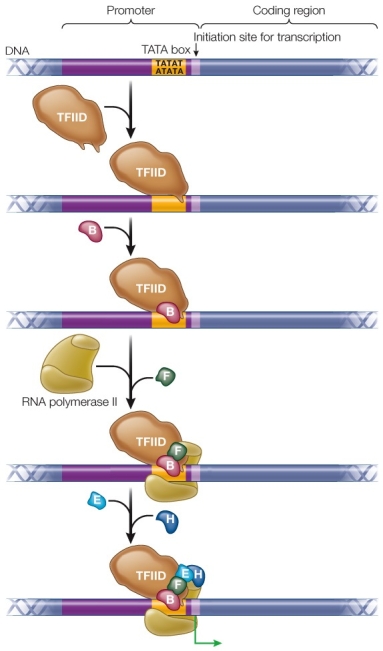 From the figure it can be concluded that
 (Multiple Choice)
4.9/5 (84)
(84) The binding of a protein to DNA to increase transcription is a case of _______ regulation.
(Short Answer)
4.9/5 (86)
(86) When the synthesis of an enzyme is turned off in response to an external biochemical cue (such as an excess in tryptophan), the enzyme is said to be _______.
(Short Answer)
5.0/5 (69)
(69) The model virus bacteriophage λ (lambda) has been used extensively to study the lysogenic mechanism.The virus genome includes genes that encode the regulator proteins cI and Cro, which compete for specific promotors on the viral DNA-including their own promotors.Cro and cI have opposite effects on each promotor: cI represses the expression of genes involved in the lytic cycle and promotes expression of genes involved in lysogeny, whereas Cro does the opposite.Suppose a mutation in Cro increases its expression.This mutation would make entering lysogeny _______ likely.A mutation that increases the expression of cI would have _______ effect on the likelihood of the virus entering lysogeny.
(Multiple Choice)
4.8/5 (77)
(77) Which item is not used by a bacteriophage to generate new viral particles?
(Multiple Choice)
4.9/5 (87)
(87) 
Filters
- Essay(0)
- Multiple Choice(0)
- Short Answer(0)
- True False(0)
- Matching(0)