



 Chat with AI
Exam 16: Regulation of Gene Expression

Exam 1: Studying Life246 Questions
Exam 2: Small Molecules and the Chemistry of Life246 Questions
Exam 3: Proteins, Carbohydrates, and Lipids246 Questions
Exam 4: Nucleic Acids and the Origin of Life246 Questions
Exam 5: Cells: the Working Units of Life248 Questions
Exam 6: Cell Membranes246 Questions
Exam 7: Cell Communication and Multicellularity246 Questions
Exam 8: Energy, Enzymes, and Metabolism246 Questions
Exam 9: Pathways That Harvest Chemical Energy246 Questions
Exam 10: Photosynthesis: Energy From Sunlight242 Questions
Exam 11: The Cell Cycle and Cell Division260 Questions
Exam 12: Inheritance, Genes, and Chromosomes250 Questions
Exam 13: Dna and Its Role in Heredity257 Questions
Exam 14: From Dna to Protein: Gene Expression252 Questions
Exam 15: Gene Mutation and Molecular Medicine251 Questions
Exam 16: Regulation of Gene Expression245 Questions
Exam 17: Genomes249 Questions
Exam 18: Recombinant Dna and Biotechnology243 Questions
Exam 20: Mechanisms of Evolution243 Questions
Exam 21: Reconstructing and Using Phylogenies246 Questions
Exam 22: Speciation247 Questions
Exam 23: Evolution of Genes and Genomes252 Questions
Exam 24: The History of Life on Earth246 Questions
Exam 25: Bacteria, Archaea, and Viruses262 Questions
Exam 26: The Origin and Diversification of Eukaryotes252 Questions
Exam 27: Plants Without Seeds: From Water to Land251 Questions
Exam 28: The Evolution of Seed Plants259 Questions
Exam 29: The Evolution and Diversity of Fungi261 Questions
Exam 30: Animal Origins and the Evolution of Body Plans248 Questions
Exam 31: Protostome Animals244 Questions
Exam 32: Deuterostome Animals246 Questions
Exam 33: The Plant Body243 Questions
Exam 34: Transport in Plants248 Questions
Exam 35: Plant Nutrition247 Questions
Exam 36: Regulation of Plant Growth246 Questions
Exam 37: Reproduction in Flowering Plants247 Questions
Exam 38: Plant Responses to Environmental Challenges246 Questions
Exam 39: Physiology, Homeostasis, and Temperature Regulation258 Questions
Exam 40: Animal Hormones249 Questions
Exam 41: Immunology: Animal Defense Systems265 Questions
Exam 42: Animal Reproduction261 Questions
Exam 43: Animal Development261 Questions
Exam 44: Neurons, Glia, and Nervous Systems250 Questions
Exam 45: Sensory Systems249 Questions
Exam 46: The Mammalian Nervous System: Structure and Higher Functions254 Questions
Exam 47: Musculoskeletal Systems259 Questions
Exam 48: Gas Exchange247 Questions
Exam 49: Circulatory Systems252 Questions
Exam 50: Nutrition, Digestion, and Absorption259 Questions
Exam 51: Salt and Water Balance and Nitrogen Excretion251 Questions
Exam 52: Animal Behavior249 Questions
Exam 53: The Physical Environment and Biogeography of Life248 Questions
Exam 54: Populations259 Questions
Exam 55: Species Interactions254 Questions
Exam 56: Communities247 Questions
Exam 57: Ecosystems238 Questions
Exam 58: A Changing Biosphere222 Questions
Select questions type


In its role in protein regulation, ubiquitin is most closely associated with
(Multiple Choice)
4.8/5  (83)
(83) If you wanted to build a complex organism with differentiated cells, which type of molecule would not help achieve that goal?
(Multiple Choice)
4.9/5 (85)
(85) Methylation most often occurs to _______ that are next to _______.
(Multiple Choice)
4.9/5 (79)
(79) If HIV is mutated such that its tat protein is less able to bind to mRNA, the most likely result will be
(Multiple Choice)
4.8/5 (72)
(72) A certain operon has structural genes that encode enzymes involved in the synthesis of a glycopeptide.This system is likely to be _______, and _______ will most likely bind to the operator.
(Multiple Choice)
5.0/5 (67)
(67) Specific transcription factors would be able to recognize sequences in _______ gene promoter regions.
(Short Answer)
4.9/5 (88)
(88) Refer to the figure showing an experiment on female honey bees. 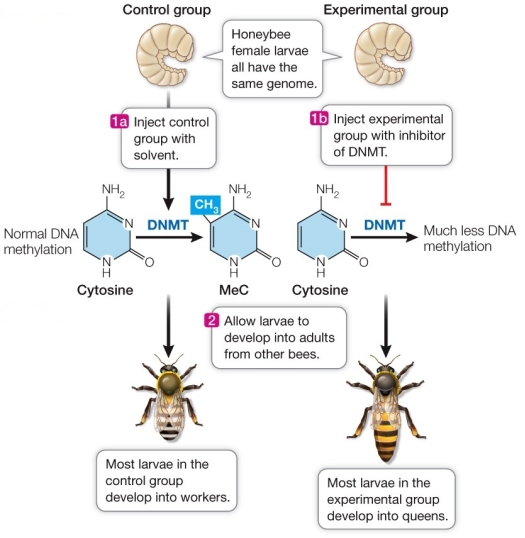 Which conclusion can be drawn from this experiment?
 (Multiple Choice)
4.8/5 (76)
(76) A mutagenesis screen uncovers two discrete mutations, each for a single gene of a given operon that contains the genes that control a biosynthetic pathway.Which phenomenon would likely be observed in an organism that carries both of these mutations?
(Multiple Choice)
4.9/5 (84)
(84) A small RNA product that would be useful for defense against invading viruses is a(n) _______, since it results in the degradation of mRNA transcripts.
(Short Answer)
4.7/5 (69)
(69) In a bacteriophage undergoing a lytic phase, the early gene products _______ the host genes and _______ the late genes.
(Multiple Choice)
4.7/5 (82)
(82) With a small number of genes, a cell can use _______ to achieve a large variety of protein products.
(Short Answer)
4.9/5 (70)
(70) Proteins that are produced all the time at a constant rate are _______ proteins.
(Multiple Choice)
4.9/5 (88)
(88) The TATA box in eukaryotes is most similar to _______ in prokaryotes.
(Multiple Choice)
4.9/5 (80)
(80) 
Filters
- Essay(0)
- Multiple Choice(0)
- Short Answer(0)
- True False(0)
- Matching(0)