



 Chat with AI
Exam 16: Regulation of Gene Expression

Exam 1: Studying Life246 Questions
Exam 2: Small Molecules and the Chemistry of Life246 Questions
Exam 3: Proteins, Carbohydrates, and Lipids246 Questions
Exam 4: Nucleic Acids and the Origin of Life246 Questions
Exam 5: Cells: the Working Units of Life248 Questions
Exam 6: Cell Membranes246 Questions
Exam 7: Cell Communication and Multicellularity246 Questions
Exam 8: Energy, Enzymes, and Metabolism246 Questions
Exam 9: Pathways That Harvest Chemical Energy246 Questions
Exam 10: Photosynthesis: Energy From Sunlight242 Questions
Exam 11: The Cell Cycle and Cell Division260 Questions
Exam 12: Inheritance, Genes, and Chromosomes250 Questions
Exam 13: Dna and Its Role in Heredity257 Questions
Exam 14: From Dna to Protein: Gene Expression252 Questions
Exam 15: Gene Mutation and Molecular Medicine251 Questions
Exam 16: Regulation of Gene Expression245 Questions
Exam 17: Genomes249 Questions
Exam 18: Recombinant Dna and Biotechnology243 Questions
Exam 20: Mechanisms of Evolution243 Questions
Exam 21: Reconstructing and Using Phylogenies246 Questions
Exam 22: Speciation247 Questions
Exam 23: Evolution of Genes and Genomes252 Questions
Exam 24: The History of Life on Earth246 Questions
Exam 25: Bacteria, Archaea, and Viruses262 Questions
Exam 26: The Origin and Diversification of Eukaryotes252 Questions
Exam 27: Plants Without Seeds: From Water to Land251 Questions
Exam 28: The Evolution of Seed Plants259 Questions
Exam 29: The Evolution and Diversity of Fungi261 Questions
Exam 30: Animal Origins and the Evolution of Body Plans248 Questions
Exam 31: Protostome Animals244 Questions
Exam 32: Deuterostome Animals246 Questions
Exam 33: The Plant Body243 Questions
Exam 34: Transport in Plants248 Questions
Exam 35: Plant Nutrition247 Questions
Exam 36: Regulation of Plant Growth246 Questions
Exam 37: Reproduction in Flowering Plants247 Questions
Exam 38: Plant Responses to Environmental Challenges246 Questions
Exam 39: Physiology, Homeostasis, and Temperature Regulation258 Questions
Exam 40: Animal Hormones249 Questions
Exam 41: Immunology: Animal Defense Systems265 Questions
Exam 42: Animal Reproduction261 Questions
Exam 43: Animal Development261 Questions
Exam 44: Neurons, Glia, and Nervous Systems250 Questions
Exam 45: Sensory Systems249 Questions
Exam 46: The Mammalian Nervous System: Structure and Higher Functions254 Questions
Exam 47: Musculoskeletal Systems259 Questions
Exam 48: Gas Exchange247 Questions
Exam 49: Circulatory Systems252 Questions
Exam 50: Nutrition, Digestion, and Absorption259 Questions
Exam 51: Salt and Water Balance and Nitrogen Excretion251 Questions
Exam 52: Animal Behavior249 Questions
Exam 53: The Physical Environment and Biogeography of Life248 Questions
Exam 54: Populations259 Questions
Exam 55: Species Interactions254 Questions
Exam 56: Communities247 Questions
Exam 57: Ecosystems238 Questions
Exam 58: A Changing Biosphere222 Questions
Select questions type


The earlier the cell intervenes in the process of protein synthesis, the _______ energy it wastes.Thus, cells will tend to regulate protein synthesis _______.
(Multiple Choice)
4.9/5  (77)
(77) Which mechanism of posttranscriptional regulation of gene expression can produce several different proteins from a single gene?
(Multiple Choice)
4.9/5 (75)
(75) Which HIV gene product is involved in regulation at the transcription elongation stage?
(Multiple Choice)
4.8/5 (83)
(83) Refer to the figure showing the potential points for the regulation of gene expression. 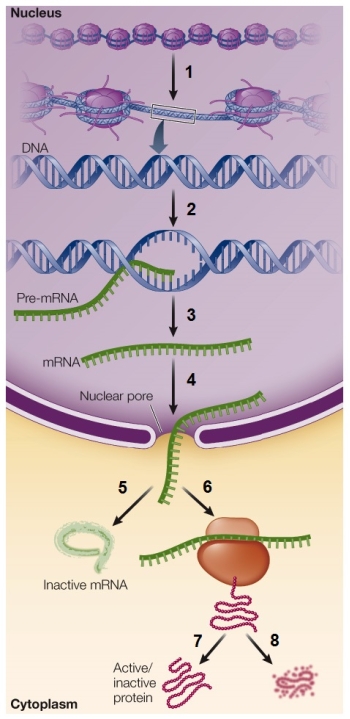 Which point would not be considered posttranscriptional control?
 (Multiple Choice)
4.8/5 (72)
(72) Refer to the figure showing the initiation of transcription in eukaryotes. 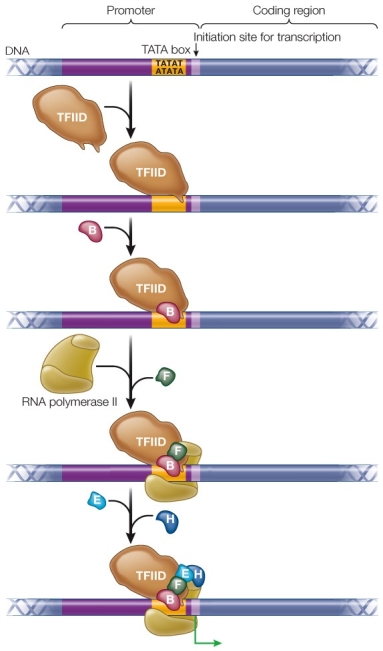 Which represents the regulatory sequence of the DNA?
 (Multiple Choice)
4.9/5 (87)
(87) In comparison with regulation of the production of enzymes, allosteric regulation of enzyme activity is _______ and _______ energetically efficient.
(Multiple Choice)
4.7/5 (82)
(82) In E.coli metabolism, _______ is the preferred energy source because it is _______.
(Multiple Choice)
5.0/5 (81)
(81) Refer to the figure showing positive and negative regulation. 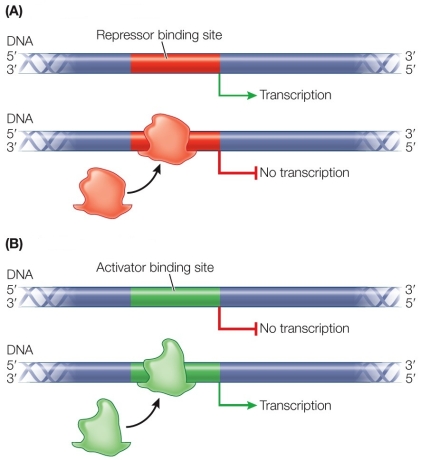 Which system would be more likely to control the transcription of biosynthetic genes, and why?
 (Essay)
4.8/5 (87)
(87) A mutation causes an increase in the activity of histone deacetylase.Most likely, histones will have _______ affinity to DNA, and there will be a(n) _______ in transcription.
(Multiple Choice)
4.8/5 (73)
(73) Refer to the figure showing phage life cycles. 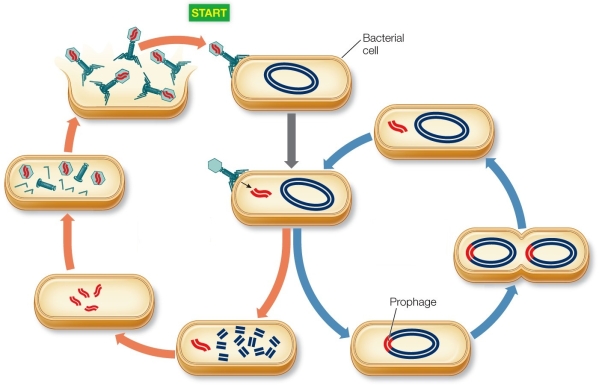 What types of processes would be controlled and/or encouraged by lysogenic cycle genes?
 (Short Answer)
4.9/5 (84)
(84) A protein is found in high concentrations in certain muscle cells in mice but is found in very low concentrations in other cells.In these muscle cells the protein binds certain regulatory sequences, increasing the expression of certain genes.This protein is most likely
(Multiple Choice)
4.9/5 (80)
(80) Heterochromatin stains _______ than euchromatin and is _______ transcriptionally active.
(Multiple Choice)
4.8/5 (82)
(82) 
Filters
- Essay(0)
- Multiple Choice(0)
- Short Answer(0)
- True False(0)
- Matching(0)