



 Chat with AI
Exam 33: The Plant Body

Exam 1: Studying Life246 Questions
Exam 2: Small Molecules and the Chemistry of Life246 Questions
Exam 3: Proteins, Carbohydrates, and Lipids246 Questions
Exam 4: Nucleic Acids and the Origin of Life246 Questions
Exam 5: Cells: the Working Units of Life248 Questions
Exam 6: Cell Membranes246 Questions
Exam 7: Cell Communication and Multicellularity246 Questions
Exam 8: Energy, Enzymes, and Metabolism246 Questions
Exam 9: Pathways That Harvest Chemical Energy246 Questions
Exam 10: Photosynthesis: Energy From Sunlight242 Questions
Exam 11: The Cell Cycle and Cell Division260 Questions
Exam 12: Inheritance, Genes, and Chromosomes250 Questions
Exam 13: Dna and Its Role in Heredity257 Questions
Exam 14: From Dna to Protein: Gene Expression252 Questions
Exam 15: Gene Mutation and Molecular Medicine251 Questions
Exam 16: Regulation of Gene Expression245 Questions
Exam 17: Genomes249 Questions
Exam 18: Recombinant Dna and Biotechnology243 Questions
Exam 20: Mechanisms of Evolution243 Questions
Exam 21: Reconstructing and Using Phylogenies246 Questions
Exam 22: Speciation247 Questions
Exam 23: Evolution of Genes and Genomes252 Questions
Exam 24: The History of Life on Earth246 Questions
Exam 25: Bacteria, Archaea, and Viruses262 Questions
Exam 26: The Origin and Diversification of Eukaryotes252 Questions
Exam 27: Plants Without Seeds: From Water to Land251 Questions
Exam 28: The Evolution of Seed Plants259 Questions
Exam 29: The Evolution and Diversity of Fungi261 Questions
Exam 30: Animal Origins and the Evolution of Body Plans248 Questions
Exam 31: Protostome Animals244 Questions
Exam 32: Deuterostome Animals246 Questions
Exam 33: The Plant Body243 Questions
Exam 34: Transport in Plants248 Questions
Exam 35: Plant Nutrition247 Questions
Exam 36: Regulation of Plant Growth246 Questions
Exam 37: Reproduction in Flowering Plants247 Questions
Exam 38: Plant Responses to Environmental Challenges246 Questions
Exam 39: Physiology, Homeostasis, and Temperature Regulation258 Questions
Exam 40: Animal Hormones249 Questions
Exam 41: Immunology: Animal Defense Systems265 Questions
Exam 42: Animal Reproduction261 Questions
Exam 43: Animal Development261 Questions
Exam 44: Neurons, Glia, and Nervous Systems250 Questions
Exam 45: Sensory Systems249 Questions
Exam 46: The Mammalian Nervous System: Structure and Higher Functions254 Questions
Exam 47: Musculoskeletal Systems259 Questions
Exam 48: Gas Exchange247 Questions
Exam 49: Circulatory Systems252 Questions
Exam 50: Nutrition, Digestion, and Absorption259 Questions
Exam 51: Salt and Water Balance and Nitrogen Excretion251 Questions
Exam 52: Animal Behavior249 Questions
Exam 53: The Physical Environment and Biogeography of Life248 Questions
Exam 54: Populations259 Questions
Exam 55: Species Interactions254 Questions
Exam 56: Communities247 Questions
Exam 57: Ecosystems238 Questions
Exam 58: A Changing Biosphere222 Questions
Select questions type


Which of the following was an important discovery in the field of plant genetics?
(Multiple Choice)
4.9/5  (94)
(94) Which structure provides the root system of a flowering plant with more surface area?
(Multiple Choice)
4.9/5 (85)
(85) The suberized cortical layer of the root, which controls entry of water into the vascular cylinder, is called the
(Multiple Choice)
4.9/5 (78)
(78) Refer to the figure showing the distribution of tissues in a typical monocot root. 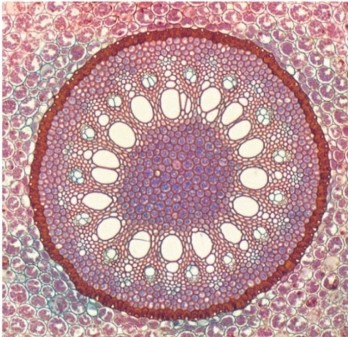 Which tissue/region found in this monocot root would not be found in a eudicot root?
 (Multiple Choice)
4.8/5 (85)
(85) Which statement would represent the best rephrasing of the following statement: "The basic body plan of a plant includes a root‒shoot axis."?
(Multiple Choice)
4.7/5 (62)
(62) The most common type of differentiated cells in plant bodies are _______ cells.
(Short Answer)
4.7/5 (78)
(78) Briefly describe the three different tissue systems that comprise the plant body, and their functions.
(Essay)
4.8/5 (89)
(89) A newly discovered flowering plant found in an alpine meadow has broad leaves with branched veins.This plant is most likely a
(Multiple Choice)
4.8/5 (76)
(76) When a young oak was 5 meters tall, a thoughtless person carved their initials in its trunk at a height of 1.5 meters above the ground.Today the tree is 10 meters tall.How high above the ground are the initials? Explain your answer in terms of plant growth.
(Essay)
4.8/5 (88)
(88) Refer to the figure of a plant periderm. 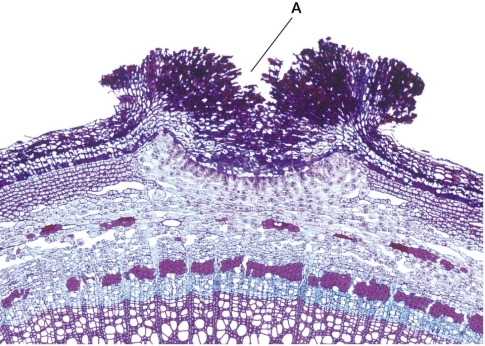 Structure A in the figure is a lenticel, which serves as a site of gas exchange with the environment.A similar structure, a _______, is found in leaves.
 (Short Answer)
4.9/5 (70)
(70) A botanist working high on the slopes of a Hawaiian volcano finds a member of the daisy family that has adapted to dry conditions with traits that are structurally similar to cacti.What part of this plant has become enlarged in order to function as a water storage organ?
(Multiple Choice)
4.8/5 (82)
(82) Which of the following does not generally distinguish the shoot and root apical meristems?
(Multiple Choice)
4.9/5 (58)
(58) Refer to the figure showing the stele of a buttercup root in cross section. 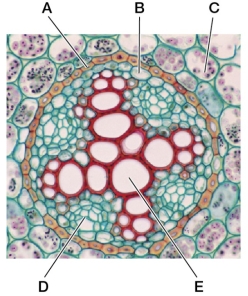 When the roots of a buttercup plant are placed experimentally in green-colored water, the dye will not penetrate into the root past a certain point.Which tissue layer shown in the figure is responsible for the restriction of the dye's movement? Identify the tissue layer.
 (Short Answer)
4.7/5 (79)
(79) Which of the following is not a characteristic of vessel elements?
(Multiple Choice)
4.8/5 (73)
(73) You observe a plant cell that is spindle-shaped, has secondary cell walls, and appears to be a dead, hollow tube.You are likely looking at a vascular cell that belongs to the
(Multiple Choice)
4.8/5 (65)
(65) The _______ meristems in roots and shoots are responsible for the _______ of all plants, and the _______ meristems are responsible for the _______ growth of woody plants.
(Multiple Choice)
4.9/5 (65)
(65) 
Filters
- Essay(0)
- Multiple Choice(0)
- Short Answer(0)
- True False(0)
- Matching(0)