



 Chat with AI
Exam 33: The Plant Body

Exam 1: Studying Life246 Questions
Exam 2: Small Molecules and the Chemistry of Life246 Questions
Exam 3: Proteins, Carbohydrates, and Lipids246 Questions
Exam 4: Nucleic Acids and the Origin of Life246 Questions
Exam 5: Cells: the Working Units of Life248 Questions
Exam 6: Cell Membranes246 Questions
Exam 7: Cell Communication and Multicellularity246 Questions
Exam 8: Energy, Enzymes, and Metabolism246 Questions
Exam 9: Pathways That Harvest Chemical Energy246 Questions
Exam 10: Photosynthesis: Energy From Sunlight242 Questions
Exam 11: The Cell Cycle and Cell Division260 Questions
Exam 12: Inheritance, Genes, and Chromosomes250 Questions
Exam 13: Dna and Its Role in Heredity257 Questions
Exam 14: From Dna to Protein: Gene Expression252 Questions
Exam 15: Gene Mutation and Molecular Medicine251 Questions
Exam 16: Regulation of Gene Expression245 Questions
Exam 17: Genomes249 Questions
Exam 18: Recombinant Dna and Biotechnology243 Questions
Exam 20: Mechanisms of Evolution243 Questions
Exam 21: Reconstructing and Using Phylogenies246 Questions
Exam 22: Speciation247 Questions
Exam 23: Evolution of Genes and Genomes252 Questions
Exam 24: The History of Life on Earth246 Questions
Exam 25: Bacteria, Archaea, and Viruses262 Questions
Exam 26: The Origin and Diversification of Eukaryotes252 Questions
Exam 27: Plants Without Seeds: From Water to Land251 Questions
Exam 28: The Evolution of Seed Plants259 Questions
Exam 29: The Evolution and Diversity of Fungi261 Questions
Exam 30: Animal Origins and the Evolution of Body Plans248 Questions
Exam 31: Protostome Animals244 Questions
Exam 32: Deuterostome Animals246 Questions
Exam 33: The Plant Body243 Questions
Exam 34: Transport in Plants248 Questions
Exam 35: Plant Nutrition247 Questions
Exam 36: Regulation of Plant Growth246 Questions
Exam 37: Reproduction in Flowering Plants247 Questions
Exam 38: Plant Responses to Environmental Challenges246 Questions
Exam 39: Physiology, Homeostasis, and Temperature Regulation258 Questions
Exam 40: Animal Hormones249 Questions
Exam 41: Immunology: Animal Defense Systems265 Questions
Exam 42: Animal Reproduction261 Questions
Exam 43: Animal Development261 Questions
Exam 44: Neurons, Glia, and Nervous Systems250 Questions
Exam 45: Sensory Systems249 Questions
Exam 46: The Mammalian Nervous System: Structure and Higher Functions254 Questions
Exam 47: Musculoskeletal Systems259 Questions
Exam 48: Gas Exchange247 Questions
Exam 49: Circulatory Systems252 Questions
Exam 50: Nutrition, Digestion, and Absorption259 Questions
Exam 51: Salt and Water Balance and Nitrogen Excretion251 Questions
Exam 52: Animal Behavior249 Questions
Exam 53: The Physical Environment and Biogeography of Life248 Questions
Exam 54: Populations259 Questions
Exam 55: Species Interactions254 Questions
Exam 56: Communities247 Questions
Exam 57: Ecosystems238 Questions
Exam 58: A Changing Biosphere222 Questions
Select questions type


You have discovered a living fossilized plant that is a relative of magnolias and had been thought to be extinct for the past five million years.The plant has rounded leaves, aerial roots, and a woody trunk.From this information, you expect to find two _______ in the stem of the tree.
(Multiple Choice)
5.0/5  (93)
(93) Facilities such as the Global Seed Vault in Norway, where seed samples from all parts of the world are stored for the future, are necessary for the preservation of genetic _______.
(Short Answer)
4.7/5 (84)
(84) In which state would you be least likely to find distinct annual rings in eudicot tree trunks?
(Multiple Choice)
5.0/5 (66)
(66) The shoot apical meristem is found _______ the nodes of mature leaves on the stem.
(Multiple Choice)
4.9/5 (71)
(71) Photosynthesis takes place in the leaf tissue called _______.
(Short Answer)
4.8/5 (82)
(82) Suppose you are studying tropical plants in a Costa Rican cloud forest and find a tree that is a eudicot in the forest ecosystem.This plant most likely has a(n) _______ root system.
(Short Answer)
4.8/5 (82)
(82) A very strange mutant mustard plant makes no internodes, instead producing node, connected to node, connected to node, etc.This plant makes incomplete _______ of its stem, resulting in a very short plant.
(Short Answer)
4.9/5 (87)
(87) You are working with a mutant plant, and the cells in this plant adhere poorly to one another.You conclude that the mutation is due to a defect in the formation of
(Multiple Choice)
4.8/5 (77)
(77) What kind of cells help to keep the transport cells of the phloem alive?
(Multiple Choice)
4.8/5 (76)
(76) The term for the structure that emerges from a shoot apical meristem and eventually becomes a mature leaf is a(n)
(Multiple Choice)
4.9/5 (82)
(82) Refer to the figure showing a plant periderm. 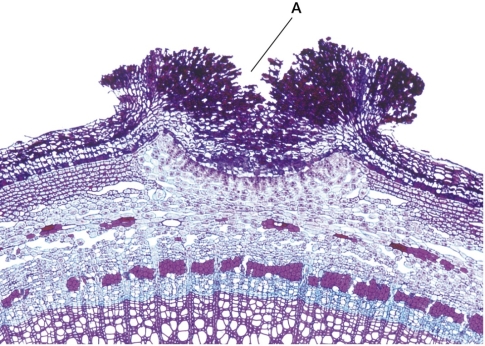 The periderm, which is the outer layer of the secondary plant body, provides protection for interior tissues by keeping water in and pathogens out.What function is provided by structure A in the figure?
 (Multiple Choice)
4.9/5 (65)
(65) Plant cells that are photosynthetically active are parenchyma cells found in the _______ layer of the leaf.
(Short Answer)
4.7/5 (74)
(74) An experimentally produced mutant plant in which the apical meristems were replaced with lateral meristems would be able to grow in girth but not in _______.
(Short Answer)
4.8/5 (88)
(88) Primary plant growth, as compared to secondary plant growth, produces proportionally more
(Multiple Choice)
4.9/5 (80)
(80) A newly discovered plant growing in a tropical forest has parallel veins in its leaves and pith in its roots.The location of the pith helps to determine whether this plant is a monocot or dicot because pith is found
(Multiple Choice)
4.9/5 (94)
(94) 
Filters
- Essay(0)
- Multiple Choice(0)
- Short Answer(0)
- True False(0)
- Matching(0)