



 Chat with AI
Exam 33: The Plant Body

Exam 1: Studying Life246 Questions
Exam 2: Small Molecules and the Chemistry of Life246 Questions
Exam 3: Proteins, Carbohydrates, and Lipids246 Questions
Exam 4: Nucleic Acids and the Origin of Life246 Questions
Exam 5: Cells: the Working Units of Life248 Questions
Exam 6: Cell Membranes246 Questions
Exam 7: Cell Communication and Multicellularity246 Questions
Exam 8: Energy, Enzymes, and Metabolism246 Questions
Exam 9: Pathways That Harvest Chemical Energy246 Questions
Exam 10: Photosynthesis: Energy From Sunlight242 Questions
Exam 11: The Cell Cycle and Cell Division260 Questions
Exam 12: Inheritance, Genes, and Chromosomes250 Questions
Exam 13: Dna and Its Role in Heredity257 Questions
Exam 14: From Dna to Protein: Gene Expression252 Questions
Exam 15: Gene Mutation and Molecular Medicine251 Questions
Exam 16: Regulation of Gene Expression245 Questions
Exam 17: Genomes249 Questions
Exam 18: Recombinant Dna and Biotechnology243 Questions
Exam 20: Mechanisms of Evolution243 Questions
Exam 21: Reconstructing and Using Phylogenies246 Questions
Exam 22: Speciation247 Questions
Exam 23: Evolution of Genes and Genomes252 Questions
Exam 24: The History of Life on Earth246 Questions
Exam 25: Bacteria, Archaea, and Viruses262 Questions
Exam 26: The Origin and Diversification of Eukaryotes252 Questions
Exam 27: Plants Without Seeds: From Water to Land251 Questions
Exam 28: The Evolution of Seed Plants259 Questions
Exam 29: The Evolution and Diversity of Fungi261 Questions
Exam 30: Animal Origins and the Evolution of Body Plans248 Questions
Exam 31: Protostome Animals244 Questions
Exam 32: Deuterostome Animals246 Questions
Exam 33: The Plant Body243 Questions
Exam 34: Transport in Plants248 Questions
Exam 35: Plant Nutrition247 Questions
Exam 36: Regulation of Plant Growth246 Questions
Exam 37: Reproduction in Flowering Plants247 Questions
Exam 38: Plant Responses to Environmental Challenges246 Questions
Exam 39: Physiology, Homeostasis, and Temperature Regulation258 Questions
Exam 40: Animal Hormones249 Questions
Exam 41: Immunology: Animal Defense Systems265 Questions
Exam 42: Animal Reproduction261 Questions
Exam 43: Animal Development261 Questions
Exam 44: Neurons, Glia, and Nervous Systems250 Questions
Exam 45: Sensory Systems249 Questions
Exam 46: The Mammalian Nervous System: Structure and Higher Functions254 Questions
Exam 47: Musculoskeletal Systems259 Questions
Exam 48: Gas Exchange247 Questions
Exam 49: Circulatory Systems252 Questions
Exam 50: Nutrition, Digestion, and Absorption259 Questions
Exam 51: Salt and Water Balance and Nitrogen Excretion251 Questions
Exam 52: Animal Behavior249 Questions
Exam 53: The Physical Environment and Biogeography of Life248 Questions
Exam 54: Populations259 Questions
Exam 55: Species Interactions254 Questions
Exam 56: Communities247 Questions
Exam 57: Ecosystems238 Questions
Exam 58: A Changing Biosphere222 Questions
Select questions type


Refer to the figure showing the torpedo stage of plant embryogenesis. 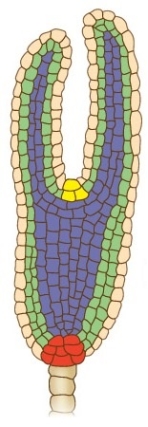 What would be the effect on plant development if the parts of the figure shown in yellow and red were nonfunctional?
 (Short Answer)
4.8/5  (85)
(85) Just inside the epidermis of the root is a region of parenchyma cells called the _______.
(Short Answer)
4.8/5 (71)
(71) The cell wall region between adjoining parenchyma cells, if peeled apart into its constituent layers, would be found to consist of
(Multiple Choice)
4.8/5 (67)
(67) If sugar travels from a tuber to a developing leaf, the tuber is a(n) _______, and the leaf is a _______.
(Multiple Choice)
4.9/5 (75)
(75) The _______ is a layer of root cells that contain the water-repellent substance suberin in their cell walls.
(Short Answer)
4.8/5 (83)
(83) Summer wood and spring wood differ both in terms of their color and in the thickness of their _______.
(Short Answer)
4.7/5 (81)
(81) The plant organs that occur in seedlings and serve for storage and/or photosynthesis are the
(Multiple Choice)
4.9/5 (83)
(83) Which of the following is not one of the functions of cork cambium products?
(Multiple Choice)
4.7/5 (90)
(90) As stationary organisms, plants must rely on _______ growth to acquire resources.
(Short Answer)
4.9/5 (84)
(84) The angle made by the stem and an attached petiole is called the leaf axil, and the shoot bud found in that angle is called a(n) _______.
(Short Answer)
4.7/5 (81)
(81) Sclerenchyma cells have thickened _______ cell walls and function when they are dead.
(Short Answer)
4.9/5 (71)
(71) Differentiate between apical and lateral meristems.Do all plants have apical meristems? Do all plants have lateral meristems?
(Essay)
4.7/5 (70)
(70) Hard or gritty texture in fruits is due to _______ plant cells?
(Short Answer)
4.9/5 (79)
(79) When the aboveground portions of a woody eudicot are undergoing secondary growth, the root system
(Multiple Choice)
4.7/5 (76)
(76) Suppose you are given a freeze-dried leaf and told to remove all of the cell layers except for the one that will provide the maximum amount of chlorophyll for an extract to be used in an experiment.You should scrape away all of the layers of cells except for the _______ cells.
(Multiple Choice)
4.9/5 (72)
(72) Whether a stem is woody or herbaceous, the outer covering is formed by the
(Multiple Choice)
4.8/5 (76)
(76) The horizontally branching roots of a plant's root system are called _______ roots.
(Multiple Choice)
4.9/5 (70)
(70) A variety of morning glory vine has special epidermal cells which, though alive, lack most organelles and therefore permit maximal conduction of light to the ground tissue.These cells are kept alive by parenchyma cells that are attached to them by many plasmodesmata.These special epidermal cells are therefore like phloem cells, which
(Multiple Choice)
4.8/5 (74)
(74) 
Filters
- Essay(0)
- Multiple Choice(0)
- Short Answer(0)
- True False(0)
- Matching(0)