



 Chat with AI
Exam 33: The Plant Body

Exam 1: Studying Life246 Questions
Exam 2: Small Molecules and the Chemistry of Life246 Questions
Exam 3: Proteins, Carbohydrates, and Lipids246 Questions
Exam 4: Nucleic Acids and the Origin of Life246 Questions
Exam 5: Cells: the Working Units of Life248 Questions
Exam 6: Cell Membranes246 Questions
Exam 7: Cell Communication and Multicellularity246 Questions
Exam 8: Energy, Enzymes, and Metabolism246 Questions
Exam 9: Pathways That Harvest Chemical Energy246 Questions
Exam 10: Photosynthesis: Energy From Sunlight242 Questions
Exam 11: The Cell Cycle and Cell Division260 Questions
Exam 12: Inheritance, Genes, and Chromosomes250 Questions
Exam 13: Dna and Its Role in Heredity257 Questions
Exam 14: From Dna to Protein: Gene Expression252 Questions
Exam 15: Gene Mutation and Molecular Medicine251 Questions
Exam 16: Regulation of Gene Expression245 Questions
Exam 17: Genomes249 Questions
Exam 18: Recombinant Dna and Biotechnology243 Questions
Exam 20: Mechanisms of Evolution243 Questions
Exam 21: Reconstructing and Using Phylogenies246 Questions
Exam 22: Speciation247 Questions
Exam 23: Evolution of Genes and Genomes252 Questions
Exam 24: The History of Life on Earth246 Questions
Exam 25: Bacteria, Archaea, and Viruses262 Questions
Exam 26: The Origin and Diversification of Eukaryotes252 Questions
Exam 27: Plants Without Seeds: From Water to Land251 Questions
Exam 28: The Evolution of Seed Plants259 Questions
Exam 29: The Evolution and Diversity of Fungi261 Questions
Exam 30: Animal Origins and the Evolution of Body Plans248 Questions
Exam 31: Protostome Animals244 Questions
Exam 32: Deuterostome Animals246 Questions
Exam 33: The Plant Body243 Questions
Exam 34: Transport in Plants248 Questions
Exam 35: Plant Nutrition247 Questions
Exam 36: Regulation of Plant Growth246 Questions
Exam 37: Reproduction in Flowering Plants247 Questions
Exam 38: Plant Responses to Environmental Challenges246 Questions
Exam 39: Physiology, Homeostasis, and Temperature Regulation258 Questions
Exam 40: Animal Hormones249 Questions
Exam 41: Immunology: Animal Defense Systems265 Questions
Exam 42: Animal Reproduction261 Questions
Exam 43: Animal Development261 Questions
Exam 44: Neurons, Glia, and Nervous Systems250 Questions
Exam 45: Sensory Systems249 Questions
Exam 46: The Mammalian Nervous System: Structure and Higher Functions254 Questions
Exam 47: Musculoskeletal Systems259 Questions
Exam 48: Gas Exchange247 Questions
Exam 49: Circulatory Systems252 Questions
Exam 50: Nutrition, Digestion, and Absorption259 Questions
Exam 51: Salt and Water Balance and Nitrogen Excretion251 Questions
Exam 52: Animal Behavior249 Questions
Exam 53: The Physical Environment and Biogeography of Life248 Questions
Exam 54: Populations259 Questions
Exam 55: Species Interactions254 Questions
Exam 56: Communities247 Questions
Exam 57: Ecosystems238 Questions
Exam 58: A Changing Biosphere222 Questions
Select questions type


The vascular cambium is located between the _______ and _______.
(Multiple Choice)
4.7/5  (76)
(76) To stop the lateral expansion of a tree, you could apply a chemical to inhibit the action of the
(Multiple Choice)
4.8/5 (80)
(80) Aboveground epidermal cells secrete a waxy layer called _______, which helps retard water loss from stems and leaves.
(Multiple Choice)
4.8/5 (72)
(72) Some plants, such as cacti, have developed spines as a means of protection.Spines are most likely modifications of which plant structure?
(Multiple Choice)
4.8/5 (72)
(72) Which is the correct order of the regions of a root tip, from the quiescent center upward?
(Multiple Choice)
4.7/5 (85)
(85) Refer to the figure showing the stele of a buttercup root in cross section. 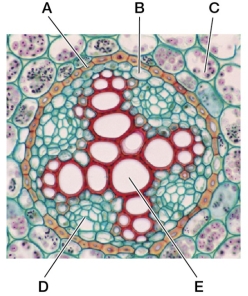 When leaves are incubated in radioactive CO2, which tissue shown in the figure will accumulate the most radioactivity? Identify the tissue layer.
 (Short Answer)
4.8/5 (84)
(84) Which statement about genetic variation in crop plants and in their wild relatives is true?
(Multiple Choice)
4.8/5 (93)
(93) In which region(s) would you expect to find xylem in a leaf?
(Multiple Choice)
4.9/5 (99)
(99) You are asked to classify a plant based on your own observations in the lab.You note that the flowers have six petals and the leaves have parallel veins.You would classify this plant as a _______ and would expect to find a(n) _______ root system.
(Multiple Choice)
4.9/5 (97)
(97) You are lost in a wilderness and decide to make a raft to try to float downstream to safety.You are happy to find a monocot with large, aerial roots for making your raft, because the _______ in the center of the monocot's roots will be low-density and make your raft float well.
(Short Answer)
4.8/5 (73)
(73) Which characteristic does not differ between eudicots and monocots?
(Multiple Choice)
4.8/5 (82)
(82) A botanist discovers a new family of flowering plants restricted to a small island.This family should be classified as an advanced family of angiosperms if it possesses
(Multiple Choice)
4.8/5 (79)
(79) Leaves are designed to conduct photosynthesis and produce sugars as a result of this process.Therefore, leaves must have functioning _______ tissue to move the solutes to another part of the plant, such as storage organs.
(Short Answer)
4.8/5 (67)
(67) If a horticulturist uses a rooting powder on a cutting from a fig tree to produce roots, the roots that are produced are
(Multiple Choice)
4.8/5 (77)
(77) Root cells produced during primary growth reach their final size in the
(Multiple Choice)
4.9/5 (71)
(71) 
Filters
- Essay(0)
- Multiple Choice(0)
- Short Answer(0)
- True False(0)
- Matching(0)