



 Chat with AI
Exam 22: Phylogenetic Reconstruction

Exam 1: Biology and Its Themes46 Questions
Exam 2: Atoms and Molecules61 Questions
Exam 3: The Chemistry of Water55 Questions
Exam 4: Carbon: the Basis of Molecular Diversity52 Questions
Exam 5: Biological Macromolecules and Lipids71 Questions
Exam 6: Energy and Life65 Questions
Exam 7: Cell Structure and Function66 Questions
Exam 8: Cell Membranes67 Questions
Exam 9: Cellular Signaling62 Questions
Exam 10: Cell Respiration68 Questions
Exam 11: Photosynthetic Processes64 Questions
Exam 12: Mitosis63 Questions
Exam 13: Sexual Life Cycles and Meiosis64 Questions
Exam 14: Mendelian Genetics65 Questions
Exam 15: Linkage and Chromosomes54 Questions
Exam 16: Nucleic Acids and Inheritance65 Questions
Exam 17: Expression of Genes70 Questions
Exam 18: Control of Gene Expression66 Questions
Exam 19: Dna Technology56 Questions
Exam 20: The Evolution of Genomes47 Questions
Exam 21: How Evolution Works60 Questions
Exam 22: Phylogenetic Reconstruction66 Questions
Exam 23: Microevolution65 Questions
Exam 24: Species and Speciation65 Questions
Exam 25: Macroevolution58 Questions
Exam 26: Introduction to Viruses54 Questions
Exam 27: Prokaryotes61 Questions
Exam 28: The Origin and Evolution of Eukaryotes66 Questions
Exam 29: Nonvascular and Seedless Vascular Plants72 Questions
Exam 30: Seed Plants64 Questions
Exam 31: Introduction to Fungi56 Questions
Exam 32: An Introduction to Animal Diversity58 Questions
Exam 33: Invertebrates58 Questions
Exam 34: Vertebrates66 Questions
Exam 35: Plant Structure and Growth68 Questions
Exam 36: Transport in Vascular Plants73 Questions
Exam 37: Plant Nutrition51 Questions
Exam 38: Reproduction of Flowering Plants59 Questions
Exam 39: Plant Signals and Behavior60 Questions
Exam 40: The Animal Body58 Questions
Exam 41: Chemical Signals in Animals62 Questions
Exam 42: Animal Digestive Systems58 Questions
Exam 43: Animal Transport Systems58 Questions
Exam 44: Animal Excretory Systems49 Questions
Exam 45: Animal Reproductive Systems64 Questions
Exam 46: Development in Animals68 Questions
Exam 47: Animal Defenses Against Infection65 Questions
Exam 48: Electrical Signals in Animals62 Questions
Exam 49: Neural Regulation in Animals69 Questions
Exam 50: Sensation and Movement in Animals68 Questions
Exam 51: An Overview of Ecology71 Questions
Exam 52: Behavioral Ecology64 Questions
Exam 53: Populations and Life History Traits73 Questions
Exam 54: Biodiversity and Communities71 Questions
Exam 55: Energy Flow and Chemical Cycling in Ecosystems80 Questions
Exam 56: Conservation and Global Ecology75 Questions
Select questions type


Which of the following statements correctly describes paragalous genes in related species?
(Multiple Choice)
5.0/5  (82)
(82) In a comparison of birds and mammals, the condition of having four limbs is ________.
(Multiple Choice)
4.9/5 (91)
(91) If you were using cladistics to build a phylogenetic tree of cats, which of the following organisms would be the best outgroup?
(Multiple Choice)
4.8/5 (78)
(78) Imagine that you discovered the following information about the three domains of life:
Feature Bacteria Archaea Eukaryotes
RNA polymerase small, simple complex complex
Introns absent present present
Antibiotic sensitivity sensitive insensitive insensitive
Membrane Lipids C chains unbranched C chains branched C chains branched
These data would support which of the following conclusions?
(Multiple Choice)
4.8/5 (80)
(80) Use the following information to answer the question. 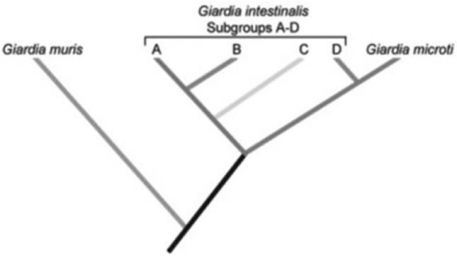 By examining the phylogenetic tree diagrammed in the figure, what conclusion can you draw about the species G. microti?
 (Multiple Choice)
4.8/5 (81)
(81) Your professor wants you to construct a phylogenetic tree of a type of plant called orchids. She gives you tissue from seven orchid species and one lily plant. What is the most likely reason she gave you the lily?
(Multiple Choice)
4.9/5 (75)
(75) The term convergent evolution is most applicable to which of the following characteristics?
(Multiple Choice)
4.9/5 (88)
(88) Which statement represents the best explanation for the observation that the nuclear DNA of wolves and domestic dogs has a very high degree of sequence homology?
(Multiple Choice)
4.8/5 (72)
(72) To apply parsimony to constructing a phylogenetic tree, ________.
(Multiple Choice)
4.8/5 (73)
(73) Which of the following statements is accurate with regard to a phylogeny, as represented by a phylogenetic tree?
(Multiple Choice)
4.9/5 (73)
(73) The following question refers to this phylogenetic tree, depicting the origins of life and the three domains. Connecting lines indicate instances of gene or genome transfer and time is indicated from left to right. 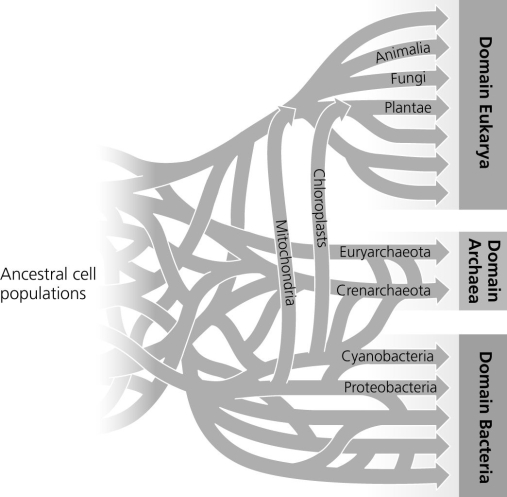 A possible phylogenetic tree for the three domains of life.
If the early history of life on Earth is accurately depicted by the figure, then which statement is most in agreement with the hypothesis proposed by this tree?
A possible phylogenetic tree for the three domains of life.
If the early history of life on Earth is accurately depicted by the figure, then which statement is most in agreement with the hypothesis proposed by this tree? (Multiple Choice)
4.9/5 (91)
(91) Birds and mammals have four limbs. Which of the following statements describes this trait?
(Multiple Choice)
4.8/5 (73)
(73) If additional DNA sequence evidence shows that yeast genes for synthesizing proteins are more similar to protein-synthesizing genes in bacteria than those in archaea, what would a systematist do with the current phylogeny?
(Multiple Choice)
4.8/5 (82)
(82) Which of the following features permits a gene to act as a molecular clock?
(Multiple Choice)
4.9/5 (87)
(87) In the below figure, which similarly inclusive taxon is represented as descending from the same common ancestor as Canidae?
(Multiple Choice)
4.8/5 (74)
(74) Which of the following evolutionary processes or characteristics would most likely result in an archaean species whose rRNA is more similar to that of humans of mice?
(Multiple Choice)
4.8/5 (81)
(81) The figure represents a phylogenetic tree of birds and their closest relatives. Which group of organisms represents the outgroup in this clade? 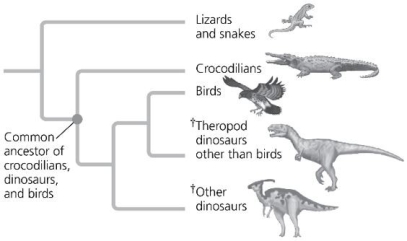
(Multiple Choice)
4.8/5 (87)
(87) Evolutionary biologists have developed a phylogeny for a group of mammals based on bone structure. Which of the following statements best predicts the phylogeny for the same group of mammals based on similarities and differences in the structure of a particular enzyme?
(Multiple Choice)
4.9/5 (82)
(82) 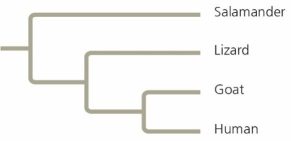
In the table, a Y indicates that the listed species possess trait 1, 2, or 3 and an N indicates that the listed species do not possess the trait. Given that phylogenies are based on shared derived characteristics, which of the following traits is useful in generating a phylogeny of species A, B, C, and D?

(Multiple Choice)
4.8/5 (82)
(82) 
Filters
- Essay(0)
- Multiple Choice(0)
- Short Answer(0)
- True False(0)
- Matching(0)