



 Chat with AI
Exam 11: Photosynthetic Processes

Exam 1: Biology and Its Themes46 Questions
Exam 2: Atoms and Molecules61 Questions
Exam 3: The Chemistry of Water55 Questions
Exam 4: Carbon: the Basis of Molecular Diversity52 Questions
Exam 5: Biological Macromolecules and Lipids71 Questions
Exam 6: Energy and Life65 Questions
Exam 7: Cell Structure and Function66 Questions
Exam 8: Cell Membranes67 Questions
Exam 9: Cellular Signaling62 Questions
Exam 10: Cell Respiration68 Questions
Exam 11: Photosynthetic Processes64 Questions
Exam 12: Mitosis63 Questions
Exam 13: Sexual Life Cycles and Meiosis64 Questions
Exam 14: Mendelian Genetics65 Questions
Exam 15: Linkage and Chromosomes54 Questions
Exam 16: Nucleic Acids and Inheritance65 Questions
Exam 17: Expression of Genes70 Questions
Exam 18: Control of Gene Expression66 Questions
Exam 19: Dna Technology56 Questions
Exam 20: The Evolution of Genomes47 Questions
Exam 21: How Evolution Works60 Questions
Exam 22: Phylogenetic Reconstruction66 Questions
Exam 23: Microevolution65 Questions
Exam 24: Species and Speciation65 Questions
Exam 25: Macroevolution58 Questions
Exam 26: Introduction to Viruses54 Questions
Exam 27: Prokaryotes61 Questions
Exam 28: The Origin and Evolution of Eukaryotes66 Questions
Exam 29: Nonvascular and Seedless Vascular Plants72 Questions
Exam 30: Seed Plants64 Questions
Exam 31: Introduction to Fungi56 Questions
Exam 32: An Introduction to Animal Diversity58 Questions
Exam 33: Invertebrates58 Questions
Exam 34: Vertebrates66 Questions
Exam 35: Plant Structure and Growth68 Questions
Exam 36: Transport in Vascular Plants73 Questions
Exam 37: Plant Nutrition51 Questions
Exam 38: Reproduction of Flowering Plants59 Questions
Exam 39: Plant Signals and Behavior60 Questions
Exam 40: The Animal Body58 Questions
Exam 41: Chemical Signals in Animals62 Questions
Exam 42: Animal Digestive Systems58 Questions
Exam 43: Animal Transport Systems58 Questions
Exam 44: Animal Excretory Systems49 Questions
Exam 45: Animal Reproductive Systems64 Questions
Exam 46: Development in Animals68 Questions
Exam 47: Animal Defenses Against Infection65 Questions
Exam 48: Electrical Signals in Animals62 Questions
Exam 49: Neural Regulation in Animals69 Questions
Exam 50: Sensation and Movement in Animals68 Questions
Exam 51: An Overview of Ecology71 Questions
Exam 52: Behavioral Ecology64 Questions
Exam 53: Populations and Life History Traits73 Questions
Exam 54: Biodiversity and Communities71 Questions
Exam 55: Energy Flow and Chemical Cycling in Ecosystems80 Questions
Exam 56: Conservation and Global Ecology75 Questions
Select questions type


Carotenoids are often found in foods that are considered to have antioxidant properties in human nutrition. Which of the following statements best describes a related function they serve in plants?

Free
(Multiple Choice)
4.8/5  (73)
(73) Correct Answer: Verified
B
Which of the following events are associated with chemiosmosis in chloroplasts?
Free
(Multiple Choice)
4.9/5 (78)
(78) Correct Answer:Verified
VerifiedB
 In which cell of the accompanying figure would elevated oxygen concentrations have the greatest inhibitory effect on carbon fixation reactions?
Free
(Multiple Choice)
4.7/5 (83)
(83) Correct Answer:Verified
VerifiedB
In chloroplasts, the photosynthetic electron transport chain acidifies which of the following cellular compartments?
(Multiple Choice)
4.7/5 (71)
(71) 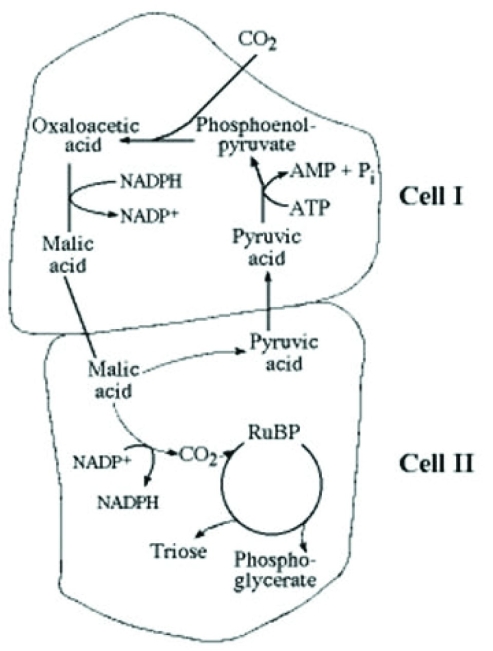 Which of the following statements best describes the accompanying figure?
 (Multiple Choice)
4.9/5 (69)
(69) Which of the following statements correctly describes a distinction between autotrophs and heterotrophs?
(Multiple Choice)
4.8/5 (80)
(80) In which cellular structure are the enzymes of the Calvin cycle localized?
(Multiple Choice)
4.9/5 (77)
(77) Which of the following observations would be the best indicator that an organism lacks photosystem II?
(Multiple Choice)
4.9/5 (83)
(83) Lab students placed ten spinach leaf disks in each of three test tubes containing a baking soda solution and a control tube without baking soda. The volume of liquid in each tube and the temperature of the solutions were held constant. All tubes were placed an equal distance from a light source as indicated in the accompanying table. After 10 minutes, the amount of oxygen present in each sample was measured.
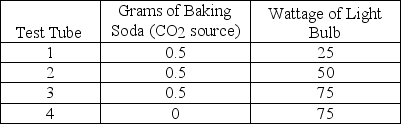 Which tube is expected to contain the greatest quantity of oxygen?
 (Multiple Choice)
4.8/5 (72)
(72) A flask containing photosynthetic green algae and a control flask containing only water are exposed to a cycle of 12 hours of light and 12 hours of darkness. Which of the following statements best describes how the relative dissolved oxygen concentration in the flask with algae will compare to the control flask?
(Multiple Choice)
4.8/5 (92)
(92) Which of the following statements best describes the relationship between autotrophs and heterotrophs?
(Multiple Choice)
4.8/5 (74)
(74) Which of the following statements best explains the ability of CAM plants to synthesize sugars in the daytime while keeping their stomata closed to reduce water loss?
(Multiple Choice)
4.9/5 (82)
(82)  The accompanying figure shows the absorption spectrum for chlorophyll a and the action spectrum for photosynthesis. Which of the following statements best explains the low rate of photosynthesis at 550 nm?
 (Multiple Choice)
4.8/5 (87)
(87) Which of the following statements best describes the conditions under which the Calvin cycle and cellular respiration occur in plants?
(Multiple Choice)
4.9/5 (75)
(75) Which of the following molecules will accumulate if light reactions occur normally, but the Calvin Cycle is inhibited?
(Multiple Choice)
4.9/5 (69)
(69) Which of the following molecules best describes the primary form in which plants stockpile extra sugar produced by photosynthesis?
(Multiple Choice)
4.9/5 (84)
(84) Which of the following processes is directly associated with photosystem I?
(Multiple Choice)
4.8/5 (80)
(80) Which of the following processes occurs in the Calvin cycle?
(Multiple Choice)
4.8/5 (85)
(85) 
Filters
- Essay(0)
- Multiple Choice(0)
- Short Answer(0)
- True False(0)
- Matching(0)