



 Chat with AI
Exam 11: Photosynthetic Processes

Exam 1: Biology and Its Themes46 Questions
Exam 2: Atoms and Molecules61 Questions
Exam 3: The Chemistry of Water55 Questions
Exam 4: Carbon: the Basis of Molecular Diversity52 Questions
Exam 5: Biological Macromolecules and Lipids71 Questions
Exam 6: Energy and Life65 Questions
Exam 7: Cell Structure and Function66 Questions
Exam 8: Cell Membranes67 Questions
Exam 9: Cellular Signaling62 Questions
Exam 10: Cell Respiration68 Questions
Exam 11: Photosynthetic Processes64 Questions
Exam 12: Mitosis63 Questions
Exam 13: Sexual Life Cycles and Meiosis64 Questions
Exam 14: Mendelian Genetics65 Questions
Exam 15: Linkage and Chromosomes54 Questions
Exam 16: Nucleic Acids and Inheritance65 Questions
Exam 17: Expression of Genes70 Questions
Exam 18: Control of Gene Expression66 Questions
Exam 19: Dna Technology56 Questions
Exam 20: The Evolution of Genomes47 Questions
Exam 21: How Evolution Works60 Questions
Exam 22: Phylogenetic Reconstruction66 Questions
Exam 23: Microevolution65 Questions
Exam 24: Species and Speciation65 Questions
Exam 25: Macroevolution58 Questions
Exam 26: Introduction to Viruses54 Questions
Exam 27: Prokaryotes61 Questions
Exam 28: The Origin and Evolution of Eukaryotes66 Questions
Exam 29: Nonvascular and Seedless Vascular Plants72 Questions
Exam 30: Seed Plants64 Questions
Exam 31: Introduction to Fungi56 Questions
Exam 32: An Introduction to Animal Diversity58 Questions
Exam 33: Invertebrates58 Questions
Exam 34: Vertebrates66 Questions
Exam 35: Plant Structure and Growth68 Questions
Exam 36: Transport in Vascular Plants73 Questions
Exam 37: Plant Nutrition51 Questions
Exam 38: Reproduction of Flowering Plants59 Questions
Exam 39: Plant Signals and Behavior60 Questions
Exam 40: The Animal Body58 Questions
Exam 41: Chemical Signals in Animals62 Questions
Exam 42: Animal Digestive Systems58 Questions
Exam 43: Animal Transport Systems58 Questions
Exam 44: Animal Excretory Systems49 Questions
Exam 45: Animal Reproductive Systems64 Questions
Exam 46: Development in Animals68 Questions
Exam 47: Animal Defenses Against Infection65 Questions
Exam 48: Electrical Signals in Animals62 Questions
Exam 49: Neural Regulation in Animals69 Questions
Exam 50: Sensation and Movement in Animals68 Questions
Exam 51: An Overview of Ecology71 Questions
Exam 52: Behavioral Ecology64 Questions
Exam 53: Populations and Life History Traits73 Questions
Exam 54: Biodiversity and Communities71 Questions
Exam 55: Energy Flow and Chemical Cycling in Ecosystems80 Questions
Exam 56: Conservation and Global Ecology75 Questions
Select questions type


Paper chromatography is a technique used to separate molecules based upon their polarity. If pigments from oak leaves are extracted and subjected to paper chromatography, which of the following statements best describes the pigment bands that would be observed?
(Multiple Choice)
4.8/5  (79)
(79)  The accompanying figure shows the absorbance spectrum for a photosynthetic bacterium that appears purple. Which of the following wavelengths of light are maximally absorbed by this organism?
 (Multiple Choice)
4.8/5 (87)
(87) Which of the following statements best describes the relationship between photosynthesis and cellular respiration?
(Multiple Choice)
4.9/5 (88)
(88) 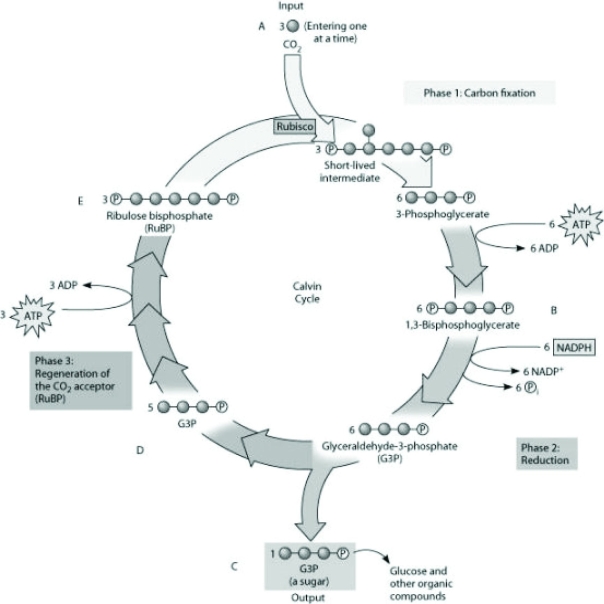 If photosynthesizing green algae are provided with CO2 containing heavy oxygen (18O), which of the following molecules produced by the algae (refer to the accompanying figure) would be least likely to contain 18O in subsequent analyses?
 (Multiple Choice)
4.8/5 (90)
(90) Which of the following statements describes a primary benefit of having photosystem reaction centers composed of several structurally different pigments?
(Multiple Choice)
4.9/5 (84)
(84) P680+ is said to be the strongest biological oxidizing agent. The strong oxidizing potential of P680+ is essential for its function because it ________.
(Multiple Choice)
4.9/5 (89)
(89) When a filament of algae is illuminated with light that is passed through a prism, different segments of algae are exposed to different wavelengths of light. When aerobic bacteria are present, they congregate in highest concentrations in the areas illuminated by the red and blue light. These data suggest a relationship between which of the following variables?
(Multiple Choice)
4.9/5 (74)
(74) Which of the following events is most immediately associated with the absorption of energy by chlorophyll molecules of the reaction-center complex?
(Multiple Choice)
4.9/5 (84)
(84) If various plant cell membranes are isolated and incubated with a proton gradient across the isolated membrane in the presence of ADP and  i, which of the following samples are most likely to be able to synthesize ATP?
 (Multiple Choice)
4.8/5 (79)
(79) Which of the following statements best explains why photosynthesis using C4 or CAM systems may be described as a metabolic compromise?
(Multiple Choice)
4.8/5 (82)
(82) Which of the following processes would be most directly affected if a thylakoid membrane is punctured so that the interior of the thylakoid is no longer separated from the stroma?
(Multiple Choice)
4.8/5 (82)
(82) Most sugar is transported from the leaves to the rest of the plant in the form of which of the following molecules?
(Multiple Choice)
4.9/5 (81)
(81) On a spaceship designed to support a multiyear voyage to the outer planets of the solar system, plants will be grown to provide oxygen and to recycle carbon dioxide. Because the spaceship will be so far from the sun, an artificial light source will be needed to support photosynthesis. Which of the following wavelengths of light should be used to maximize plant growth?
(Multiple Choice)
4.9/5 (86)
(86) In autumn, chlorophyll is degraded in the leaves of deciduous trees. Which of the following statements best explains the change in color from green to shades of yellow, orange, or red?
(Multiple Choice)
4.7/5 (93)
(93) A mutation that eliminates a plant's ability to perform photorespiration will most likely have which of the following effects on the plant?
(Multiple Choice)
4.9/5 (91)
(91) Which of the following statements best describes a characteristic of C4 plants?
(Multiple Choice)
4.8/5 (80)
(80) In mechanism, photophosphorylation is most similar to ________.
(Multiple Choice)
4.8/5 (82)
(82) When a filament of algae is illuminated with light that is passed through a prism, different segments of algae are exposed to different wavelengths of light. When aerobic bacteria are present, they congregate in highest concentrations in the areas illuminated by the red and blue light. Which of the following statements provides the best explanation for the bacteria congregation in these areas?
(Multiple Choice)
5.0/5 (82)
(82) 
Filters
- Essay(0)
- Multiple Choice(0)
- Short Answer(0)
- True False(0)
- Matching(0)