



 Chat with AI
Exam 55: Energy Flow and Chemical Cycling in Ecosystems

Exam 1: Biology and Its Themes46 Questions
Exam 2: Atoms and Molecules61 Questions
Exam 3: The Chemistry of Water55 Questions
Exam 4: Carbon: the Basis of Molecular Diversity52 Questions
Exam 5: Biological Macromolecules and Lipids71 Questions
Exam 6: Energy and Life65 Questions
Exam 7: Cell Structure and Function66 Questions
Exam 8: Cell Membranes67 Questions
Exam 9: Cellular Signaling62 Questions
Exam 10: Cell Respiration68 Questions
Exam 11: Photosynthetic Processes64 Questions
Exam 12: Mitosis63 Questions
Exam 13: Sexual Life Cycles and Meiosis64 Questions
Exam 14: Mendelian Genetics65 Questions
Exam 15: Linkage and Chromosomes54 Questions
Exam 16: Nucleic Acids and Inheritance65 Questions
Exam 17: Expression of Genes70 Questions
Exam 18: Control of Gene Expression66 Questions
Exam 19: Dna Technology56 Questions
Exam 20: The Evolution of Genomes47 Questions
Exam 21: How Evolution Works60 Questions
Exam 22: Phylogenetic Reconstruction66 Questions
Exam 23: Microevolution65 Questions
Exam 24: Species and Speciation65 Questions
Exam 25: Macroevolution58 Questions
Exam 26: Introduction to Viruses54 Questions
Exam 27: Prokaryotes61 Questions
Exam 28: The Origin and Evolution of Eukaryotes66 Questions
Exam 29: Nonvascular and Seedless Vascular Plants72 Questions
Exam 30: Seed Plants64 Questions
Exam 31: Introduction to Fungi56 Questions
Exam 32: An Introduction to Animal Diversity58 Questions
Exam 33: Invertebrates58 Questions
Exam 34: Vertebrates66 Questions
Exam 35: Plant Structure and Growth68 Questions
Exam 36: Transport in Vascular Plants73 Questions
Exam 37: Plant Nutrition51 Questions
Exam 38: Reproduction of Flowering Plants59 Questions
Exam 39: Plant Signals and Behavior60 Questions
Exam 40: The Animal Body58 Questions
Exam 41: Chemical Signals in Animals62 Questions
Exam 42: Animal Digestive Systems58 Questions
Exam 43: Animal Transport Systems58 Questions
Exam 44: Animal Excretory Systems49 Questions
Exam 45: Animal Reproductive Systems64 Questions
Exam 46: Development in Animals68 Questions
Exam 47: Animal Defenses Against Infection65 Questions
Exam 48: Electrical Signals in Animals62 Questions
Exam 49: Neural Regulation in Animals69 Questions
Exam 50: Sensation and Movement in Animals68 Questions
Exam 51: An Overview of Ecology71 Questions
Exam 52: Behavioral Ecology64 Questions
Exam 53: Populations and Life History Traits73 Questions
Exam 54: Biodiversity and Communities71 Questions
Exam 55: Energy Flow and Chemical Cycling in Ecosystems80 Questions
Exam 56: Conservation and Global Ecology75 Questions
Select questions type


Use the following figure to answer the question. 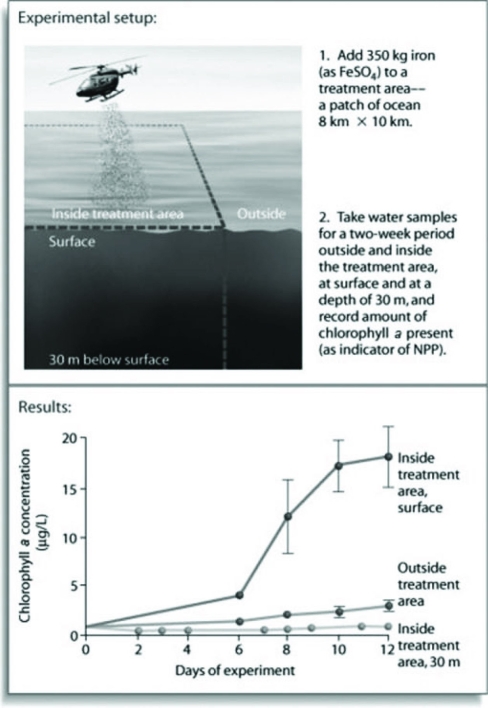 After looking at the evidence from the experiment in the figure, which of the following is the most accurate conclusion about productivity in marine ecosystems?
Free
(Multiple Choice)
4.9/5  (76)
(76) Correct Answer: Verified
C
The flow of energy in an example arctic ecosystem goes through a simple food chain as depicted below:
Phytoplankton → zooplankton → fish → seals → polar bears
Which of the following is the most accurate conclusion when considering the energetics in this food chain?
Free
(Multiple Choice)
4.9/5 (80)
(80) Correct Answer:Verified
VerifiedD
Which of the following is a reason that inefficient transfer of energy among trophic levels results in the typically high endangerment status of many top-level predators?
Free
(Multiple Choice)
4.9/5 (83)
(83) Correct Answer:Verified
VerifiedA
If a pristine river valley was converted to a gravel mine, altering the stream channel and also impacting the associated aquatic and terrestrial biota, which of the following would most likely be the first step to restoring the former river valley ecosystem?
(Multiple Choice)
4.9/5 (73)
(73) Which statement best describes what ultimately happens to the chemical energy that is consumed but not used to produce new biomass in the process of energy transfer between trophic levels in an ecosystem?
(Multiple Choice)
5.0/5 (69)
(69) Which of the following organisms is correctly paired with a trophic level?
(Multiple Choice)
4.8/5 (87)
(87) Which of the following components is not recycled within an ecosystem?
(Multiple Choice)
4.8/5 (89)
(89) Use the following figure to answer the question. 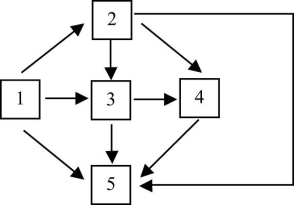 Food web for a particular terrestrial ecosystem (arrows represent energy flow and numbers represent species)
Which species in the food web most likely represents a primary producer?
Food web for a particular terrestrial ecosystem (arrows represent energy flow and numbers represent species)
Which species in the food web most likely represents a primary producer? (Multiple Choice)
4.9/5 (86)
(86) Consider the food chain of grass → grasshopper → mouse → snake → hawk. About how much of the chemical energy fixed by photosynthesis of the grass (100 percent) is available to the hawk, assuming a 10% trophic efficiency?
(Multiple Choice)
4.9/5 (60)
(60) Which of the following was a result of the Hubbard Brook watershed deforestation experiment?
(Multiple Choice)
4.8/5 (80)
(80) Which of the following terms encompasses all of the others?
(Multiple Choice)
4.9/5 (88)
(88) Which of the following best represents the goal of restoration ecology?
(Multiple Choice)
4.8/5 (72)
(72) Why is it that satellites, using wavelength reflectance technology, detect variable levels of productivity across latitudes in the Earth's oceans, rather than an increase approaching the equator?
(Multiple Choice)
4.8/5 (66)
(66) The amount of energy from light (or chemicals, in chemoautotrophic systems) converted to the chemical energy of organic molecules per unit time is defined as ________.
(Multiple Choice)
4.7/5 (81)
(81) The introduction of a predator population of arctic foxes to a small island caused the grassland community of the island to slowly convert to tundra due to changes in nutrient cycling. Which of the following best explains this change in the ecosystem?
(Multiple Choice)
4.8/5 (62)
(62) Which of these ecosystems has the lowest net primary production per square meter?
(Multiple Choice)
5.0/5 (86)
(86) Use the figure to answer the question: 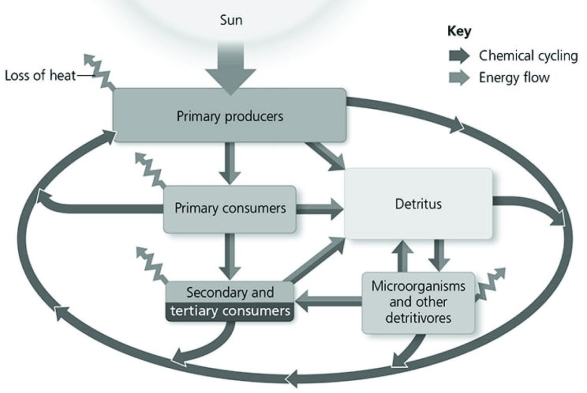 Which of the following best explains why no arrows lead directly from "Detritus" to secondary consumers?
 (Multiple Choice)
4.8/5 (82)
(82) Which of the following best represents the actions of photoautotrophs?
(Multiple Choice)
5.0/5 (79)
(79) The discipline that applies ecological principles to returning degraded ecosystems to a more natural state is known as ________.
(Multiple Choice)
5.0/5 (88)
(88) Use the following figure to answer the question. 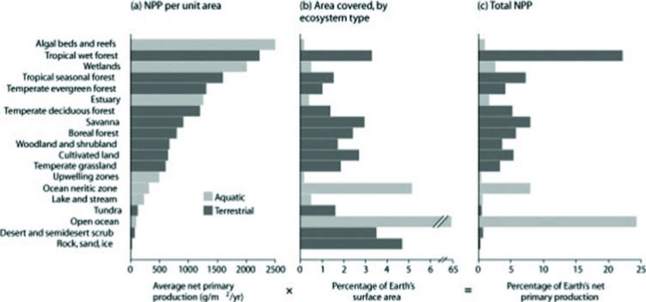 Which terrestrial habitat type in the figure makes available the most net biomass tissue per unit area available for consumers?
 (Multiple Choice)
4.8/5 (96)
(96) 
Filters
- Essay(0)
- Multiple Choice(0)
- Short Answer(0)
- True False(0)
- Matching(0)