



 Chat with AI
Exam 10: Cell Respiration

Exam 1: Biology and Its Themes46 Questions
Exam 2: Atoms and Molecules61 Questions
Exam 3: The Chemistry of Water55 Questions
Exam 4: Carbon: the Basis of Molecular Diversity52 Questions
Exam 5: Biological Macromolecules and Lipids71 Questions
Exam 6: Energy and Life65 Questions
Exam 7: Cell Structure and Function66 Questions
Exam 8: Cell Membranes67 Questions
Exam 9: Cellular Signaling62 Questions
Exam 10: Cell Respiration68 Questions
Exam 11: Photosynthetic Processes64 Questions
Exam 12: Mitosis63 Questions
Exam 13: Sexual Life Cycles and Meiosis64 Questions
Exam 14: Mendelian Genetics65 Questions
Exam 15: Linkage and Chromosomes54 Questions
Exam 16: Nucleic Acids and Inheritance65 Questions
Exam 17: Expression of Genes70 Questions
Exam 18: Control of Gene Expression66 Questions
Exam 19: Dna Technology56 Questions
Exam 20: The Evolution of Genomes47 Questions
Exam 21: How Evolution Works60 Questions
Exam 22: Phylogenetic Reconstruction66 Questions
Exam 23: Microevolution65 Questions
Exam 24: Species and Speciation65 Questions
Exam 25: Macroevolution58 Questions
Exam 26: Introduction to Viruses54 Questions
Exam 27: Prokaryotes61 Questions
Exam 28: The Origin and Evolution of Eukaryotes66 Questions
Exam 29: Nonvascular and Seedless Vascular Plants72 Questions
Exam 30: Seed Plants64 Questions
Exam 31: Introduction to Fungi56 Questions
Exam 32: An Introduction to Animal Diversity58 Questions
Exam 33: Invertebrates58 Questions
Exam 34: Vertebrates66 Questions
Exam 35: Plant Structure and Growth68 Questions
Exam 36: Transport in Vascular Plants73 Questions
Exam 37: Plant Nutrition51 Questions
Exam 38: Reproduction of Flowering Plants59 Questions
Exam 39: Plant Signals and Behavior60 Questions
Exam 40: The Animal Body58 Questions
Exam 41: Chemical Signals in Animals62 Questions
Exam 42: Animal Digestive Systems58 Questions
Exam 43: Animal Transport Systems58 Questions
Exam 44: Animal Excretory Systems49 Questions
Exam 45: Animal Reproductive Systems64 Questions
Exam 46: Development in Animals68 Questions
Exam 47: Animal Defenses Against Infection65 Questions
Exam 48: Electrical Signals in Animals62 Questions
Exam 49: Neural Regulation in Animals69 Questions
Exam 50: Sensation and Movement in Animals68 Questions
Exam 51: An Overview of Ecology71 Questions
Exam 52: Behavioral Ecology64 Questions
Exam 53: Populations and Life History Traits73 Questions
Exam 54: Biodiversity and Communities71 Questions
Exam 55: Energy Flow and Chemical Cycling in Ecosystems80 Questions
Exam 56: Conservation and Global Ecology75 Questions
Select questions type


Which of the following statements best describes a characteristic of NAD+?

Free
(Multiple Choice)
4.8/5  (76)
(76) Correct Answer: Verified
A
Which of the summary statements below best describes the results of the following reaction?
C6H12O6 + 6O2 → 6CO2 + 6H2O + Energy
Free
(Multiple Choice)
4.8/5 (72)
(72) Correct Answer:Verified
VerifiedA
What is the oxidizing agent in the following reaction?
Pyruvate + NADH + H+ → Lactate + NAD+
Free
(Multiple Choice)
4.8/5 (92)
(92) Correct Answer:Verified
VerifiedD
The enzyme phosphofructokinase (PFK) catalyzes a key step in glycolysis and is inhibited by high levels of which of the following molecules?
(Multiple Choice)
4.7/5 (70)
(70) Exposing inner mitochondrial membranes to ultrasonic vibrations will fragment the membranes and pieces will reseal to form small vesicles that contain the intermembrane space. These vesicles can transfer electrons from NADH to oxygen and synthesize ATP. Which of the following statements best describes what will happen to the vesicles when NADH is added?
(Multiple Choice)
4.8/5 (74)
(74) In chemiosmosis, the most direct source of energy used to convert ADP +  i to ATP is energy released ________.
 (Multiple Choice)
4.8/5 (76)
(76) If a cell produces on average 30 ATP molecules for each molecule of glucose that is completely oxidized to carbon dioxide and water, how many ATP molecules on average can the cell synthesize for each molecule of pyruvate oxidized to carbon dioxide and water?
(Multiple Choice)
4.8/5 (83)
(83) The immediate energy source that drives ATP synthesis by ATP synthase during oxidative phosphorylation is the ________.
(Multiple Choice)
4.8/5 (81)
(81) Substrate-level phosphorylation accounts for approximately what percent of the ATP formed by the reactions of glycolysis?
(Multiple Choice)
4.9/5 (90)
(90) If the proteins of the electron transport chain were labeled with a fluorescent tag, the fluorescence observed by microscopy will be localized to which of the following regions of the mitochondria?
(Multiple Choice)
4.9/5 (79)
(79) Which of the following statements best describes the primary role played by oxygen in cellular respiration?
(Multiple Choice)
5.0/5 (69)
(69) Which of the following statements best explains why carbohydrates and fats may be considered high-energy foods?
(Multiple Choice)
4.8/5 (76)
(76) 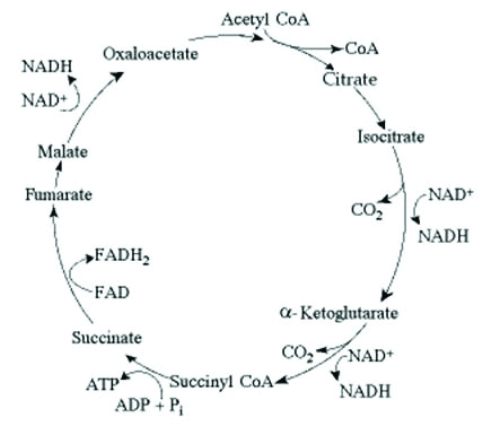 The citric acid cycle.
If pyruvate oxidation is blocked, what is the most likely effect on the levels of oxaloacetate and citrate in the citric acid cycle shown in the accompanying figure?
The citric acid cycle.
If pyruvate oxidation is blocked, what is the most likely effect on the levels of oxaloacetate and citrate in the citric acid cycle shown in the accompanying figure? (Multiple Choice)
4.7/5 (84)
(84) Which of the following types of metabolic poison would most directly interfere with glycolysis?
(Multiple Choice)
4.8/5 (86)
(86) Which of the following is one of the molecules formed by the removal of a carboxyl group (as CO2) from a molecule of pyruvate?
(Multiple Choice)
4.9/5 (87)
(87) New biosensors, applied like a temporary tattoo to the skin, can alert endurance athletes that they are about to "hit the wall" and will find it difficult to continue exercising. These biosensors monitor lactate present in sweat during strenuous exercise. Which of the statements below best explains the use of lactate as an indicator of exercise capacity?
(Multiple Choice)
4.8/5 (79)
(79) Which of the following sequences describes the path by which electrons move from high-energy to lower-energy molecules in aerobic respiration?
(Multiple Choice)
4.7/5 (83)
(83) Which of the following reactions produces the majority of the CO2 released by the complete oxidation of glucose?
(Multiple Choice)
4.7/5 (70)
(70) The enzyme phosphofructokinase (PFK) catalyzes a key step in glycolysis. About 10% of Springer spaniels suffer from canine PFK deficiency. Dogs affected with this disorder most likely display which of the following symptoms?
(Multiple Choice)
4.7/5 (70)
(70) 
Filters
- Essay(0)
- Multiple Choice(0)
- Short Answer(0)
- True False(0)
- Matching(0)