



 Chat with AI
Exam 45: Animal Reproductive Systems

Exam 1: Biology and Its Themes46 Questions
Exam 2: Atoms and Molecules61 Questions
Exam 3: The Chemistry of Water55 Questions
Exam 4: Carbon: the Basis of Molecular Diversity52 Questions
Exam 5: Biological Macromolecules and Lipids71 Questions
Exam 6: Energy and Life65 Questions
Exam 7: Cell Structure and Function66 Questions
Exam 8: Cell Membranes67 Questions
Exam 9: Cellular Signaling62 Questions
Exam 10: Cell Respiration68 Questions
Exam 11: Photosynthetic Processes64 Questions
Exam 12: Mitosis63 Questions
Exam 13: Sexual Life Cycles and Meiosis64 Questions
Exam 14: Mendelian Genetics65 Questions
Exam 15: Linkage and Chromosomes54 Questions
Exam 16: Nucleic Acids and Inheritance65 Questions
Exam 17: Expression of Genes70 Questions
Exam 18: Control of Gene Expression66 Questions
Exam 19: Dna Technology56 Questions
Exam 20: The Evolution of Genomes47 Questions
Exam 21: How Evolution Works60 Questions
Exam 22: Phylogenetic Reconstruction66 Questions
Exam 23: Microevolution65 Questions
Exam 24: Species and Speciation65 Questions
Exam 25: Macroevolution58 Questions
Exam 26: Introduction to Viruses54 Questions
Exam 27: Prokaryotes61 Questions
Exam 28: The Origin and Evolution of Eukaryotes66 Questions
Exam 29: Nonvascular and Seedless Vascular Plants72 Questions
Exam 30: Seed Plants64 Questions
Exam 31: Introduction to Fungi56 Questions
Exam 32: An Introduction to Animal Diversity58 Questions
Exam 33: Invertebrates58 Questions
Exam 34: Vertebrates66 Questions
Exam 35: Plant Structure and Growth68 Questions
Exam 36: Transport in Vascular Plants73 Questions
Exam 37: Plant Nutrition51 Questions
Exam 38: Reproduction of Flowering Plants59 Questions
Exam 39: Plant Signals and Behavior60 Questions
Exam 40: The Animal Body58 Questions
Exam 41: Chemical Signals in Animals62 Questions
Exam 42: Animal Digestive Systems58 Questions
Exam 43: Animal Transport Systems58 Questions
Exam 44: Animal Excretory Systems49 Questions
Exam 45: Animal Reproductive Systems64 Questions
Exam 46: Development in Animals68 Questions
Exam 47: Animal Defenses Against Infection65 Questions
Exam 48: Electrical Signals in Animals62 Questions
Exam 49: Neural Regulation in Animals69 Questions
Exam 50: Sensation and Movement in Animals68 Questions
Exam 51: An Overview of Ecology71 Questions
Exam 52: Behavioral Ecology64 Questions
Exam 53: Populations and Life History Traits73 Questions
Exam 54: Biodiversity and Communities71 Questions
Exam 55: Energy Flow and Chemical Cycling in Ecosystems80 Questions
Exam 56: Conservation and Global Ecology75 Questions
Select questions type


Which option correctly lists, in chronological order, the three phases of the human ovarian cycle?

Free
(Multiple Choice)
4.8/5  (78)
(78) Correct Answer: Verified
C
Refer to the following figure, which diagrams the reproductive anatomy of the human female, to answer the question. 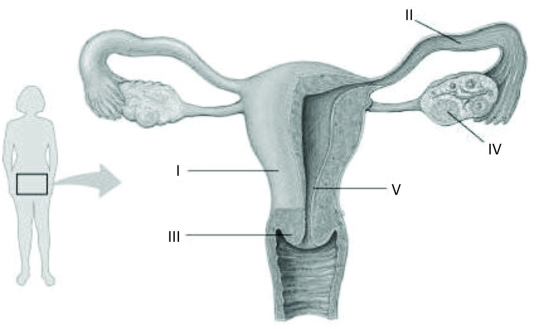 In the figure, which letter identifies a structure that is ciliated?
Free
(Multiple Choice)
4.9/5 (84)
(84) Correct Answer:Verified
VerifiedB
Water fleas of the genus Daphnia can switch from a pattern of asexual reproduction to sexual reproduction. This change would be more likely to occur under which of the following conditions?
Free
(Multiple Choice)
4.8/5 (92)
(92) Correct Answer:Verified
VerifiedB
Which would most likely happen if the temperature of the human scrotum was increased by 2°C for several weeks? The male would experience ________.
(Multiple Choice)
4.9/5 (74)
(74) Refer to the following figure, which diagrams the reproductive anatomy of the human male, to answer the question. 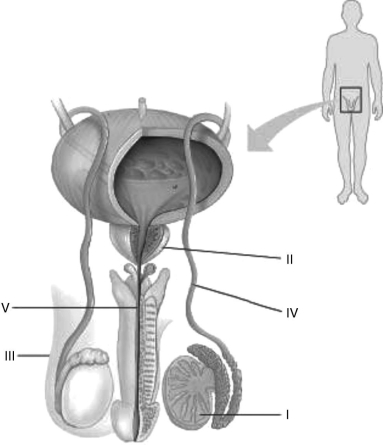 In the figure, which letter identifies an accessory gland that releases its product directly into the urethra?
 (Multiple Choice)
4.8/5 (65)
(65) Which of the following is the correct order of structures through which sperm pass during an ejaculation?
(Multiple Choice)
5.0/5 (74)
(74) Labor contractions can be increased by the medical use of a synthetic drug that mimics the action of ________.
(Multiple Choice)
4.9/5 (81)
(81) Which of the following best describes the cloaca in nonmammalian adult vertebrates?
(Multiple Choice)
4.8/5 (85)
(85) Which of the following correctly pairs the structure with its product?
(Multiple Choice)
4.9/5 (81)
(81) After a hurricane damages a coral reef, some sea anemones are broken apart. Several pieces from one anemone regenerate lost body parts and grow and develop into three complete anemones. Which type of reproduction is represented in this example?
(Multiple Choice)
4.9/5 (87)
(87) Under which of the following conditions will asexual reproduction be more likely to result in greater reproductive success than sexual reproduction?
(Multiple Choice)
4.9/5 (83)
(83) An inactivating mutation in the progesterone receptor gene would likely result in ________.
(Multiple Choice)
4.9/5 (78)
(78) Which of the following can occur after intercourse between a female who has undergone tubal ligation and a male with a normally functioning reproductive tract?
(Multiple Choice)
4.8/5 (69)
(69) Refer to the following figure, which diagrams the reproductive anatomy of the human female, to answer the question. 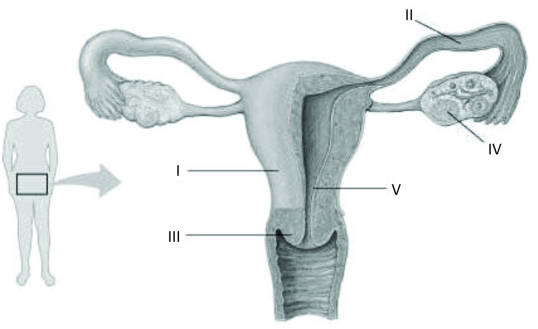 In the figure, which letter identifies the corpus luteum?
 (Multiple Choice)
4.9/5 (92)
(92) The green anaconda is a nonvenomous snake that lives in tropical rain forests of South America. While the green anaconda can swim to hunt for food, it primarily lives on dry land. Female green anaconda usually gives birth to 20 to 40 live young in a single litter. Which type of fertilization is likely used by green anacondas and why?
(Multiple Choice)
4.9/5 (77)
(77) Which hormone is released from Sertoli cells and inhibits the release of follicle stimulating hormone?
(Multiple Choice)
4.8/5 (91)
(91) Which option correctly lists, in chronological order, the three phases of the human uterine cycle?
(Multiple Choice)
4.8/5 (72)
(72) 
Filters
- Essay(0)
- Multiple Choice(0)
- Short Answer(0)
- True False(0)
- Matching(0)