



 Chat with AI
Exam 24: Species and Speciation

Exam 1: Biology and Its Themes46 Questions
Exam 2: Atoms and Molecules61 Questions
Exam 3: The Chemistry of Water55 Questions
Exam 4: Carbon: the Basis of Molecular Diversity52 Questions
Exam 5: Biological Macromolecules and Lipids71 Questions
Exam 6: Energy and Life65 Questions
Exam 7: Cell Structure and Function66 Questions
Exam 8: Cell Membranes67 Questions
Exam 9: Cellular Signaling62 Questions
Exam 10: Cell Respiration68 Questions
Exam 11: Photosynthetic Processes64 Questions
Exam 12: Mitosis63 Questions
Exam 13: Sexual Life Cycles and Meiosis64 Questions
Exam 14: Mendelian Genetics65 Questions
Exam 15: Linkage and Chromosomes54 Questions
Exam 16: Nucleic Acids and Inheritance65 Questions
Exam 17: Expression of Genes70 Questions
Exam 18: Control of Gene Expression66 Questions
Exam 19: Dna Technology56 Questions
Exam 20: The Evolution of Genomes47 Questions
Exam 21: How Evolution Works60 Questions
Exam 22: Phylogenetic Reconstruction66 Questions
Exam 23: Microevolution65 Questions
Exam 24: Species and Speciation65 Questions
Exam 25: Macroevolution58 Questions
Exam 26: Introduction to Viruses54 Questions
Exam 27: Prokaryotes61 Questions
Exam 28: The Origin and Evolution of Eukaryotes66 Questions
Exam 29: Nonvascular and Seedless Vascular Plants72 Questions
Exam 30: Seed Plants64 Questions
Exam 31: Introduction to Fungi56 Questions
Exam 32: An Introduction to Animal Diversity58 Questions
Exam 33: Invertebrates58 Questions
Exam 34: Vertebrates66 Questions
Exam 35: Plant Structure and Growth68 Questions
Exam 36: Transport in Vascular Plants73 Questions
Exam 37: Plant Nutrition51 Questions
Exam 38: Reproduction of Flowering Plants59 Questions
Exam 39: Plant Signals and Behavior60 Questions
Exam 40: The Animal Body58 Questions
Exam 41: Chemical Signals in Animals62 Questions
Exam 42: Animal Digestive Systems58 Questions
Exam 43: Animal Transport Systems58 Questions
Exam 44: Animal Excretory Systems49 Questions
Exam 45: Animal Reproductive Systems64 Questions
Exam 46: Development in Animals68 Questions
Exam 47: Animal Defenses Against Infection65 Questions
Exam 48: Electrical Signals in Animals62 Questions
Exam 49: Neural Regulation in Animals69 Questions
Exam 50: Sensation and Movement in Animals68 Questions
Exam 51: An Overview of Ecology71 Questions
Exam 52: Behavioral Ecology64 Questions
Exam 53: Populations and Life History Traits73 Questions
Exam 54: Biodiversity and Communities71 Questions
Exam 55: Energy Flow and Chemical Cycling in Ecosystems80 Questions
Exam 56: Conservation and Global Ecology75 Questions
Select questions type


Which of the following statements about stable hybrid zones is most accurate?

Free
(Multiple Choice)
4.9/5  (73)
(73) Correct Answer: Verified
D
Three populations of crickets look very similar, but the males have different courtship songs. If the cricket populations were to contact each other in the wild, the different courtship songs would most likely function as which type of reproductive isolating mechanism?
Free
(Multiple Choice)
4.8/5 (83)
(83) Correct Answer:Verified
VerifiedC
A narrow hybrid zone separates the toad species Bombina bombina and B. variegata. A genetic study identified a locus where one allele (R) occurred in all B. variegata, occurred in a few B. bombina at the edge of the hybrid zone, and was replaced totally by another allele (r) in B. bombina that lived far from the hybrid zone. Which of the following statements is most likely to be accurate with regard to the frequency of V1 in the hybrid zone?
Free
(Multiple Choice)
4.8/5 (77)
(77) Correct Answer:Verified
VerifiedC
Beetle pollinators of a particular plant are attracted to its flowers' bright orange color. The beetles not only pollinate the flowers, but they mate while inside the flowers. A mutant version of the plant with red flowers becomes more common with the passage of time. A particular variant of the beetle prefers the red flowers to the orange flowers. Over time, these two beetle variants diverge from each other to such an extent that interbreeding is no longer possible. Which of the following possible causes of speciation best describes the beetle example and what factor has driven it?
(Multiple Choice)
4.9/5 (76)
(76) Which of the following possible isolating mechanisms prevents individuals from wasting time and energy hybridizing with an individual of another species?
(Multiple Choice)
4.9/5 (86)
(86) A team of scientists plans to study divergence of populations and needs to maximize the rate of divergence to see results within the period of their grant funding. They will form a new population by taking some individuals from a source population and isolating them so the source and new populations cannot interbreed. Which of the following strategies would maximize the likelihood of seeing divergence between the source and new populations in this study?
(Multiple Choice)
4.8/5 (95)
(95) New species can sometimes arise via hybridization and subsequent polyploidy. Which of the following describes the likely geographic and reproductive relationships between the hybridizing species?
(Multiple Choice)
4.8/5 (69)
(69) Which of the following provides an example of a mechanical isolation as a prezygotic barrier?
(Multiple Choice)
4.9/5 (88)
(88) In the western United States, pronghorn antelopes and domestic cattle often associate with one another in the same open rangeland. In a hypothetical situation, a certain species of flea originally fed only on pronghorn antelopes. Some of these fleas developed a strong preference for cattle blood and mated only with other fleas that also preferred cattle blood. The host mammal can be considered as the fleas' habitat. Which of the following processes most likely occurred if the situation persisted and a new species evolved?
(Multiple Choice)
4.8/5 (71)
(71) Recently, a museum scientist discovered a case of preserved grasshoppers that do not resemble any named species. No information about when and where the specimens were collected is available. Which of the following species concepts would be most appropriate to use in identifying and naming the new specimens?
(Multiple Choice)
4.8/5 (89)
(89) 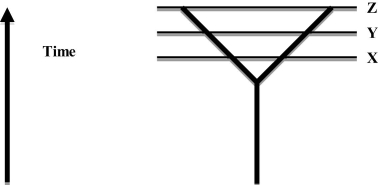 The diagram represents the splitting of one population into two separate lineages that become more different over time (the distance between the two lines represents the amount of difference between the two lineages). Which of the following statements about the two lineages is most accurate?
 (Multiple Choice)
5.0/5 (81)
(81) Which of the following possible causes of speciation is most likely to cause rapid speciation?
(Multiple Choice)
4.8/5 (86)
(86) Which of the following statements best describes macroevolution?
(Multiple Choice)
4.8/5 (79)
(79) Which of the following characteristics are demonstrated by the production of sterile mules after female horses mate with male donkeys?
(Multiple Choice)
4.8/5 (77)
(77) Which of the following processes would contribute to divergence between lineages once divergence has already begun?
(Multiple Choice)
4.7/5 (83)
(83) One possible outcome of hybridization is fusion of two species. Which of the following conditions is most likely to increase the probability of fusion of the two species as a result of hybridization?
(Multiple Choice)
4.8/5 (78)
(78) Two species of fruit flies occur on the volcanic, equatorial West African island of Sao Tomé that rose from the Atlantic Ocean 14 million years ago. Drosophila santomea occurs only on at higher elevations, while D. yakuba inhabits the lowlands. D. yakuba also occurs on the African mainland. On Sao Tomé a hybrid zone between the two species exists at middle elevations. Hybrid males, but not females, are sterile, and hybrids are greatly outnumbered by D. santomea. Studies of the two species' nuclear genomes reveal that D. yakuba on the island is more closely related to mainland D. yakuba than to D. santomea (2n = 4 in both species). Using this information, which of the following phenomena is the best initial hypothesis for how D. santomea descended from D. yakuba?
(Multiple Choice)
4.9/5 (69)
(69) In the oceans on either side of the Isthmus of Panama are 30 species of snapping shrimp, 15 species on the Pacific side and 15 different species on the Atlantic side. Species live at different water depths. Morphological and genetic data show that Atlantic and Pacific species that live at similar depths are sister species. Geological evidence indicates that the Isthmus of Panama started rising about 10 million years ago and the oceans were completely separated by the isthmus about 3 million years ago. If the isthmus indeed formed gradually, which of the following patterns of genetic differences is most likely in these species pairs?
(Multiple Choice)
5.0/5 (77)
(77) In the oceans on either side of the Isthmus of Panama are 30 species of snapping shrimp, 15 species on the Pacific side and 15 different species on the Atlantic side. Species live at different water depths. Morphological and genetic data show that Atlantic and Pacific species that live at similar depths are sister species. Geological evidence indicates that the Isthmus of Panama started rising about 10 million years ago and the oceans were completely separated by the isthmus about 3 million years ago. If the geological evidence has been misinterpreted and the isthmus had formed very rapidly (in less than 1,000 years), which of the following predictions is most likely?
(Multiple Choice)
4.9/5 (84)
(84) Males of different species of the fruit fly Drosophila that live in the same parts of the Hawaiian Islands have different elaborate courtship rituals. These rituals involve fighting other males and making stylized movements that attract females. What type of reproductive isolation does this represent?
(Multiple Choice)
4.9/5 (69)
(69) 
Filters
- Essay(0)
- Multiple Choice(0)
- Short Answer(0)
- True False(0)
- Matching(0)