



 Chat with AI
Exam 24: Species and Speciation

Exam 1: Biology and Its Themes46 Questions
Exam 2: Atoms and Molecules61 Questions
Exam 3: The Chemistry of Water55 Questions
Exam 4: Carbon: the Basis of Molecular Diversity52 Questions
Exam 5: Biological Macromolecules and Lipids71 Questions
Exam 6: Energy and Life65 Questions
Exam 7: Cell Structure and Function66 Questions
Exam 8: Cell Membranes67 Questions
Exam 9: Cellular Signaling62 Questions
Exam 10: Cell Respiration68 Questions
Exam 11: Photosynthetic Processes64 Questions
Exam 12: Mitosis63 Questions
Exam 13: Sexual Life Cycles and Meiosis64 Questions
Exam 14: Mendelian Genetics65 Questions
Exam 15: Linkage and Chromosomes54 Questions
Exam 16: Nucleic Acids and Inheritance65 Questions
Exam 17: Expression of Genes70 Questions
Exam 18: Control of Gene Expression66 Questions
Exam 19: Dna Technology56 Questions
Exam 20: The Evolution of Genomes47 Questions
Exam 21: How Evolution Works60 Questions
Exam 22: Phylogenetic Reconstruction66 Questions
Exam 23: Microevolution65 Questions
Exam 24: Species and Speciation65 Questions
Exam 25: Macroevolution58 Questions
Exam 26: Introduction to Viruses54 Questions
Exam 27: Prokaryotes61 Questions
Exam 28: The Origin and Evolution of Eukaryotes66 Questions
Exam 29: Nonvascular and Seedless Vascular Plants72 Questions
Exam 30: Seed Plants64 Questions
Exam 31: Introduction to Fungi56 Questions
Exam 32: An Introduction to Animal Diversity58 Questions
Exam 33: Invertebrates58 Questions
Exam 34: Vertebrates66 Questions
Exam 35: Plant Structure and Growth68 Questions
Exam 36: Transport in Vascular Plants73 Questions
Exam 37: Plant Nutrition51 Questions
Exam 38: Reproduction of Flowering Plants59 Questions
Exam 39: Plant Signals and Behavior60 Questions
Exam 40: The Animal Body58 Questions
Exam 41: Chemical Signals in Animals62 Questions
Exam 42: Animal Digestive Systems58 Questions
Exam 43: Animal Transport Systems58 Questions
Exam 44: Animal Excretory Systems49 Questions
Exam 45: Animal Reproductive Systems64 Questions
Exam 46: Development in Animals68 Questions
Exam 47: Animal Defenses Against Infection65 Questions
Exam 48: Electrical Signals in Animals62 Questions
Exam 49: Neural Regulation in Animals69 Questions
Exam 50: Sensation and Movement in Animals68 Questions
Exam 51: An Overview of Ecology71 Questions
Exam 52: Behavioral Ecology64 Questions
Exam 53: Populations and Life History Traits73 Questions
Exam 54: Biodiversity and Communities71 Questions
Exam 55: Energy Flow and Chemical Cycling in Ecosystems80 Questions
Exam 56: Conservation and Global Ecology75 Questions
Select questions type


The number of cichlid species in Lake Victoria is declining, in part because of predation by Nile perch. Which of the following factors is also likely to contribute to the decline in the number of cichlid species in Lake Victoria?
(Multiple Choice)
4.9/5  (69)
(69) Lions and tigers sometimes breed in zoos, but hybrids have not been seen in nature, nor can the hybrids in zoos reproduce well. Which of the following statements is the best conclusion that can be derived from this information?
(Multiple Choice)
4.8/5 (61)
(61) Which of the following methods is most likely to lead to the production of two species from one ancestral species?
(Multiple Choice)
4.8/5 (78)
(78) Which of the following statements best describes a limitation of the biological species concept?
(Multiple Choice)
4.9/5 (96)
(96) Two species of tree frogs that live sympatrically in the eastern United States differ in ploidy: Hyla chrysoscelis is diploid, and Hyla versicolor is tetraploid. The frogs are identical in appearance, but their mating calls, which females use to find mates, differ. Which difference most likely evolved first?
(Multiple Choice)
4.8/5 (74)
(74) In the oceans on either side of the Isthmus of Panama are 30 species of snapping shrimp, 15 species on the Pacific side and 15 different species on the Atlantic side. Species live at different water depths. Morphological and genetic data show that Atlantic and Pacific species that live at similar depths are sister species. Geological evidence indicates that the Isthmus of Panama started rising about 10 million years ago and the oceans were completely separated by the isthmus about 3 million years ago. Which of the following statements would best explain why the shallow-water sister species are more similar to each other than are the deeper-water species?
(Multiple Choice)
4.8/5 (73)
(73) House finches (birds) occurred only in western North America until 1939, when a few individuals were released in New York City. These individuals established a breeding population and gradually expanded their range. The western population also expanded its range somewhat eastward, and the two populations have recently come in contact. Which of the following terms best describes the process that had occurred if the two forms did not interbreed when their expanding ranges met?
(Multiple Choice)
4.9/5 (61)
(61) Which of the following organisms would be LEAST able to cross a geographic barrier of water that could lead to allopatric speciation?
(Multiple Choice)
4.8/5 (79)
(79) Which of the following statements best describes unity within a species?
(Multiple Choice)
4.9/5 (80)
(80) Which of the following statements correctly describes a change that must occur for a new species to arise?
(Multiple Choice)
4.8/5 (87)
(87) The following question is based on information from Kondo Y. and Kashiwagi A., Experimentally induced autotetraploidy and allotetraploidy in two Japanese pond frogs, Journal of Herpetology 38(3):381−92 (2004).
Two researchers experimentally formed tetraploid frogs by fertilizing diploid eggs from Rana porosa brevipoda with diploid sperm from Rana nigromaculata. When they allowed the tetraploid frogs to mate with each other, most of the offspring that survived to maturity were tetraploid, with chromosome sets of both diploid parent species. Based on these results, if this type of tetraploid formed in the wild, what would be the most likely result?
(Multiple Choice)
4.9/5 (89)
(89) The diagram represents the splitting of one population into two separate lineages that become more different over time (the distance between the two lines represents the amount of difference between the two lineages). Which of the following scenarios is most likely result in the patterns shown in the diagram? 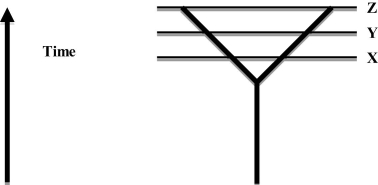
(Multiple Choice)
4.8/5 (78)
(78) According to the concept of punctuated equilibrium, the "sudden" appearance of a new species in the fossil record means that ________.
(Multiple Choice)
4.8/5 (88)
(88) A team of scientists is trying to understand the evolutionary history of three species of grasses. They hypothesize that Species T is a descendent of a hybrid between Species R and Species S. Which of the following experimental approaches would best help elucidate the evolutionary history of these three species?
(Multiple Choice)
5.0/5 (86)
(86) A small number of birds arrive on an island from a neighboring larger island. This small population begins to adapt to the new food plants available on the island, and their beaks begin to change. About twice a year, one or two more birds from the neighboring island arrive. Which of the following effects is most likely to result from the immigration?
(Multiple Choice)
4.8/5 (84)
(84) Two juniper trees (Juniperus scopulorum and J. monosperma) have overlapping geographic ranges. Pollen grains (which contain sperm cells) from one species are unable to germinate and make pollen tubes on female ovules (which contain egg cells) of the other species. Which of the following isolating mechanisms keeps the two species separate?
(Multiple Choice)
4.7/5 (78)
(78) Lions and tigers sometimes breed in zoos, but hybrids have not been seen in nature and even in zoos they do not reproduce well. Which of the following statements is the best conclusion that can be derived from this information?
(Multiple Choice)
4.8/5 (78)
(78) Many songbirds breed in North America in the spring and summer, and then migrate to Central and South America in the fall. They spend the winter in these warmer areas where they feed and prepare for the spring migration north and another breeding season. Two hypothetical species of sparrow, species X and species Y, overwinter together in mixed flocks in Costa Rica. In spring, species X goes to the east coast of North America, and species Y goes to the west coast. Which of the following factors most likely keeps these species separate?
(Multiple Choice)
4.9/5 (71)
(71) Which of the following statements about the punctuated and gradual models of speciation is most accurate?
(Multiple Choice)
4.9/5 (72)
(72) Which of the following statements best describes the difference between geographic isolation and habitat differentiation (isolation)?
(Multiple Choice)
5.0/5 (92)
(92) 
Filters
- Essay(0)
- Multiple Choice(0)
- Short Answer(0)
- True False(0)
- Matching(0)