



 Chat with AI
Exam 52: Behavioral Ecology

Exam 1: Biology and Its Themes46 Questions
Exam 2: Atoms and Molecules61 Questions
Exam 3: The Chemistry of Water55 Questions
Exam 4: Carbon: the Basis of Molecular Diversity52 Questions
Exam 5: Biological Macromolecules and Lipids71 Questions
Exam 6: Energy and Life65 Questions
Exam 7: Cell Structure and Function66 Questions
Exam 8: Cell Membranes67 Questions
Exam 9: Cellular Signaling62 Questions
Exam 10: Cell Respiration68 Questions
Exam 11: Photosynthetic Processes64 Questions
Exam 12: Mitosis63 Questions
Exam 13: Sexual Life Cycles and Meiosis64 Questions
Exam 14: Mendelian Genetics65 Questions
Exam 15: Linkage and Chromosomes54 Questions
Exam 16: Nucleic Acids and Inheritance65 Questions
Exam 17: Expression of Genes70 Questions
Exam 18: Control of Gene Expression66 Questions
Exam 19: Dna Technology56 Questions
Exam 20: The Evolution of Genomes47 Questions
Exam 21: How Evolution Works60 Questions
Exam 22: Phylogenetic Reconstruction66 Questions
Exam 23: Microevolution65 Questions
Exam 24: Species and Speciation65 Questions
Exam 25: Macroevolution58 Questions
Exam 26: Introduction to Viruses54 Questions
Exam 27: Prokaryotes61 Questions
Exam 28: The Origin and Evolution of Eukaryotes66 Questions
Exam 29: Nonvascular and Seedless Vascular Plants72 Questions
Exam 30: Seed Plants64 Questions
Exam 31: Introduction to Fungi56 Questions
Exam 32: An Introduction to Animal Diversity58 Questions
Exam 33: Invertebrates58 Questions
Exam 34: Vertebrates66 Questions
Exam 35: Plant Structure and Growth68 Questions
Exam 36: Transport in Vascular Plants73 Questions
Exam 37: Plant Nutrition51 Questions
Exam 38: Reproduction of Flowering Plants59 Questions
Exam 39: Plant Signals and Behavior60 Questions
Exam 40: The Animal Body58 Questions
Exam 41: Chemical Signals in Animals62 Questions
Exam 42: Animal Digestive Systems58 Questions
Exam 43: Animal Transport Systems58 Questions
Exam 44: Animal Excretory Systems49 Questions
Exam 45: Animal Reproductive Systems64 Questions
Exam 46: Development in Animals68 Questions
Exam 47: Animal Defenses Against Infection65 Questions
Exam 48: Electrical Signals in Animals62 Questions
Exam 49: Neural Regulation in Animals69 Questions
Exam 50: Sensation and Movement in Animals68 Questions
Exam 51: An Overview of Ecology71 Questions
Exam 52: Behavioral Ecology64 Questions
Exam 53: Populations and Life History Traits73 Questions
Exam 54: Biodiversity and Communities71 Questions
Exam 55: Energy Flow and Chemical Cycling in Ecosystems80 Questions
Exam 56: Conservation and Global Ecology75 Questions
Select questions type


Use the following figures to answer the question. 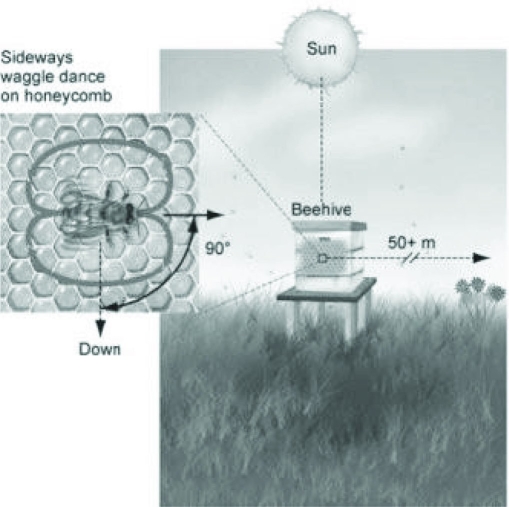 From the figures, what can we determine about the location of the food sources?
Free
(Multiple Choice)
4.7/5  (81)
(81) Correct Answer: Verified
D
Use the following figures to answer the question. 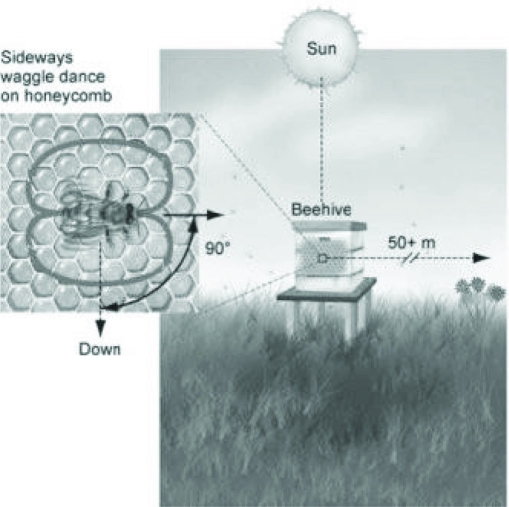 What could you conclude if the honeybee in the figure switched from the "waggle dance" to the "round dance"?
Free
(Multiple Choice)
4.9/5 (84)
(84) Correct Answer:Verified
VerifiedD
A male stickleback fish will attack other male sticklebacks that invade its nesting territory. It will only attack male fish, which display the red belly characteristic of the species. Which of the following is an ultimate causation of this behavior?
Free
(Multiple Choice)
4.9/5 (82)
(82) Correct Answer:Verified
VerifiedC
Which of the following would best test the hypothesis that moths stop flying in response to high-intensity bat sounds?
(Multiple Choice)
4.9/5 (87)
(87) A stickleback fish will attack a fish model as long as the model has red coloring. Which of the following is illustrated by this observation?
(Multiple Choice)
4.8/5 (84)
(84) Which of the following best explains why coastal and inland garter snakes react differently to banana slug prey?
(Multiple Choice)
4.9/5 (74)
(74) You have captured a number of rats from a wild population and quickly surmise with tests that they are very good at avoiding food with poisons. Which of the following best explains this observation?
(Multiple Choice)
4.8/5 (83)
(83) Which one of the following statements about mating systems and parental care is true?
(Multiple Choice)
4.9/5 (85)
(85) Which of the following led to the evolution of sexual dimorphism?
(Multiple Choice)
5.0/5 (88)
(88) What correlates with the color of the throats of males in a population of side-blotched lizards?
(Multiple Choice)
4.9/5 (82)
(82) An owner of a new restaurant wants to locate near a college campus. Her new Veggie Burger restaurant can locate within 1 mile of campus or more cheaply 2 miles from the campus. But at 2 miles from campus, the restaurant may draw fewer customers. Which of the following behaviors relates best to aspects of the restaurant owner's decision, weighing the cost of the location, the distance from customers, and the profitability of the business?
(Multiple Choice)
4.9/5 (73)
(73) What is generally correct about animals that help other animals of the same species?
(Multiple Choice)
4.9/5 (85)
(85) Upon returning to its hive, how does a European honeybee communicate to other worker bees the presence of nearby food sources?
(Multiple Choice)
4.9/5 (83)
(83) Many behaviors result from interactions with the environment. Which of the following ultimately modifies all behaviors?
(Multiple Choice)
4.9/5 (91)
(91) Upon observing a golden eagle flying overhead, a sentry prairie dog gives a warning call to other foraging members of the prairie dog community. Which of the following behaviors are represented by this example?
(Multiple Choice)
4.8/5 (87)
(87) How do altruistic behaviors arise through natural selection?
(Multiple Choice)
4.9/5 (77)
(77) Which of the following is a behavior that minimizes the cost of looking for food and maximizes the benefits of finding food?
(Multiple Choice)
4.8/5 (76)
(76) Female spotted sandpipers aggressively court males and, after mating, leave the clutch of eggs for the male to incubate. This sequence may be repeated several times with different males until no available males remain, forcing the female to incubate her last clutch. Which of the following terms best describes this behavior?
(Multiple Choice)
4.8/5 (82)
(82) 
Filters
- Essay(0)
- Multiple Choice(0)
- Short Answer(0)
- True False(0)
- Matching(0)