



 Chat with AI
Exam 34: Vertebrates

Exam 1: Biology and Its Themes46 Questions
Exam 2: Atoms and Molecules61 Questions
Exam 3: The Chemistry of Water55 Questions
Exam 4: Carbon: the Basis of Molecular Diversity52 Questions
Exam 5: Biological Macromolecules and Lipids71 Questions
Exam 6: Energy and Life65 Questions
Exam 7: Cell Structure and Function66 Questions
Exam 8: Cell Membranes67 Questions
Exam 9: Cellular Signaling62 Questions
Exam 10: Cell Respiration68 Questions
Exam 11: Photosynthetic Processes64 Questions
Exam 12: Mitosis63 Questions
Exam 13: Sexual Life Cycles and Meiosis64 Questions
Exam 14: Mendelian Genetics65 Questions
Exam 15: Linkage and Chromosomes54 Questions
Exam 16: Nucleic Acids and Inheritance65 Questions
Exam 17: Expression of Genes70 Questions
Exam 18: Control of Gene Expression66 Questions
Exam 19: Dna Technology56 Questions
Exam 20: The Evolution of Genomes47 Questions
Exam 21: How Evolution Works60 Questions
Exam 22: Phylogenetic Reconstruction66 Questions
Exam 23: Microevolution65 Questions
Exam 24: Species and Speciation65 Questions
Exam 25: Macroevolution58 Questions
Exam 26: Introduction to Viruses54 Questions
Exam 27: Prokaryotes61 Questions
Exam 28: The Origin and Evolution of Eukaryotes66 Questions
Exam 29: Nonvascular and Seedless Vascular Plants72 Questions
Exam 30: Seed Plants64 Questions
Exam 31: Introduction to Fungi56 Questions
Exam 32: An Introduction to Animal Diversity58 Questions
Exam 33: Invertebrates58 Questions
Exam 34: Vertebrates66 Questions
Exam 35: Plant Structure and Growth68 Questions
Exam 36: Transport in Vascular Plants73 Questions
Exam 37: Plant Nutrition51 Questions
Exam 38: Reproduction of Flowering Plants59 Questions
Exam 39: Plant Signals and Behavior60 Questions
Exam 40: The Animal Body58 Questions
Exam 41: Chemical Signals in Animals62 Questions
Exam 42: Animal Digestive Systems58 Questions
Exam 43: Animal Transport Systems58 Questions
Exam 44: Animal Excretory Systems49 Questions
Exam 45: Animal Reproductive Systems64 Questions
Exam 46: Development in Animals68 Questions
Exam 47: Animal Defenses Against Infection65 Questions
Exam 48: Electrical Signals in Animals62 Questions
Exam 49: Neural Regulation in Animals69 Questions
Exam 50: Sensation and Movement in Animals68 Questions
Exam 51: An Overview of Ecology71 Questions
Exam 52: Behavioral Ecology64 Questions
Exam 53: Populations and Life History Traits73 Questions
Exam 54: Biodiversity and Communities71 Questions
Exam 55: Energy Flow and Chemical Cycling in Ecosystems80 Questions
Exam 56: Conservation and Global Ecology75 Questions
Select questions type


Mammals and birds eat more often than reptiles. Which of the following traits shared by mammals and birds best explains this habit?

Free
(Multiple Choice)
4.9/5  (83)
(83) Correct Answer: Verified
A
Which of the following organisms is considered the most recent common ancestor of living tetrapods?
Free
(Multiple Choice)
5.0/5 (77)
(77) Correct Answer:Verified
VerifiedA
Which clade does not include humans?
Free
(Multiple Choice)
4.8/5 (70)
(70) Correct Answer:Verified
VerifiedC
During chordate evolution, which of the following structures arose first?
(Multiple Choice)
5.0/5 (88)
(88) If a tunicate's pharyngeal gill slits were blocked by a foreign object, which of the following processes would the organism have trouble performing?
(Multiple Choice)
4.9/5 (77)
(77) The ancestors of amniotes laid eggs in water. It could be argued that embryos of amniotes still develop in water for which of the following reasons?
(Multiple Choice)
5.0/5 (86)
(86) Which of the following statements is correct regarding lancelets?
(Multiple Choice)
4.8/5 (85)
(85) In vertebrates, the earliest known mineralized structures were associated with body parts involved in which of the following processes?
(Multiple Choice)
4.9/5 (95)
(95) In what respect do hominins differ from all other anthropoids?
(Multiple Choice)
4.9/5 (62)
(62) Which of the following could be considered the most recent common ancestor of living tetrapods?
(Multiple Choice)
4.8/5 (73)
(73) Which of the following characteristics evolved independently in mammals and birds?
(Multiple Choice)
4.8/5 (88)
(88) The evolution of similar insulating skin coverings such as fur, hair, and feathers in mammals and birds is a result of which of the following evolutionary processes?
(Multiple Choice)
4.8/5 (75)
(75) Which of these statements accurately describes a similarity between sharks and ray-finned fishes?
(Multiple Choice)
4.9/5 (83)
(83) While hiking in a tropical rainforest, you find a large, snakelike organism that is 1-meter-long, has smooth skin, and appears to be segmented. You think it might be a snake or an amphibian. Which of the following characteristics, if observed, should help you arrive at a conclusive answer?
(Multiple Choice)
5.0/5 (71)
(71) Arrange the following taxonomic terms in order from most inclusive to least inclusive.
(Multiple Choice)
4.8/5 (88)
(88) As hominins diverged from other primates, which of the following appeared first?
(Multiple Choice)
4.9/5 (71)
(71) Use the following information to answer the question.
Brown et al. and Morwood et al. reported in 2004 that they had found skeletal remains of a previously unknown type of hominin, now dubbed Homo floresiensis, on the Indonesian island of Flores. These hominins were small (approximately 1 m tall) with small braincases (approximately 380 cm3) as compared with other hominins. The remains of H.floresiensis were found alongside handmade stone tools and the remains of dwarf elephants that also inhabited the island, suggesting that H. floresiensis was able both to make tools and to coordinate the hunting of animals much larger than itself. H. floresiensis is estimated to have lived at the site where the remains were found from 700,000 years ago to 60,000 years ago.
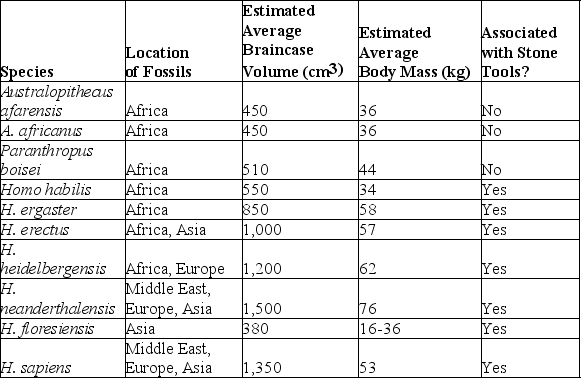 The table is a comparison of several characteristics of H. floresiensis to those of nine other hominin species (arranged roughly from oldest to most recent). What do these data suggest?
 (Multiple Choice)
4.8/5 (82)
(82) Female birds lay their eggs, thereby facilitating flight by reducing weight. Which "strategy" seems most likely for female bats to use to achieve the same goal?
(Multiple Choice)
4.8/5 (71)
(71) Which of these structures would most likely have been observed in the common ancestor of chondrichthyans and osteichthyans?
(Multiple Choice)
4.8/5 (77)
(77) Living vertebrates can be divided into two major clades. Select the appropriate pair.
(Multiple Choice)
4.8/5 (78)
(78) 
Filters
- Essay(0)
- Multiple Choice(0)
- Short Answer(0)
- True False(0)
- Matching(0)