



 Chat with AI
Exam 13: Sexual Life Cycles and Meiosis

Exam 1: Biology and Its Themes46 Questions
Exam 2: Atoms and Molecules61 Questions
Exam 3: The Chemistry of Water55 Questions
Exam 4: Carbon: the Basis of Molecular Diversity52 Questions
Exam 5: Biological Macromolecules and Lipids71 Questions
Exam 6: Energy and Life65 Questions
Exam 7: Cell Structure and Function66 Questions
Exam 8: Cell Membranes67 Questions
Exam 9: Cellular Signaling62 Questions
Exam 10: Cell Respiration68 Questions
Exam 11: Photosynthetic Processes64 Questions
Exam 12: Mitosis63 Questions
Exam 13: Sexual Life Cycles and Meiosis64 Questions
Exam 14: Mendelian Genetics65 Questions
Exam 15: Linkage and Chromosomes54 Questions
Exam 16: Nucleic Acids and Inheritance65 Questions
Exam 17: Expression of Genes70 Questions
Exam 18: Control of Gene Expression66 Questions
Exam 19: Dna Technology56 Questions
Exam 20: The Evolution of Genomes47 Questions
Exam 21: How Evolution Works60 Questions
Exam 22: Phylogenetic Reconstruction66 Questions
Exam 23: Microevolution65 Questions
Exam 24: Species and Speciation65 Questions
Exam 25: Macroevolution58 Questions
Exam 26: Introduction to Viruses54 Questions
Exam 27: Prokaryotes61 Questions
Exam 28: The Origin and Evolution of Eukaryotes66 Questions
Exam 29: Nonvascular and Seedless Vascular Plants72 Questions
Exam 30: Seed Plants64 Questions
Exam 31: Introduction to Fungi56 Questions
Exam 32: An Introduction to Animal Diversity58 Questions
Exam 33: Invertebrates58 Questions
Exam 34: Vertebrates66 Questions
Exam 35: Plant Structure and Growth68 Questions
Exam 36: Transport in Vascular Plants73 Questions
Exam 37: Plant Nutrition51 Questions
Exam 38: Reproduction of Flowering Plants59 Questions
Exam 39: Plant Signals and Behavior60 Questions
Exam 40: The Animal Body58 Questions
Exam 41: Chemical Signals in Animals62 Questions
Exam 42: Animal Digestive Systems58 Questions
Exam 43: Animal Transport Systems58 Questions
Exam 44: Animal Excretory Systems49 Questions
Exam 45: Animal Reproductive Systems64 Questions
Exam 46: Development in Animals68 Questions
Exam 47: Animal Defenses Against Infection65 Questions
Exam 48: Electrical Signals in Animals62 Questions
Exam 49: Neural Regulation in Animals69 Questions
Exam 50: Sensation and Movement in Animals68 Questions
Exam 51: An Overview of Ecology71 Questions
Exam 52: Behavioral Ecology64 Questions
Exam 53: Populations and Life History Traits73 Questions
Exam 54: Biodiversity and Communities71 Questions
Exam 55: Energy Flow and Chemical Cycling in Ecosystems80 Questions
Exam 56: Conservation and Global Ecology75 Questions
Select questions type


During which of the following processes do homologous pairs of chromosomes align adjacent to one another at the metaphase plate of a cell?

Free
(Multiple Choice)
4.7/5  (76)
(76) Correct Answer: Verified
B
For the following question, match the key event of meiosis with the stages listed below.
I. Prophase I V. Prophase II
II. Metaphase I VI. Metaphase II
III. Anaphase I VII. Anaphase II
IV. Telophase I VIII. Telophase II
Homologous chromosomes are aligned at the middle of the spindle.
Free
(Multiple Choice)
4.8/5 (65)
(65) Correct Answer:Verified
VerifiedB
If a plant biologist succeeds in generating a single plant with a particularly desirable flower, which of the following approaches would be the most efficient way to generate more plants with this trait? 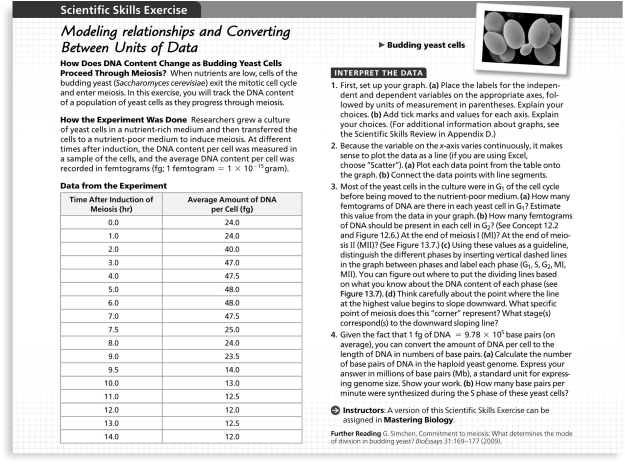
Free
(Multiple Choice)
4.9/5 (89)
(89) Correct Answer:Verified
VerifiedC
Genetic variation leads to genetic diversity in populations and is the raw material for evolution. Which of the following statements best represents the connection between reproduction and evolution?
(Multiple Choice)
4.7/5 (83)
(83) Which of the following processes has just occurred when chiasmata can first be viewed under a microscope?
(Multiple Choice)
4.7/5 (78)
(78) Multiple cells from the same species were isolated, the relative cohesion protein content for each type was determined, and the results were plotted on the graph. Refer to the graph to answer the following question. 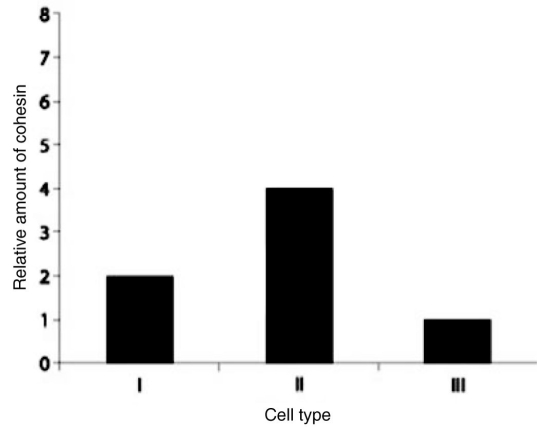 Which sample is consistent with a cell that has completed meiosis?
 (Multiple Choice)
5.0/5 (71)
(71) Which of the following statements describes a major difference between mitosis and meiosis I in a diploid organism?
(Multiple Choice)
4.9/5 (76)
(76) Cells from a diploid protist with n=1 are followed through mitosis and meiosis. The drawings in the figure below represent the chromosomes. Refer to the drawings and answer the following question(s). 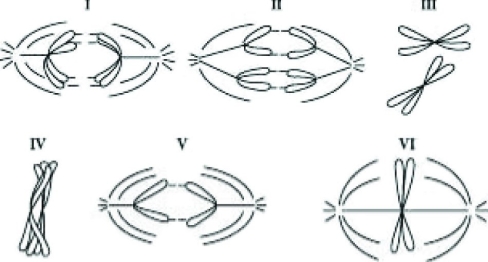 Which diagram represents metaphase of mitosis?
 (Multiple Choice)
4.8/5 (74)
(74) Asexual reproduction occurs during which of the following processes?
(Multiple Choice)
4.9/5 (75)
(75) Quaking aspen trees usually reproduce by extending underground stems that then push aboveground and grow into trees. Sexual reproduction is not as common, but when it does happen, the haploid gametes have 19 chromosomes. How many chromosomes are in the cells of the underground stems?
(Multiple Choice)
4.8/5 (93)
(93) During which of the following processes does independent assortment of chromosomes occur?
(Multiple Choice)
5.0/5 (83)
(83) Which of the following statements describes one characteristic of each chromosome in a cell during the entire process of meiosis I?
(Multiple Choice)
4.8/5 (63)
(63) During which of the following phases of meiosis do centromeres split and sister chromatids migrate to opposite poles of the cell?
(Multiple Choice)
4.8/5 (66)
(66) The somatic cells of a particular plant each contain a total of 46 chromosomes. How do the chromosomes of this plant differ from the chromosomes of humans, who also have a total of 46?
(Multiple Choice)
5.0/5 (91)
(91) Multiple cells from the same species were isolated, the relative cohesion protein content for each type was determined, and the results were plotted on the graph. Refer to the graph to answer the following question. 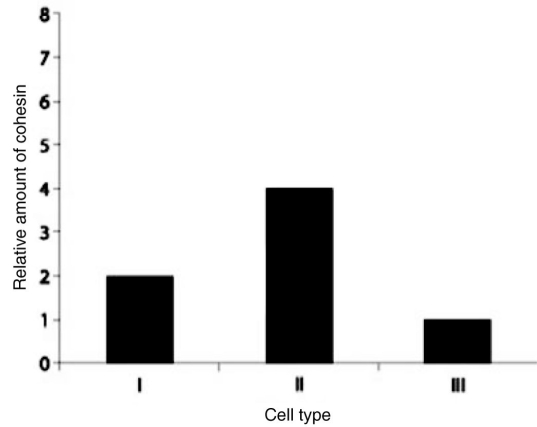 Which sample is consistent with a cell that is in metaphase I?
 (Multiple Choice)
4.7/5 (90)
(90) How do cells at the completion of meiosis compare with cells that are in prophase of meiosis I?
(Multiple Choice)
4.9/5 (80)
(80) Which of the following statements best describes homologous chromosomes?
(Multiple Choice)
4.9/5 (96)
(96) A particular organism has 46 chromosomes in its karyotype. Which of the following statements is correct regarding this organism?
(Multiple Choice)
4.8/5 (62)
(62) Multiple cells from the same species were isolated, the relative cohesion protein content for each type was determined, and the results were plotted on the graph. Refer to the graph to answer the following question. 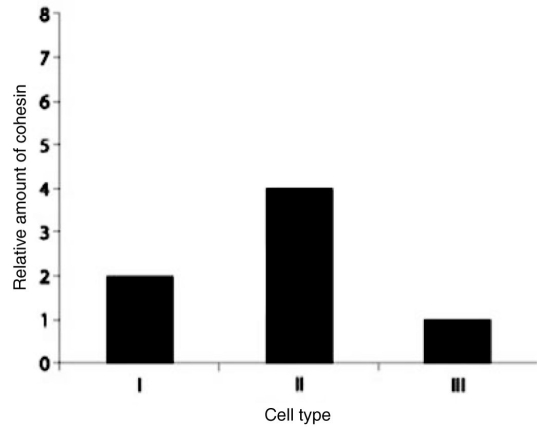 Which sample is consistent with a cell that is in telophase I?
 (Multiple Choice)
4.7/5 (86)
(86) A (hypothetical) diploid organism has different genes that control wing length and wing color.
A female of this species with short blue-colored wings has a chromosome pair with two short-wing alleles and a second chromosome pair with one blue-wing allele and one orange-wing allele. The eggs from this individual will have which of the following combinations of alleles?
(Multiple Choice)
4.8/5 (78)
(78) 
Filters
- Essay(0)
- Multiple Choice(0)
- Short Answer(0)
- True False(0)
- Matching(0)