



 Chat with AI
Exam 13: Sexual Life Cycles and Meiosis

Exam 1: Biology and Its Themes46 Questions
Exam 2: Atoms and Molecules61 Questions
Exam 3: The Chemistry of Water55 Questions
Exam 4: Carbon: the Basis of Molecular Diversity52 Questions
Exam 5: Biological Macromolecules and Lipids71 Questions
Exam 6: Energy and Life65 Questions
Exam 7: Cell Structure and Function66 Questions
Exam 8: Cell Membranes67 Questions
Exam 9: Cellular Signaling62 Questions
Exam 10: Cell Respiration68 Questions
Exam 11: Photosynthetic Processes64 Questions
Exam 12: Mitosis63 Questions
Exam 13: Sexual Life Cycles and Meiosis64 Questions
Exam 14: Mendelian Genetics65 Questions
Exam 15: Linkage and Chromosomes54 Questions
Exam 16: Nucleic Acids and Inheritance65 Questions
Exam 17: Expression of Genes70 Questions
Exam 18: Control of Gene Expression66 Questions
Exam 19: Dna Technology56 Questions
Exam 20: The Evolution of Genomes47 Questions
Exam 21: How Evolution Works60 Questions
Exam 22: Phylogenetic Reconstruction66 Questions
Exam 23: Microevolution65 Questions
Exam 24: Species and Speciation65 Questions
Exam 25: Macroevolution58 Questions
Exam 26: Introduction to Viruses54 Questions
Exam 27: Prokaryotes61 Questions
Exam 28: The Origin and Evolution of Eukaryotes66 Questions
Exam 29: Nonvascular and Seedless Vascular Plants72 Questions
Exam 30: Seed Plants64 Questions
Exam 31: Introduction to Fungi56 Questions
Exam 32: An Introduction to Animal Diversity58 Questions
Exam 33: Invertebrates58 Questions
Exam 34: Vertebrates66 Questions
Exam 35: Plant Structure and Growth68 Questions
Exam 36: Transport in Vascular Plants73 Questions
Exam 37: Plant Nutrition51 Questions
Exam 38: Reproduction of Flowering Plants59 Questions
Exam 39: Plant Signals and Behavior60 Questions
Exam 40: The Animal Body58 Questions
Exam 41: Chemical Signals in Animals62 Questions
Exam 42: Animal Digestive Systems58 Questions
Exam 43: Animal Transport Systems58 Questions
Exam 44: Animal Excretory Systems49 Questions
Exam 45: Animal Reproductive Systems64 Questions
Exam 46: Development in Animals68 Questions
Exam 47: Animal Defenses Against Infection65 Questions
Exam 48: Electrical Signals in Animals62 Questions
Exam 49: Neural Regulation in Animals69 Questions
Exam 50: Sensation and Movement in Animals68 Questions
Exam 51: An Overview of Ecology71 Questions
Exam 52: Behavioral Ecology64 Questions
Exam 53: Populations and Life History Traits73 Questions
Exam 54: Biodiversity and Communities71 Questions
Exam 55: Energy Flow and Chemical Cycling in Ecosystems80 Questions
Exam 56: Conservation and Global Ecology75 Questions
Select questions type


Independent assortment of chromosomes is a result of which of the following processes?
(Multiple Choice)
4.9/5  (78)
(78) Which of the following processes facilitates the fastest way for animal species to adapt to a changing environment?
(Multiple Choice)
4.9/5 (76)
(76) Which of the following statements correctly describes a karyotype?
(Multiple Choice)
4.8/5 (82)
(82) A triploid cell contains three sets of homologous chromosomes. Which of the following describes the chromosomes in a triploid cell where n = 6?
(Multiple Choice)
4.9/5 (75)
(75) Which of the following statements is true of a species that has a chromosome number of 2n = 16?
(Multiple Choice)
4.8/5 (78)
(78) During which of the following phases of meiosis do homologous chromosomes separate?
(Multiple Choice)
4.8/5 (81)
(81) A (hypothetical) diploid organism has different genes that control wing color and wing length. A female of this species has a paternal chromosome set containing one orange-wing allele and one long-wing allele and a maternal set containing one blue-wing allele and one short-wing allele. Which of the following types of eggs would she be expected to produce after meiosis?
(Multiple Choice)
4.9/5 (82)
(82) Two different species of protists living in a tide pool. Species A reproduces both sexually and asexually, and Species B reproduce only asexually. The pool gradually becomes infested with disease-causing viruses. Which species are more likely to survive in the changing environment?
(Multiple Choice)
4.8/5 (85)
(85) Somatic cells of roundworms have four individual chromosomes per cell. How many chromosomes would you expect to find in an ovum from a roundworm?
(Multiple Choice)
4.8/5 (87)
(87) Which of the following processes occurs in meiosis but not in mitosis?
(Multiple Choice)
4.8/5 (84)
(84) During which of the following processes do sister chromatids separate from each other?
(Multiple Choice)
4.9/5 (64)
(64) Which of the following processes best describes the mechanism of gamete production in plants?
(Multiple Choice)
5.0/5 (85)
(85) Which of the following characteristics are part of the sexual life cycle of most fungi but are not part of the sexual life cycles of plants or animals?
(Multiple Choice)
5.0/5 (79)
(79) 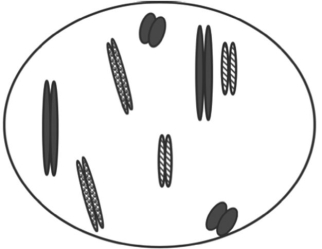 The figure represents the nucleus of an animal cell about to enter mitosis. How many different chromosomes are present in the diagram?
 (Multiple Choice)
4.8/5 (69)
(69) Which of the following statements describes a major difference between meiosis II and mitosis in a diploid animal?
(Multiple Choice)
4.9/5 (83)
(83) Crossing over of chromosomes normally takes place during which of the following processes?
(Multiple Choice)
4.9/5 (70)
(70) Which of the following statements about reproduction is correct?
(Multiple Choice)
4.7/5 (83)
(83) Cells from a diploid protist with n=1 are followed through mitosis and meiosis. The drawings in the figure below represent the chromosomes. Refer to the drawings and answer the following question(s). 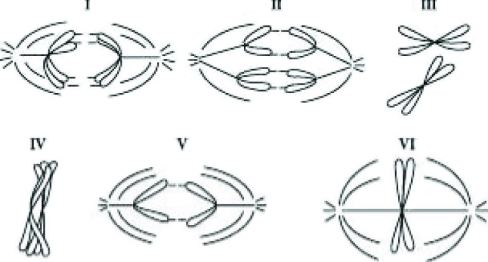 Which diagram represents anaphase II of meiosis?
 (Multiple Choice)
4.9/5 (86)
(86) Which of the following pairs of processes make the greatest contribution to genetic diversity between generations of a diploid insect?
(Multiple Choice)
4.7/5 (73)
(73) For the following question, match the key event of meiosis with the stages listed below.
I. Prophase I V. Prophase II
II. Metaphase I VI. Metaphase II
III. Anaphase I VII. Anaphase II
IV. Telophase I VIII. Telophase II
Haploid cells form containing joined sister chromatids.
(Multiple Choice)
4.8/5 (84)
(84) 
Filters
- Essay(0)
- Multiple Choice(0)
- Short Answer(0)
- True False(0)
- Matching(0)