



 Chat with AI
Exam 19: Dna Technology

Exam 1: Biology and Its Themes46 Questions
Exam 2: Atoms and Molecules61 Questions
Exam 3: The Chemistry of Water55 Questions
Exam 4: Carbon: the Basis of Molecular Diversity52 Questions
Exam 5: Biological Macromolecules and Lipids71 Questions
Exam 6: Energy and Life65 Questions
Exam 7: Cell Structure and Function66 Questions
Exam 8: Cell Membranes67 Questions
Exam 9: Cellular Signaling62 Questions
Exam 10: Cell Respiration68 Questions
Exam 11: Photosynthetic Processes64 Questions
Exam 12: Mitosis63 Questions
Exam 13: Sexual Life Cycles and Meiosis64 Questions
Exam 14: Mendelian Genetics65 Questions
Exam 15: Linkage and Chromosomes54 Questions
Exam 16: Nucleic Acids and Inheritance65 Questions
Exam 17: Expression of Genes70 Questions
Exam 18: Control of Gene Expression66 Questions
Exam 19: Dna Technology56 Questions
Exam 20: The Evolution of Genomes47 Questions
Exam 21: How Evolution Works60 Questions
Exam 22: Phylogenetic Reconstruction66 Questions
Exam 23: Microevolution65 Questions
Exam 24: Species and Speciation65 Questions
Exam 25: Macroevolution58 Questions
Exam 26: Introduction to Viruses54 Questions
Exam 27: Prokaryotes61 Questions
Exam 28: The Origin and Evolution of Eukaryotes66 Questions
Exam 29: Nonvascular and Seedless Vascular Plants72 Questions
Exam 30: Seed Plants64 Questions
Exam 31: Introduction to Fungi56 Questions
Exam 32: An Introduction to Animal Diversity58 Questions
Exam 33: Invertebrates58 Questions
Exam 34: Vertebrates66 Questions
Exam 35: Plant Structure and Growth68 Questions
Exam 36: Transport in Vascular Plants73 Questions
Exam 37: Plant Nutrition51 Questions
Exam 38: Reproduction of Flowering Plants59 Questions
Exam 39: Plant Signals and Behavior60 Questions
Exam 40: The Animal Body58 Questions
Exam 41: Chemical Signals in Animals62 Questions
Exam 42: Animal Digestive Systems58 Questions
Exam 43: Animal Transport Systems58 Questions
Exam 44: Animal Excretory Systems49 Questions
Exam 45: Animal Reproductive Systems64 Questions
Exam 46: Development in Animals68 Questions
Exam 47: Animal Defenses Against Infection65 Questions
Exam 48: Electrical Signals in Animals62 Questions
Exam 49: Neural Regulation in Animals69 Questions
Exam 50: Sensation and Movement in Animals68 Questions
Exam 51: An Overview of Ecology71 Questions
Exam 52: Behavioral Ecology64 Questions
Exam 53: Populations and Life History Traits73 Questions
Exam 54: Biodiversity and Communities71 Questions
Exam 55: Energy Flow and Chemical Cycling in Ecosystems80 Questions
Exam 56: Conservation and Global Ecology75 Questions
Select questions type


In DNA technology, the term vector can refer to ________.

Free
(Multiple Choice)
4.8/5  (67)
(67) Correct Answer: Verified
D
Which of the following sequences in double-stranded DNA is most likely to be recognized as a cutting site for a restriction enzyme?
Free
(Multiple Choice)
4.9/5 (77)
(77) Correct Answer:Verified
VerifiedB
One predicted aspect of climate change is that levels of precipitation and temperature will become more variable. Given this information, which of the following describes the best strategy for genetically engineering crops?
Free
(Multiple Choice)
4.8/5 (73)
(73) Correct Answer:Verified
VerifiedC
Which of the following is an ethical question regarding the use of CRISPR-Cas9 gene editing in humans?
(Multiple Choice)
4.9/5 (78)
(78) Which of the following correctly lists the processes in order for one cycle of polymerase chain reaction (PCR)?
(Multiple Choice)
4.8/5 (71)
(71) Which of the following reasons best explains why sequencing an entire genome, such as that of C. elegans, a nematode, is important for genetic research?
(Multiple Choice)
4.7/5 (81)
(81) In animals, what is the difference between reproductive cloning and therapeutic cloning?
(Multiple Choice)
4.9/5 (79)
(79) Which of the following describes a concern that has been raised regarding the use of transgenic plants to produce human proteins, like growth hormones or insulin?
(Multiple Choice)
4.9/5 (91)
(91) Use the figure to answer the following question. 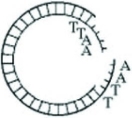 The activity of which of the following enzymes would produce a molecule of DNA as represented in the figure?
 (Multiple Choice)
4.8/5 (82)
(82) Expression of a cloned eukaryotic gene in a bacterial cell involves many challenges. The use of mRNA and reverse transcriptase is part of a strategy to solve the problem of ________.
(Multiple Choice)
4.8/5 (77)
(77) Reproductive cloning of human embryos is generally considered unethical. However, on the subject of therapeutic cloning, there is a wider divergence of opinion. Which of the following statements provides the best argument in support of therapeutic cloning?
(Multiple Choice)
4.7/5 (79)
(79) Which of the following sequences is most likely to be cut by a restriction endonuclease?
(Multiple Choice)
4.7/5 (67)
(67) Animal cloning may result in premature death of the clones due to which of the following problems?
(Multiple Choice)
4.8/5 (88)
(88) Use the following information to answer the question.
In an effort to produce large amounts of a eukaryotic gene product, a plasmid that contains both a eukaryotic gene of interest and an antibiotic resistant gene was constructed. A transformation was performed to attempt to insert the plasmid into the bacterium, E. coli. Which of the following describes a growth condition and culture analysis that supports the claim that plasmid has entered the E. coli bacterial cell.
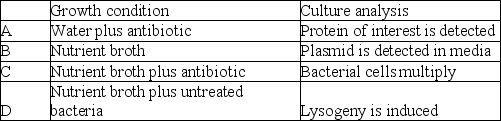
(Multiple Choice)
4.9/5 (75)
(75) Which of the following processes helps bacterial cells protect their own DNA from restriction enzymes (endonucleases)?
(Multiple Choice)
4.8/5 (81)
(81) Gene therapy requires the ability to do which of the following?
(Multiple Choice)
5.0/5 (82)
(82) Which of the following describes how DNA microarrays have helped advance genomic studies?
(Multiple Choice)
4.8/5 (90)
(90) Which of the following outcomes could be achieved using RNAi methodology?
(Multiple Choice)
4.9/5 (80)
(80) Which of the following best describes a biological concern regarding the use of CRISPR-Cas9 gene editing in humans?
(Multiple Choice)
4.8/5 (72)
(72) Which of the following statements describes a technical barrier to using gene therapy in humans?
(Multiple Choice)
4.8/5 (92)
(92) 
Filters
- Essay(0)
- Multiple Choice(0)
- Short Answer(0)
- True False(0)
- Matching(0)