



 Chat with AI
Exam 35: Plant Structure and Growth

Exam 1: Biology and Its Themes46 Questions
Exam 2: Atoms and Molecules61 Questions
Exam 3: The Chemistry of Water55 Questions
Exam 4: Carbon: the Basis of Molecular Diversity52 Questions
Exam 5: Biological Macromolecules and Lipids71 Questions
Exam 6: Energy and Life65 Questions
Exam 7: Cell Structure and Function66 Questions
Exam 8: Cell Membranes67 Questions
Exam 9: Cellular Signaling62 Questions
Exam 10: Cell Respiration68 Questions
Exam 11: Photosynthetic Processes64 Questions
Exam 12: Mitosis63 Questions
Exam 13: Sexual Life Cycles and Meiosis64 Questions
Exam 14: Mendelian Genetics65 Questions
Exam 15: Linkage and Chromosomes54 Questions
Exam 16: Nucleic Acids and Inheritance65 Questions
Exam 17: Expression of Genes70 Questions
Exam 18: Control of Gene Expression66 Questions
Exam 19: Dna Technology56 Questions
Exam 20: The Evolution of Genomes47 Questions
Exam 21: How Evolution Works60 Questions
Exam 22: Phylogenetic Reconstruction66 Questions
Exam 23: Microevolution65 Questions
Exam 24: Species and Speciation65 Questions
Exam 25: Macroevolution58 Questions
Exam 26: Introduction to Viruses54 Questions
Exam 27: Prokaryotes61 Questions
Exam 28: The Origin and Evolution of Eukaryotes66 Questions
Exam 29: Nonvascular and Seedless Vascular Plants72 Questions
Exam 30: Seed Plants64 Questions
Exam 31: Introduction to Fungi56 Questions
Exam 32: An Introduction to Animal Diversity58 Questions
Exam 33: Invertebrates58 Questions
Exam 34: Vertebrates66 Questions
Exam 35: Plant Structure and Growth68 Questions
Exam 36: Transport in Vascular Plants73 Questions
Exam 37: Plant Nutrition51 Questions
Exam 38: Reproduction of Flowering Plants59 Questions
Exam 39: Plant Signals and Behavior60 Questions
Exam 40: The Animal Body58 Questions
Exam 41: Chemical Signals in Animals62 Questions
Exam 42: Animal Digestive Systems58 Questions
Exam 43: Animal Transport Systems58 Questions
Exam 44: Animal Excretory Systems49 Questions
Exam 45: Animal Reproductive Systems64 Questions
Exam 46: Development in Animals68 Questions
Exam 47: Animal Defenses Against Infection65 Questions
Exam 48: Electrical Signals in Animals62 Questions
Exam 49: Neural Regulation in Animals69 Questions
Exam 50: Sensation and Movement in Animals68 Questions
Exam 51: An Overview of Ecology71 Questions
Exam 52: Behavioral Ecology64 Questions
Exam 53: Populations and Life History Traits73 Questions
Exam 54: Biodiversity and Communities71 Questions
Exam 55: Energy Flow and Chemical Cycling in Ecosystems80 Questions
Exam 56: Conservation and Global Ecology75 Questions
Select questions type


Which of the following is true for an emerging lateral root to function?

Free
(Multiple Choice)
4.8/5  (77)
(77) Correct Answer: Verified
B
The following question is based on the drawings of root or stem cross sections shown in the figure. 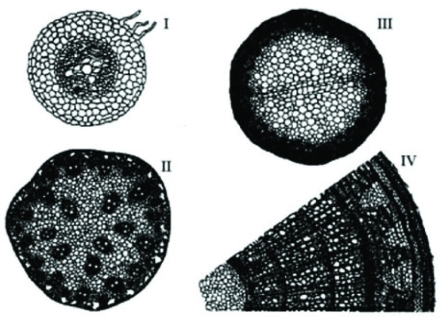 Refer to the figure. A woody eudicot is represented by which of the following?
Free
(Multiple Choice)
4.8/5 (68)
(68) Correct Answer:Verified
VerifiedC
Most of the growth of a plant body is the result of ________.
Free
(Multiple Choice)
4.8/5 (78)
(78) Correct Answer:Verified
VerifiedD
Which of the following are water-conducting cells that are dead at functional maturity?
(Multiple Choice)
4.8/5 (90)
(90) In a meristematic region, the cell plate during mitosis is perpendicular to the side of the stem. In what direction will the stem grow?
(Multiple Choice)
4.9/5 (83)
(83) The following diagram is of a cross section of a plant leaf. Use the diagram to answer the question. 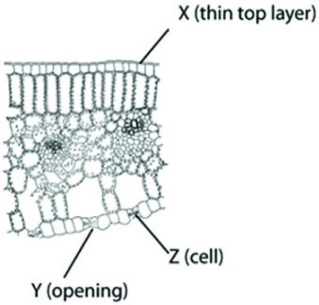 Which of the following is the main function associated with structure X?
 (Multiple Choice)
4.9/5 (79)
(79) Which of the following best describes the growth of most plant structures, except for flowers?
(Multiple Choice)
4.8/5 (100)
(100) Which of the following is unique to the shoot apical meristem region?
I. the region of cell division
II. leaf primordia
III. cells that will give rise to the protoderm, ground meristem, and procambium
(Multiple Choice)
4.9/5 (88)
(88) Suppose a flower had normal expression of genes A and C and expression of gene B in all four whorls. Based on the ABC hypothesis, what would be the structure of that flower, starting at the outermost whorl?
(Multiple Choice)
4.9/5 (79)
(79) As a youngster, you drive a nail in the trunk of a young tree that is 3 meters tall. The nail is about 1.5 meters from the ground. Fifteen years later, you return and discover that the tree has grown to a height of 30 meters. About how many meters above the ground is the nail?
(Multiple Choice)
4.8/5 (89)
(89) The phase change of an apical meristem from the juvenile to the mature vegetative phase is often revealed by ________.
(Multiple Choice)
4.8/5 (68)
(68) Which of the following biological molecules is specific to woody sclerenchyma cells?
(Multiple Choice)
4.8/5 (76)
(76) Which of the following structures is correctly paired with its function?
(Multiple Choice)
4.8/5 (79)
(79) The following question is based on this cross section of a monocot stem. 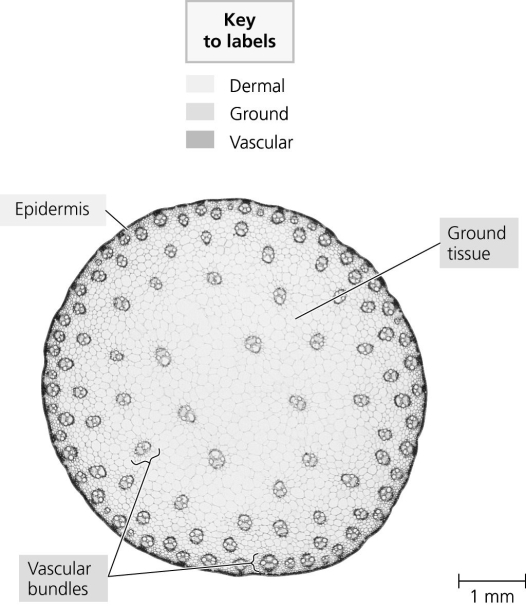 Which of the following is NOT a pattern of vascular bundles evident in this stem?
 (Multiple Choice)
4.8/5 (87)
(87) The following question is based on the image below. 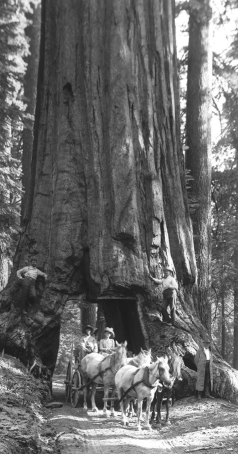 As this wagon passed from the middle of the Sequoia tree to the outside, what would be the order of tissues it passed through?
 (Multiple Choice)
4.9/5 (75)
(75) The following question is based on the drawings of root or stem cross sections shown in the figure. 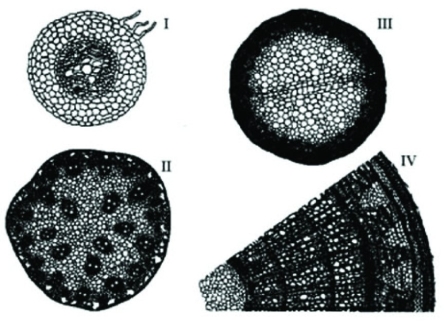 Refer to the figure. A monocot stem is represented by which of the following?
 (Multiple Choice)
4.7/5 (74)
(74) Which of the following is a common feature of secondary xylem and cork cells?
(Multiple Choice)
4.8/5 (88)
(88) Which of the following accurately describes the structure of a leaf?
(Multiple Choice)
4.8/5 (79)
(79) Onions are monocots with certain parts adapted for storage. From which of the following plant parts is the main storage structure formed?
(Multiple Choice)
4.9/5 (77)
(77) 
Filters
- Essay(0)
- Multiple Choice(0)
- Short Answer(0)
- True False(0)
- Matching(0)