



 Chat with AI
Exam 35: Plant Structure and Growth

Exam 1: Biology and Its Themes46 Questions
Exam 2: Atoms and Molecules61 Questions
Exam 3: The Chemistry of Water55 Questions
Exam 4: Carbon: the Basis of Molecular Diversity52 Questions
Exam 5: Biological Macromolecules and Lipids71 Questions
Exam 6: Energy and Life65 Questions
Exam 7: Cell Structure and Function66 Questions
Exam 8: Cell Membranes67 Questions
Exam 9: Cellular Signaling62 Questions
Exam 10: Cell Respiration68 Questions
Exam 11: Photosynthetic Processes64 Questions
Exam 12: Mitosis63 Questions
Exam 13: Sexual Life Cycles and Meiosis64 Questions
Exam 14: Mendelian Genetics65 Questions
Exam 15: Linkage and Chromosomes54 Questions
Exam 16: Nucleic Acids and Inheritance65 Questions
Exam 17: Expression of Genes70 Questions
Exam 18: Control of Gene Expression66 Questions
Exam 19: Dna Technology56 Questions
Exam 20: The Evolution of Genomes47 Questions
Exam 21: How Evolution Works60 Questions
Exam 22: Phylogenetic Reconstruction66 Questions
Exam 23: Microevolution65 Questions
Exam 24: Species and Speciation65 Questions
Exam 25: Macroevolution58 Questions
Exam 26: Introduction to Viruses54 Questions
Exam 27: Prokaryotes61 Questions
Exam 28: The Origin and Evolution of Eukaryotes66 Questions
Exam 29: Nonvascular and Seedless Vascular Plants72 Questions
Exam 30: Seed Plants64 Questions
Exam 31: Introduction to Fungi56 Questions
Exam 32: An Introduction to Animal Diversity58 Questions
Exam 33: Invertebrates58 Questions
Exam 34: Vertebrates66 Questions
Exam 35: Plant Structure and Growth68 Questions
Exam 36: Transport in Vascular Plants73 Questions
Exam 37: Plant Nutrition51 Questions
Exam 38: Reproduction of Flowering Plants59 Questions
Exam 39: Plant Signals and Behavior60 Questions
Exam 40: The Animal Body58 Questions
Exam 41: Chemical Signals in Animals62 Questions
Exam 42: Animal Digestive Systems58 Questions
Exam 43: Animal Transport Systems58 Questions
Exam 44: Animal Excretory Systems49 Questions
Exam 45: Animal Reproductive Systems64 Questions
Exam 46: Development in Animals68 Questions
Exam 47: Animal Defenses Against Infection65 Questions
Exam 48: Electrical Signals in Animals62 Questions
Exam 49: Neural Regulation in Animals69 Questions
Exam 50: Sensation and Movement in Animals68 Questions
Exam 51: An Overview of Ecology71 Questions
Exam 52: Behavioral Ecology64 Questions
Exam 53: Populations and Life History Traits73 Questions
Exam 54: Biodiversity and Communities71 Questions
Exam 55: Energy Flow and Chemical Cycling in Ecosystems80 Questions
Exam 56: Conservation and Global Ecology75 Questions
Select questions type


The veins of leaves are best described as which of the following?
I. composed of xylem and phloem
II. continuous, with vascular bundles in the stem
III. finely branched to be in close contact with photosynthesizing cells
(Multiple Choice)
4.9/5  (85)
(85) Which of the following describes an anatomical difference between roots and leaves?
(Multiple Choice)
5.0/5 (93)
(93) Which structure is correctly paired with its tissue system?
(Multiple Choice)
4.9/5 (73)
(73) Which of the following plant parts absorbs most of the water and minerals taken up from the soil?
(Multiple Choice)
4.7/5 (75)
(75) Which of the following accurately describes meristematic plant cells?
(Multiple Choice)
4.8/5 (80)
(80) Which of the following structures cannot be formed by an axillary bud?
(Multiple Choice)
5.0/5 (77)
(77) Which of the following cell types retains the ability to undergo cell division?
(Multiple Choice)
4.9/5 (66)
(66) Increasing the number of stomata per unit surface area of a leaf when atmospheric carbon dioxide levels decline is most analogous to which of the following human adaptations?
(Multiple Choice)
4.8/5 (78)
(78) Shoot elongation in a growing bud is due primarily to which of the following?
(Multiple Choice)
4.8/5 (86)
(86) The following question is based on the figure below. 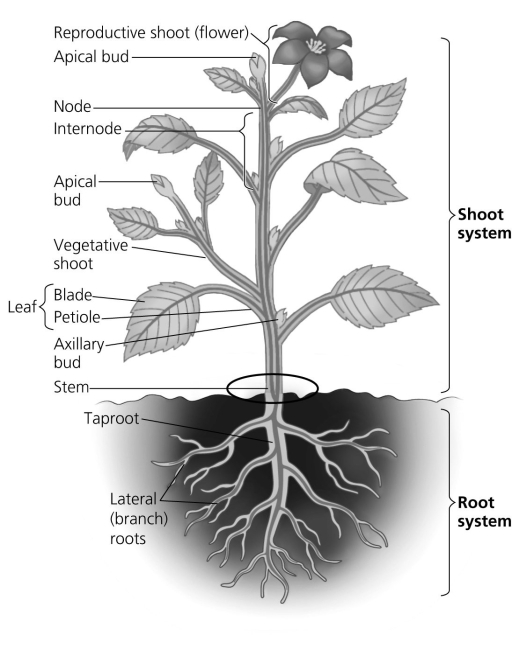 Which of the following must have occurred during development in the region between the root and stem circled on this diagram of an herbaceous eudicot?
 (Multiple Choice)
4.8/5 (80)
(80) Many ornamental roses have sepals and multiple showy petals, but lack reproductive parts. Assuming that rose development follows the ABC hypothesis, which gene is most likely to be suppressed?
(Multiple Choice)
5.0/5 (88)
(88) The following question is based on the diagram of three-years-old growth in a winter twig below. 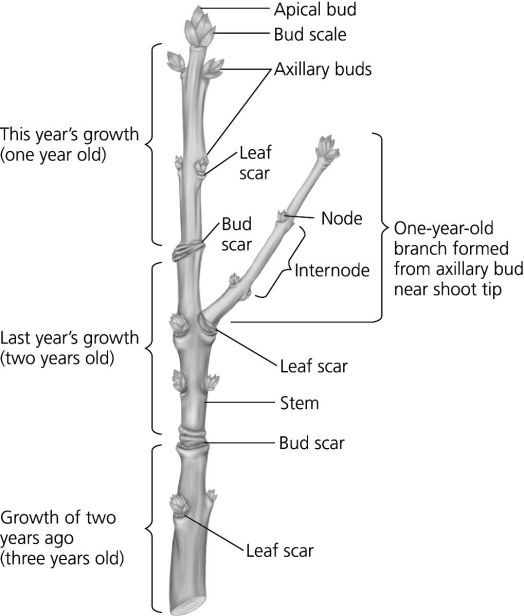 If you examined the cut surface at the base of this twig, how many growth rings should be present?
 (Multiple Choice)
4.8/5 (78)
(78) Which of the following is the correct sequence of the zones in the primary growth of a root, moving from the root cap toward the stem?
(Multiple Choice)
4.8/5 (74)
(74) A plant has the following characteristics: a taproot system, several growth rings evident in a cross section of the stem, and a layer of bark around the outside. Which of the following best describes the plant?
(Multiple Choice)
5.0/5 (64)
(64) Growth and development of plant parts involves which of the following processes?
I. cell division to produce new cells
II. enlargement and elongation of cells
III. specialization of cells into tissues
(Multiple Choice)
4.9/5 (80)
(80) The bark of a tree trunk includes which of the following tissues?
(Multiple Choice)
4.9/5 (77)
(77) The following question is based on data from Northern Red Maples in the table below
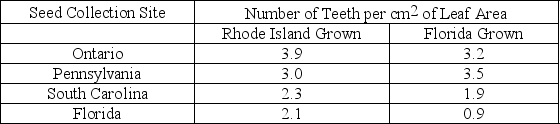 Which data above best illustrates phenotypic plasticity in leaf "toothiness"?
 (Multiple Choice)
4.8/5 (85)
(85) 
Filters
- Essay(0)
- Multiple Choice(0)
- Short Answer(0)
- True False(0)
- Matching(0)