



 Chat with AI
Exam 15: Linkage and Chromosomes

Exam 1: Biology and Its Themes46 Questions
Exam 2: Atoms and Molecules61 Questions
Exam 3: The Chemistry of Water55 Questions
Exam 4: Carbon: the Basis of Molecular Diversity52 Questions
Exam 5: Biological Macromolecules and Lipids71 Questions
Exam 6: Energy and Life65 Questions
Exam 7: Cell Structure and Function66 Questions
Exam 8: Cell Membranes67 Questions
Exam 9: Cellular Signaling62 Questions
Exam 10: Cell Respiration68 Questions
Exam 11: Photosynthetic Processes64 Questions
Exam 12: Mitosis63 Questions
Exam 13: Sexual Life Cycles and Meiosis64 Questions
Exam 14: Mendelian Genetics65 Questions
Exam 15: Linkage and Chromosomes54 Questions
Exam 16: Nucleic Acids and Inheritance65 Questions
Exam 17: Expression of Genes70 Questions
Exam 18: Control of Gene Expression66 Questions
Exam 19: Dna Technology56 Questions
Exam 20: The Evolution of Genomes47 Questions
Exam 21: How Evolution Works60 Questions
Exam 22: Phylogenetic Reconstruction66 Questions
Exam 23: Microevolution65 Questions
Exam 24: Species and Speciation65 Questions
Exam 25: Macroevolution58 Questions
Exam 26: Introduction to Viruses54 Questions
Exam 27: Prokaryotes61 Questions
Exam 28: The Origin and Evolution of Eukaryotes66 Questions
Exam 29: Nonvascular and Seedless Vascular Plants72 Questions
Exam 30: Seed Plants64 Questions
Exam 31: Introduction to Fungi56 Questions
Exam 32: An Introduction to Animal Diversity58 Questions
Exam 33: Invertebrates58 Questions
Exam 34: Vertebrates66 Questions
Exam 35: Plant Structure and Growth68 Questions
Exam 36: Transport in Vascular Plants73 Questions
Exam 37: Plant Nutrition51 Questions
Exam 38: Reproduction of Flowering Plants59 Questions
Exam 39: Plant Signals and Behavior60 Questions
Exam 40: The Animal Body58 Questions
Exam 41: Chemical Signals in Animals62 Questions
Exam 42: Animal Digestive Systems58 Questions
Exam 43: Animal Transport Systems58 Questions
Exam 44: Animal Excretory Systems49 Questions
Exam 45: Animal Reproductive Systems64 Questions
Exam 46: Development in Animals68 Questions
Exam 47: Animal Defenses Against Infection65 Questions
Exam 48: Electrical Signals in Animals62 Questions
Exam 49: Neural Regulation in Animals69 Questions
Exam 50: Sensation and Movement in Animals68 Questions
Exam 51: An Overview of Ecology71 Questions
Exam 52: Behavioral Ecology64 Questions
Exam 53: Populations and Life History Traits73 Questions
Exam 54: Biodiversity and Communities71 Questions
Exam 55: Energy Flow and Chemical Cycling in Ecosystems80 Questions
Exam 56: Conservation and Global Ecology75 Questions
Select questions type


Which of the following reasons explains why map units on a chromosome linkage map are not reliable measures of physical distances?

Free
(Multiple Choice)
4.9/5  (82)
(82) Correct Answer: Verified
A
The chromosomal alteration that results from a chromosome fragment joined to a nonhomologous chromosome is called a ________.
Free
(Multiple Choice)
4.9/5 (78)
(78) Correct Answer:Verified
VerifiedC
Which of the following events will result in recombination between linked genes?
Free
(Multiple Choice)
4.8/5 (89)
(89) Correct Answer:Verified
VerifiedD
If a pair of homologous chromosomes fails to separate during meiosis I, select the choice that shows the chromosome number of the four resulting gametes with respect to the normal haploid number (n)?
(Multiple Choice)
4.9/5 (74)
(74) Which of the following events results in X-inactivation in female mammals?
(Multiple Choice)
4.8/5 (75)
(75) Cinnabar eye color is an X-linked, recessive characteristic in fruit flies. If a female having cinnabar eyes is crossed with a male having wild-type, red eyes, what percent of the F1 males will have cinnabar eyes?
(Multiple Choice)
4.8/5 (86)
(86) Which of the following statements describes the most likely result of a defect in meiosis that results in the failure of spindle microtubules to bind some kinetochores?
(Multiple Choice)
4.9/5 (89)
(89) In cats, an X-linked locus is responsible for fur color. There are two known alleles at this locus. One results in black fur color; the other results in orange fur color. A heterozygote animal has patches of orange and black fur (tortoiseshell). Which coat color phenotypes are expected from the cross of a black female and an orange male?
(Multiple Choice)
4.8/5 (85)
(85) Use the following information to answer the question.
A plantlike species on the hypothetical planet Pandora has three genetic traits: leaf color, controlled by gene L; a stem texture, controlled by gene S; and root length controlled by gene R. Each of the three genes has two alleles. The three genes are linked and recombine.
A geneticist performed a testcross with an organism of that species that is heterozygous for the three traits. She recorded progeny with the following phenotypic distribution:
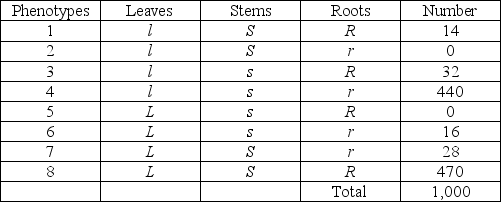 Assuming that genetic inheritance for this hypothetical plant functions the same as on Earth, the parents in this cross most likely have the same phenotypes as which of the following progeny?
 (Multiple Choice)
4.7/5 (91)
(91) A testcross performed with F1 dihybrid flies results in more parental-type offspring than recombinant-type offspring. Which of the following statements best explains this result?
(Multiple Choice)
5.0/5 (67)
(67) In Drosophila melanogaster, wing-size and body-color genes are linked. Vestigial wings and black body color are both recessive traits. A researcher crossed black-bodied, normal-winged females and gray-bodied, vestigial-winged males. The F1 were all gray bodied, normal winged. A test cross was performed with F1 females. The researcher calculated a map distance of 17 map units. Which of the following information is correct about the testcross progeny?
(Multiple Choice)
4.9/5 (88)
(88) Which of the following phrases correctly defines one genetic map unit?
(Multiple Choice)
4.9/5 (70)
(70) Some snail species' shells can have right-handed direction of shell coiling or left-handed direction of shell coiling. The direction of coiling depends on a protein deposited by the mother in the egg cytoplasm with DD and Dd mothers depositing a protein that directs right-handed direction of coiling in shells. If Dd egg-producing snail and a dd sperm-producing snail mate what genotype(s) and phenotype(s) of offspring will result?
(Multiple Choice)
4.8/5 (87)
(87) A man with normal vision who is a dwarf due to achondroplasia has children with a woman with colorblindness who is of average height. Dwarfism caused by achondroplasia is autosomal dominant, and red-green color blindness is X-linked recessive. What proportion of their daughters are expected to be color-blind with achondroplasia?
(Multiple Choice)
4.9/5 (69)
(69) A recessive allele on the X chromosome is responsible for red-green color blindness in humans. A woman with normal vision whose father is color blind has children with a color-blind male. What is the probability that this couple's first son will be color blind?
(Multiple Choice)
4.9/5 (84)
(84) Which of the following statements explains the observation that closely linked genes are typically inherited together?
(Multiple Choice)
4.9/5 (76)
(76) A man with normal vision who is a dwarf due to achondroplasia has children with a woman who is colorblind and of average height. Dwarfism caused by achondroplasia is autosomal dominant, and red-green color blindness is X-linked recessive. What proportion of their sons are expected to be color blind and of normal height?
(Multiple Choice)
4.8/5 (79)
(79) Use the following information to answer the question. 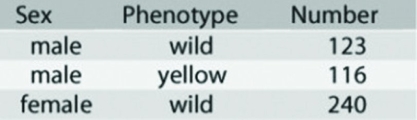 In a Drosophila experiment, a homozygous wild-type female was crossed with a yellow-bodied male. All of the resulting F1 flies were phenotypically wild type. Crossing the F1 flies resulted in F2 flies having the characteristics shown in the figure. Which of the following statements best describes the yellow body allele?
 (Multiple Choice)
4.7/5 (78)
(78) Glucose-6-phosphate dehydrogenase deficiency (G6PD) is inherited as an X-linked recessive allele in humans. A woman whose father had G6PD is planning a family with a man who has no history of the disease. What proportion of their sons are expected to have the disease?
(Multiple Choice)
4.9/5 (75)
(75) 
Filters
- Essay(0)
- Multiple Choice(0)
- Short Answer(0)
- True False(0)
- Matching(0)