



 Chat with AI
Exam 22: Phylogenetic Reconstruction

Exam 1: Biology and Its Themes46 Questions
Exam 2: Atoms and Molecules61 Questions
Exam 3: The Chemistry of Water55 Questions
Exam 4: Carbon: the Basis of Molecular Diversity52 Questions
Exam 5: Biological Macromolecules and Lipids71 Questions
Exam 6: Energy and Life65 Questions
Exam 7: Cell Structure and Function66 Questions
Exam 8: Cell Membranes67 Questions
Exam 9: Cellular Signaling62 Questions
Exam 10: Cell Respiration68 Questions
Exam 11: Photosynthetic Processes64 Questions
Exam 12: Mitosis63 Questions
Exam 13: Sexual Life Cycles and Meiosis64 Questions
Exam 14: Mendelian Genetics65 Questions
Exam 15: Linkage and Chromosomes54 Questions
Exam 16: Nucleic Acids and Inheritance65 Questions
Exam 17: Expression of Genes70 Questions
Exam 18: Control of Gene Expression66 Questions
Exam 19: Dna Technology56 Questions
Exam 20: The Evolution of Genomes47 Questions
Exam 21: How Evolution Works60 Questions
Exam 22: Phylogenetic Reconstruction66 Questions
Exam 23: Microevolution65 Questions
Exam 24: Species and Speciation65 Questions
Exam 25: Macroevolution58 Questions
Exam 26: Introduction to Viruses54 Questions
Exam 27: Prokaryotes61 Questions
Exam 28: The Origin and Evolution of Eukaryotes66 Questions
Exam 29: Nonvascular and Seedless Vascular Plants72 Questions
Exam 30: Seed Plants64 Questions
Exam 31: Introduction to Fungi56 Questions
Exam 32: An Introduction to Animal Diversity58 Questions
Exam 33: Invertebrates58 Questions
Exam 34: Vertebrates66 Questions
Exam 35: Plant Structure and Growth68 Questions
Exam 36: Transport in Vascular Plants73 Questions
Exam 37: Plant Nutrition51 Questions
Exam 38: Reproduction of Flowering Plants59 Questions
Exam 39: Plant Signals and Behavior60 Questions
Exam 40: The Animal Body58 Questions
Exam 41: Chemical Signals in Animals62 Questions
Exam 42: Animal Digestive Systems58 Questions
Exam 43: Animal Transport Systems58 Questions
Exam 44: Animal Excretory Systems49 Questions
Exam 45: Animal Reproductive Systems64 Questions
Exam 46: Development in Animals68 Questions
Exam 47: Animal Defenses Against Infection65 Questions
Exam 48: Electrical Signals in Animals62 Questions
Exam 49: Neural Regulation in Animals69 Questions
Exam 50: Sensation and Movement in Animals68 Questions
Exam 51: An Overview of Ecology71 Questions
Exam 52: Behavioral Ecology64 Questions
Exam 53: Populations and Life History Traits73 Questions
Exam 54: Biodiversity and Communities71 Questions
Exam 55: Energy Flow and Chemical Cycling in Ecosystems80 Questions
Exam 56: Conservation and Global Ecology75 Questions
Select questions type


Some beetles and flies have antler-like structures on their heads, much like male deer. The existence of antlers in beetle, fly, and deer species with strong male-male competition is an example of which of the following?

Free
(Multiple Choice)
4.9/5  (76)
(76) Correct Answer: Verified
A
If organisms 1, 2, and 3 belong to the same class but to different orders and if organisms 3, 4, and 5 belong to the same order but to different families, which of the following pairs of organisms would be expected to show the greatest degree of morphological homology?
Free
(Multiple Choice)
4.9/5 (85)
(85) Correct Answer:Verified
VerifiedD
Which eukaryotic kingdom includes members that are the result of endosymbioses that included an ancient aerobic bacterium and an ancient cyanobacterium?
Free
(Multiple Choice)
4.8/5 (86)
(86) Correct Answer:Verified
VerifiedA
Which of the following statements explains why paralogous genes can diverge from each other within the same gene pool, whereas orthologous genes diverge only after gene pools are isolated from each other?
(Multiple Choice)
4.8/5 (73)
(73) Which of the following statements about horizontal gene transfer is accurate?
(Multiple Choice)
5.0/5 (70)
(70) Which of the following taxa are problematic when the goal is to construct phylogenies that accurately reflect evolutionary history?
(Multiple Choice)
4.9/5 (77)
(77) Which phylogenetic tree can best be used to support the claim that the microsporidians are a sister group of the cryptomycetes?
(Multiple Choice)
4.7/5 (73)
(73) 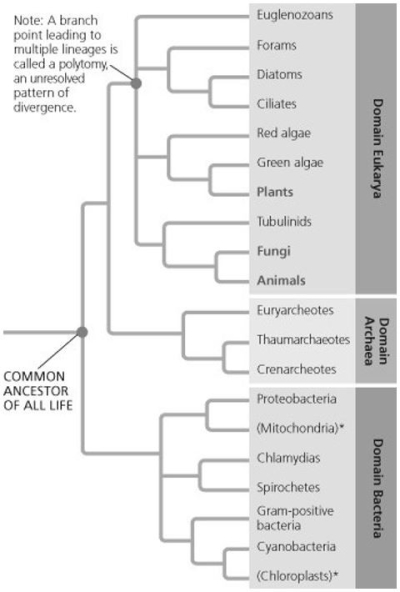 Cyanobacteria were once called blue-green algae because they are photosynthetic. According to the phylogeny shown, to which of the following organisms are the cyanobacteria more closely related?
 (Multiple Choice)
4.9/5 (84)
(84) Which of the following information would be most useful in creating a phylogenetic tree of a taxon?
(Multiple Choice)
4.7/5 (79)
(79) 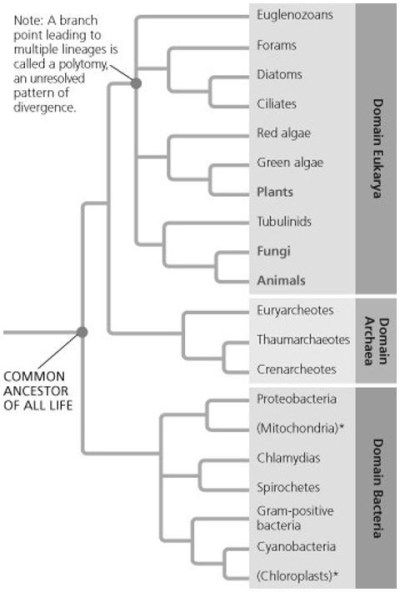 A phylogenetic tree is shown for the three domains of life (Eukarya, Archaea, and Bacteria). The tree branches in two directions from the first point, labeled Common ancestor of all life. One branch leads in the direction of Eukarya and Archaea, and the other branch leads to Bacteria. The branch leading to Eukarya and Archaea divide, one branch leading to each domain. The branch leading to Eukarya divides into four branches. One leads to Euglenozoans, and the other three lead to branching points. The first leads to Forams in one direction, and another branching point in the other that leads to Diatoms and Ciliates. The second branching point leads to Red algae in one direction, and a branching point that leads to green algae and land plants in the other direction. The third branching point leads to amoebas in one direction, and a branching point that leads to fungi and animals in the other direction. Land plants, Fungi and Animals are all highlighted.
Which of the following pairs of organisms form a sister group?
A phylogenetic tree is shown for the three domains of life (Eukarya, Archaea, and Bacteria). The tree branches in two directions from the first point, labeled Common ancestor of all life. One branch leads in the direction of Eukarya and Archaea, and the other branch leads to Bacteria. The branch leading to Eukarya and Archaea divide, one branch leading to each domain. The branch leading to Eukarya divides into four branches. One leads to Euglenozoans, and the other three lead to branching points. The first leads to Forams in one direction, and another branching point in the other that leads to Diatoms and Ciliates. The second branching point leads to Red algae in one direction, and a branching point that leads to green algae and land plants in the other direction. The third branching point leads to amoebas in one direction, and a branching point that leads to fungi and animals in the other direction. Land plants, Fungi and Animals are all highlighted.
Which of the following pairs of organisms form a sister group? (Multiple Choice)
5.0/5 (84)
(84) Use the following figure and description to answer the question. 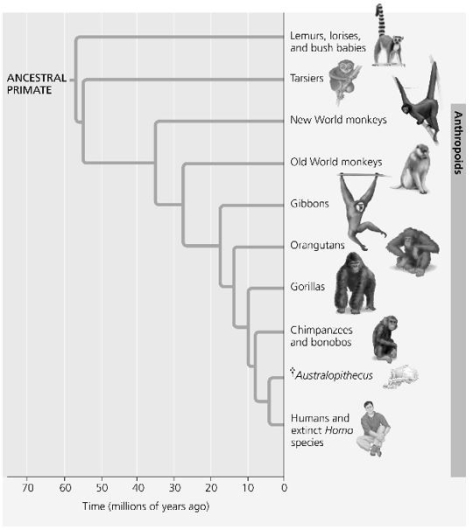 Humans, chimpanzees, gorillas, and orangutans are members of a clade called the great apes, which shared a common ancestor approximately 15 million years ago.
Referring to the phylogenetic tree in the figure, which of the following pairs of apes are most closely related?
Humans, chimpanzees, gorillas, and orangutans are members of a clade called the great apes, which shared a common ancestor approximately 15 million years ago.
Referring to the phylogenetic tree in the figure, which of the following pairs of apes are most closely related? (Multiple Choice)
4.9/5 (70)
(70) Which phylogenetic tree can best be used to show that the zygomycetes and chytrids are the most closely related?
(Multiple Choice)
4.9/5 (67)
(67) For which of the following organisms would a phylogenetic tree constructed using sequence differences in mitochondrial DNA would be most valid for discerning their evolutionary relatedness?
(Multiple Choice)
5.0/5 (80)
(80) Which of the following items is most likely to form a simple linear relationship with the number of gene-duplication events, when placed as the label on the vertical axis of the following graph? 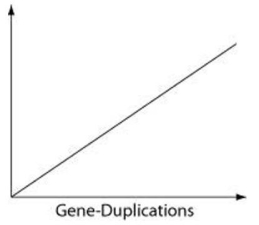
(Multiple Choice)
4.9/5 (82)
(82) Use the following information to answer the question. 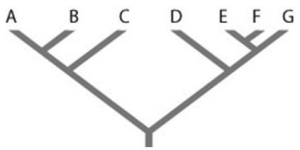 In the figure, the letters A-G represent individual species that all descended from a common ancestor. Which of the following groups of these species forms a monophyletic group?
 (Multiple Choice)
4.8/5 (83)
(83) If you were using cladistics to build a phylogenetic tree of cats, which of the following would be the best outgroup?
(Multiple Choice)
4.9/5 (80)
(80) Which of the following statements best describes the rationale for applying the principle of maximum parsimony in constructing phylogenetic trees?
(Multiple Choice)
4.9/5 (91)
(91) The relative lengths of the frog and mouse branches in the phylogenetic tree in the figure indicate that ________. 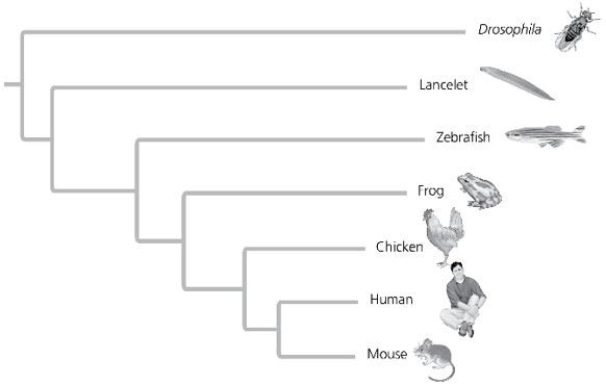
(Multiple Choice)
4.9/5 (90)
(90) In the figure, the letters A-G represent individual species that all descended from a common ancestor. 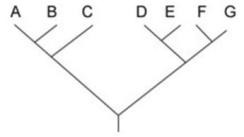 Which of the following conclusions regarding the phylogeny of these organisms can be made from this tree?
 (Multiple Choice)
4.8/5 (77)
(77) Carolus Linnaeus believed that species remained fixed in the form in which they had been created. Which of the following concepts are inconsistent with Linnaeus's model of classification?
(Multiple Choice)
4.8/5 (76)
(76) 
Filters
- Essay(0)
- Multiple Choice(0)
- Short Answer(0)
- True False(0)
- Matching(0)