



 Chat with AI
Exam 42: Animal Digestive Systems

Exam 1: Biology and Its Themes46 Questions
Exam 2: Atoms and Molecules61 Questions
Exam 3: The Chemistry of Water55 Questions
Exam 4: Carbon: the Basis of Molecular Diversity52 Questions
Exam 5: Biological Macromolecules and Lipids71 Questions
Exam 6: Energy and Life65 Questions
Exam 7: Cell Structure and Function66 Questions
Exam 8: Cell Membranes67 Questions
Exam 9: Cellular Signaling62 Questions
Exam 10: Cell Respiration68 Questions
Exam 11: Photosynthetic Processes64 Questions
Exam 12: Mitosis63 Questions
Exam 13: Sexual Life Cycles and Meiosis64 Questions
Exam 14: Mendelian Genetics65 Questions
Exam 15: Linkage and Chromosomes54 Questions
Exam 16: Nucleic Acids and Inheritance65 Questions
Exam 17: Expression of Genes70 Questions
Exam 18: Control of Gene Expression66 Questions
Exam 19: Dna Technology56 Questions
Exam 20: The Evolution of Genomes47 Questions
Exam 21: How Evolution Works60 Questions
Exam 22: Phylogenetic Reconstruction66 Questions
Exam 23: Microevolution65 Questions
Exam 24: Species and Speciation65 Questions
Exam 25: Macroevolution58 Questions
Exam 26: Introduction to Viruses54 Questions
Exam 27: Prokaryotes61 Questions
Exam 28: The Origin and Evolution of Eukaryotes66 Questions
Exam 29: Nonvascular and Seedless Vascular Plants72 Questions
Exam 30: Seed Plants64 Questions
Exam 31: Introduction to Fungi56 Questions
Exam 32: An Introduction to Animal Diversity58 Questions
Exam 33: Invertebrates58 Questions
Exam 34: Vertebrates66 Questions
Exam 35: Plant Structure and Growth68 Questions
Exam 36: Transport in Vascular Plants73 Questions
Exam 37: Plant Nutrition51 Questions
Exam 38: Reproduction of Flowering Plants59 Questions
Exam 39: Plant Signals and Behavior60 Questions
Exam 40: The Animal Body58 Questions
Exam 41: Chemical Signals in Animals62 Questions
Exam 42: Animal Digestive Systems58 Questions
Exam 43: Animal Transport Systems58 Questions
Exam 44: Animal Excretory Systems49 Questions
Exam 45: Animal Reproductive Systems64 Questions
Exam 46: Development in Animals68 Questions
Exam 47: Animal Defenses Against Infection65 Questions
Exam 48: Electrical Signals in Animals62 Questions
Exam 49: Neural Regulation in Animals69 Questions
Exam 50: Sensation and Movement in Animals68 Questions
Exam 51: An Overview of Ecology71 Questions
Exam 52: Behavioral Ecology64 Questions
Exam 53: Populations and Life History Traits73 Questions
Exam 54: Biodiversity and Communities71 Questions
Exam 55: Energy Flow and Chemical Cycling in Ecosystems80 Questions
Exam 56: Conservation and Global Ecology75 Questions
Select questions type


Fat digestion yields fatty acids and glycerol. Protein digestion yields amino acids. Both digestive processes ________.

Free
(Multiple Choice)
4.8/5  (73)
(73) Correct Answer: Verified
B
Ticks are parasites that obtain nutrients by ingesting blood from a host animal. Ticks would be classified as ________.
Free
(Multiple Choice)
4.7/5 (77)
(77) Correct Answer:Verified
VerifiedC
Varsha is a paleontologist and discovers an intact mammalian skull with large, wide molars, and thin incisors only at the front of the jaw. The skull was lacking canines. What type of diet did this mammal likely eat?
Free
(Multiple Choice)
4.9/5 (72)
(72) Correct Answer:Verified
VerifiedB
The active ingredient orlistat acts to decrease the amount of fat that is absorbed by attaching to enzymes that digest fat. Which of the following is a potential target of orlistat?
(Multiple Choice)
4.8/5 (76)
(76) If there is a strong genetic link for type II diabetes mellitus in your family, which option might you take to minimize your risk of developing the disorder?
(Multiple Choice)
5.0/5 (83)
(83) Lysine is an essential amino acid for animals. An animal that lacked lysine in its diet ________.
(Multiple Choice)
4.9/5 (83)
(83) 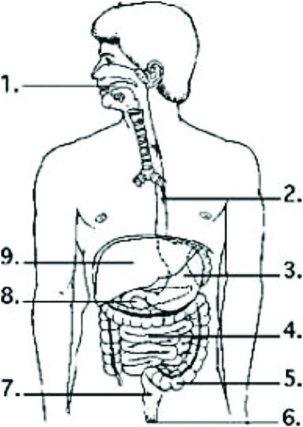 Examine the digestive system structures in the figure. In which labeled structure is the rate of nutrient absorption the highest?
 (Multiple Choice)
4.7/5 (67)
(67) Fat digestion yields fatty acids and glycerol, whereas protein digestion yields amino acids. Which of the following statements is true regarding these processes?
(Multiple Choice)
4.9/5 (85)
(85) Which benefit do intestinal bacteria gain living in a mutualistic relationship with an animal?
(Multiple Choice)
4.8/5 (76)
(76) Which statement best explains why cattle able to survive on a diet consisting almost entirely of plant material?
(Multiple Choice)
4.8/5 (81)
(81) Gastroliths are stones that are used by the digestive systems of some animals to perform mechanical digestion. Fossilized gastroliths have been found with dinosaur skeletons. What does this evidence suggest about the digestive systems of dinosaurs?
(Multiple Choice)
4.8/5 (79)
(79) A fasting animal whose energy needs exceed those provided in its diet will draw on its stored resources in which order?
(Multiple Choice)
4.9/5 (72)
(72) Which of the following statements correctly describes peristalsis?
(Multiple Choice)
4.8/5 (76)
(76) Which statement best describes how stomach cells survive the acidity and protein-digesting activities in the stomach?
(Multiple Choice)
4.9/5 (90)
(90) Termites are insects that eat a variety of dead plants, but they are most well-known for burrowing into wooden structures (including houses!) and eating the cellulose within the wood. What type of feeding mechanism do termites use?
(Multiple Choice)
5.0/5 (75)
(75) If you put the following events in the order they occur in the human digestive system, which would be the third event in the series?
(Multiple Choice)
4.9/5 (88)
(88) Jasmine, a 36-year-old female, visits her personal care physician complaining of muscle cramps and reduced appetite. Which of the following options would a doctor likely advise her to do to reduce her symptoms?
(Multiple Choice)
4.7/5 (87)
(87) The mammalian trachea and esophagus both connect to the ________.
(Multiple Choice)
4.9/5 (90)
(90) Which of the following organs is correctly paired with its function?
(Multiple Choice)
4.9/5 (79)
(79) 
Filters
- Essay(0)
- Multiple Choice(0)
- Short Answer(0)
- True False(0)
- Matching(0)