



 Chat with AI
Exam 42: Animal Digestive Systems

Exam 1: Biology and Its Themes46 Questions
Exam 2: Atoms and Molecules61 Questions
Exam 3: The Chemistry of Water55 Questions
Exam 4: Carbon: the Basis of Molecular Diversity52 Questions
Exam 5: Biological Macromolecules and Lipids71 Questions
Exam 6: Energy and Life65 Questions
Exam 7: Cell Structure and Function66 Questions
Exam 8: Cell Membranes67 Questions
Exam 9: Cellular Signaling62 Questions
Exam 10: Cell Respiration68 Questions
Exam 11: Photosynthetic Processes64 Questions
Exam 12: Mitosis63 Questions
Exam 13: Sexual Life Cycles and Meiosis64 Questions
Exam 14: Mendelian Genetics65 Questions
Exam 15: Linkage and Chromosomes54 Questions
Exam 16: Nucleic Acids and Inheritance65 Questions
Exam 17: Expression of Genes70 Questions
Exam 18: Control of Gene Expression66 Questions
Exam 19: Dna Technology56 Questions
Exam 20: The Evolution of Genomes47 Questions
Exam 21: How Evolution Works60 Questions
Exam 22: Phylogenetic Reconstruction66 Questions
Exam 23: Microevolution65 Questions
Exam 24: Species and Speciation65 Questions
Exam 25: Macroevolution58 Questions
Exam 26: Introduction to Viruses54 Questions
Exam 27: Prokaryotes61 Questions
Exam 28: The Origin and Evolution of Eukaryotes66 Questions
Exam 29: Nonvascular and Seedless Vascular Plants72 Questions
Exam 30: Seed Plants64 Questions
Exam 31: Introduction to Fungi56 Questions
Exam 32: An Introduction to Animal Diversity58 Questions
Exam 33: Invertebrates58 Questions
Exam 34: Vertebrates66 Questions
Exam 35: Plant Structure and Growth68 Questions
Exam 36: Transport in Vascular Plants73 Questions
Exam 37: Plant Nutrition51 Questions
Exam 38: Reproduction of Flowering Plants59 Questions
Exam 39: Plant Signals and Behavior60 Questions
Exam 40: The Animal Body58 Questions
Exam 41: Chemical Signals in Animals62 Questions
Exam 42: Animal Digestive Systems58 Questions
Exam 43: Animal Transport Systems58 Questions
Exam 44: Animal Excretory Systems49 Questions
Exam 45: Animal Reproductive Systems64 Questions
Exam 46: Development in Animals68 Questions
Exam 47: Animal Defenses Against Infection65 Questions
Exam 48: Electrical Signals in Animals62 Questions
Exam 49: Neural Regulation in Animals69 Questions
Exam 50: Sensation and Movement in Animals68 Questions
Exam 51: An Overview of Ecology71 Questions
Exam 52: Behavioral Ecology64 Questions
Exam 53: Populations and Life History Traits73 Questions
Exam 54: Biodiversity and Communities71 Questions
Exam 55: Energy Flow and Chemical Cycling in Ecosystems80 Questions
Exam 56: Conservation and Global Ecology75 Questions
Select questions type


Jahasz-Pocsine and co-workers found a correlation between gastric bypass surgery and neurological complications. In gastric bypass surgery, the stomach can be made smaller so as to hold less food and thus promote weight loss. Surgeons performed gastric bypass surgery on 150 patients at the University of Arkansas for Medical Sciences Neurology Clinic. Of the 150 patients, 26 experienced neurological complications related to the surgery. What is the most likely cause for the neurological complications?
(Multiple Choice)
4.9/5  (95)
(95) 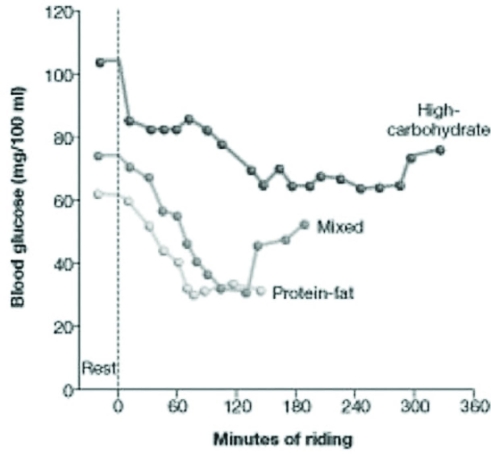 Each of three groups of cyclists had a different diet: high-carbohydrate; a mix of carbohydrates, fat, and protein; or high in protein and fat. The blood glucose levels of the riders over a six-hour period after consuming each diet is shown in the accompanying graph. Which statement best summarizes the data in the graph?
 (Multiple Choice)
4.9/5 (82)
(82) Nutrient-rich blood from the intestine is carried to the liver via which vessel?
(Multiple Choice)
4.8/5 (84)
(84) If you were to jog 1 km a few hours after lunch, which stored fuel would you probably tap?
(Multiple Choice)
4.8/5 (100)
(100) Which statement best describes why mechanical digestion, the process of breaking down large chunks of food into smaller pieces, is an important digestive process?
(Multiple Choice)
4.9/5 (77)
(77) Which of the following correctly describes the function of chylomicrons?
(Multiple Choice)
4.9/5 (85)
(85) The following table shows the contents of a multivitamin supplement and its percentage of recommended daily values (% DV).
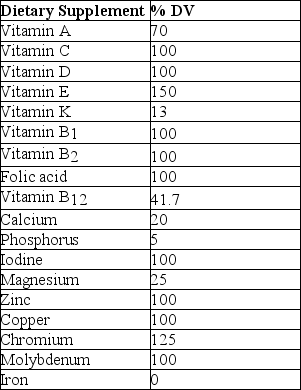 The most likely reason that some of the vitamins and minerals in this supplement are found at less than 100% is that ________.
 (Multiple Choice)
4.8/5 (85)
(85) Which of the following statements is true regarding the digestive system in mammals?
(Multiple Choice)
4.8/5 (100)
(100) Over-the-counter medications for acid reflux or heartburn block the production of stomach acid. Which of the following cells are directly affected by this medication?
(Multiple Choice)
4.8/5 (72)
(72) Which statement best explains how the absorption of fats differ from that of carbohydrates?
(Multiple Choice)
4.8/5 (86)
(86) Which of the following is the fate of organic molecules that are absorbed in digestion but not immediately used for metabolism in an organism?
(Multiple Choice)
5.0/5 (90)
(90) Which of the following happens to the production of insulin and glucagon in a healthy person after eating a carbohydrate-rich meal?
(Multiple Choice)
4.9/5 (89)
(89) Which of the following is a difference between vitamins and minerals?
(Multiple Choice)
4.7/5 (85)
(85) Which statement best describes why cells of the digestive system secrete proteolytic enzymes, such as pepsin, in their inactive forms?
(Multiple Choice)
4.7/5 (79)
(79) Which process does the large surface area in the intestine make more efficient?
(Multiple Choice)
4.7/5 (68)
(68) Megaloblastic anemia results from a vitamin deficiency and causes abnormalities in red blood cell production and neurological issues. Megaloblastic anemia may be caused by a deficiency in which of the following vitamins?
(Multiple Choice)
4.8/5 (97)
(97) Which statement best describes what secretions of the parietal cells do upon activation by stomach acidity?
(Multiple Choice)
4.9/5 (63)
(63) Researchers sequenced bacterial DNA found in the stomachs of humans to analyze the human microbiome. They compared the microbiomes of stomachs from healthy humans to those of stomachs from humans infected by H. pylori. What can you conclude from these data? 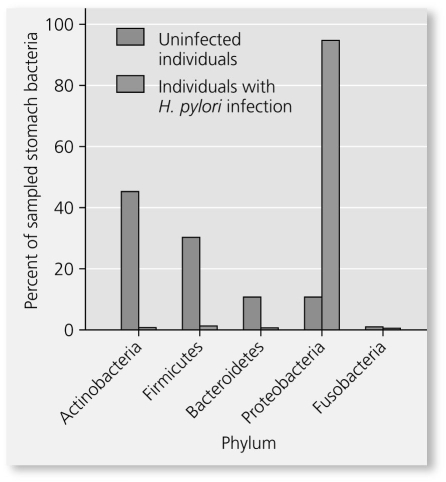
(Multiple Choice)
4.8/5 (90)
(90) Which of the following molecules provides the greatest energy storage for animals?
(Multiple Choice)
4.8/5 (80)
(80) 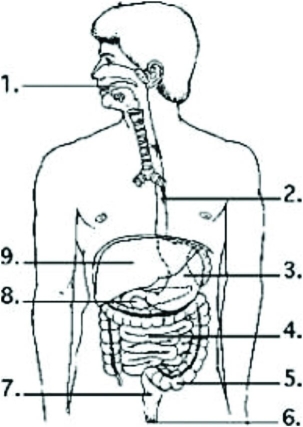 Examine the digestive system structures in the figure. In which labeled structure does the digestion of fats occur?
 (Multiple Choice)
4.8/5 (86)
(86) 
Filters
- Essay(0)
- Multiple Choice(0)
- Short Answer(0)
- True False(0)
- Matching(0)