



 Chat with AI
Exam 42: Animal Digestive Systems

Exam 1: Biology and Its Themes46 Questions
Exam 2: Atoms and Molecules61 Questions
Exam 3: The Chemistry of Water55 Questions
Exam 4: Carbon: the Basis of Molecular Diversity52 Questions
Exam 5: Biological Macromolecules and Lipids71 Questions
Exam 6: Energy and Life65 Questions
Exam 7: Cell Structure and Function66 Questions
Exam 8: Cell Membranes67 Questions
Exam 9: Cellular Signaling62 Questions
Exam 10: Cell Respiration68 Questions
Exam 11: Photosynthetic Processes64 Questions
Exam 12: Mitosis63 Questions
Exam 13: Sexual Life Cycles and Meiosis64 Questions
Exam 14: Mendelian Genetics65 Questions
Exam 15: Linkage and Chromosomes54 Questions
Exam 16: Nucleic Acids and Inheritance65 Questions
Exam 17: Expression of Genes70 Questions
Exam 18: Control of Gene Expression66 Questions
Exam 19: Dna Technology56 Questions
Exam 20: The Evolution of Genomes47 Questions
Exam 21: How Evolution Works60 Questions
Exam 22: Phylogenetic Reconstruction66 Questions
Exam 23: Microevolution65 Questions
Exam 24: Species and Speciation65 Questions
Exam 25: Macroevolution58 Questions
Exam 26: Introduction to Viruses54 Questions
Exam 27: Prokaryotes61 Questions
Exam 28: The Origin and Evolution of Eukaryotes66 Questions
Exam 29: Nonvascular and Seedless Vascular Plants72 Questions
Exam 30: Seed Plants64 Questions
Exam 31: Introduction to Fungi56 Questions
Exam 32: An Introduction to Animal Diversity58 Questions
Exam 33: Invertebrates58 Questions
Exam 34: Vertebrates66 Questions
Exam 35: Plant Structure and Growth68 Questions
Exam 36: Transport in Vascular Plants73 Questions
Exam 37: Plant Nutrition51 Questions
Exam 38: Reproduction of Flowering Plants59 Questions
Exam 39: Plant Signals and Behavior60 Questions
Exam 40: The Animal Body58 Questions
Exam 41: Chemical Signals in Animals62 Questions
Exam 42: Animal Digestive Systems58 Questions
Exam 43: Animal Transport Systems58 Questions
Exam 44: Animal Excretory Systems49 Questions
Exam 45: Animal Reproductive Systems64 Questions
Exam 46: Development in Animals68 Questions
Exam 47: Animal Defenses Against Infection65 Questions
Exam 48: Electrical Signals in Animals62 Questions
Exam 49: Neural Regulation in Animals69 Questions
Exam 50: Sensation and Movement in Animals68 Questions
Exam 51: An Overview of Ecology71 Questions
Exam 52: Behavioral Ecology64 Questions
Exam 53: Populations and Life History Traits73 Questions
Exam 54: Biodiversity and Communities71 Questions
Exam 55: Energy Flow and Chemical Cycling in Ecosystems80 Questions
Exam 56: Conservation and Global Ecology75 Questions
Select questions type


It is important for pregnant women to consume folic acid supplements because ________.
(Multiple Choice)
4.9/5  (76)
(76) After surgical removal of the gallbladder, a person might need to limit his or her dietary intake of ________.
(Multiple Choice)
4.8/5 (82)
(82) Food being digested in the stomach is in a highly acidic environment. The pH of the small intestine is higher than that of the stomach. Which statement best explains why this occurs?
(Multiple Choice)
4.9/5 (79)
(79) 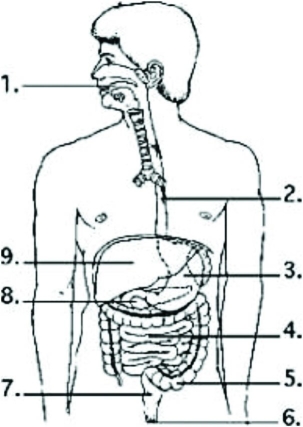 Examine the digestive system structures in the figure. In which labeled structure are bacteria that produce vitamins found in the greatest concentration?
 (Multiple Choice)
4.7/5 (67)
(67) A zoologist analyzes the jawbones of an extinct mammal and concludes that it was an herbivore. How did the zoologist most likely arrive at this conclusion?
(Multiple Choice)
4.8/5 (78)
(78) What is the importance of the mucus that is released by salivary glands?
(Multiple Choice)
4.8/5 (84)
(84) Iodine deficiency in mammals will most likely result in ________.
(Multiple Choice)
4.8/5 (80)
(80) In which digestive system organ does nearly all nutrient absorption occur?
(Multiple Choice)
4.9/5 (86)
(86) Which of the following is an advantage of a complete digestive system?
(Multiple Choice)
4.9/5 (73)
(73) Animals cannot produce enzymes to digest cellulose, yet many termite species consume cellulose from plant material as a main part of their diet. How do termites access the nutrients contained in cellulose?
(Multiple Choice)
4.9/5 (66)
(66) Constipation can result from the consumption of a substance that ________.
(Multiple Choice)
4.9/5 (82)
(82) Which group of animals are characterized by having a relatively long cecum?
(Multiple Choice)
4.9/5 (80)
(80) In which organ does almost all enzymatic digestion of food occur?
(Multiple Choice)
5.0/5 (67)
(67) If you found a vertebrate skull in the woods and the teeth were sharp and scissor-like, which type of food would you expect this animal to eat?
(Multiple Choice)
4.9/5 (85)
(85) When used appropriately by a patient, antibiotic treatment can effectively reduce bacteria populations and help fight infections. However, antibiotic treatments can have unintended effects. What is one concern when using antibiotics?
(Multiple Choice)
4.8/5 (85)
(85) The process by which digested dietary substances cross cell membranes to be used by the body is known as ________.
(Multiple Choice)
4.9/5 (96)
(96) 
Filters
- Essay(0)
- Multiple Choice(0)
- Short Answer(0)
- True False(0)
- Matching(0)