



 Chat with AI
Exam 29: Nonvascular and Seedless Vascular Plants

Exam 1: Biology and Its Themes46 Questions
Exam 2: Atoms and Molecules61 Questions
Exam 3: The Chemistry of Water55 Questions
Exam 4: Carbon: the Basis of Molecular Diversity52 Questions
Exam 5: Biological Macromolecules and Lipids71 Questions
Exam 6: Energy and Life65 Questions
Exam 7: Cell Structure and Function66 Questions
Exam 8: Cell Membranes67 Questions
Exam 9: Cellular Signaling62 Questions
Exam 10: Cell Respiration68 Questions
Exam 11: Photosynthetic Processes64 Questions
Exam 12: Mitosis63 Questions
Exam 13: Sexual Life Cycles and Meiosis64 Questions
Exam 14: Mendelian Genetics65 Questions
Exam 15: Linkage and Chromosomes54 Questions
Exam 16: Nucleic Acids and Inheritance65 Questions
Exam 17: Expression of Genes70 Questions
Exam 18: Control of Gene Expression66 Questions
Exam 19: Dna Technology56 Questions
Exam 20: The Evolution of Genomes47 Questions
Exam 21: How Evolution Works60 Questions
Exam 22: Phylogenetic Reconstruction66 Questions
Exam 23: Microevolution65 Questions
Exam 24: Species and Speciation65 Questions
Exam 25: Macroevolution58 Questions
Exam 26: Introduction to Viruses54 Questions
Exam 27: Prokaryotes61 Questions
Exam 28: The Origin and Evolution of Eukaryotes66 Questions
Exam 29: Nonvascular and Seedless Vascular Plants72 Questions
Exam 30: Seed Plants64 Questions
Exam 31: Introduction to Fungi56 Questions
Exam 32: An Introduction to Animal Diversity58 Questions
Exam 33: Invertebrates58 Questions
Exam 34: Vertebrates66 Questions
Exam 35: Plant Structure and Growth68 Questions
Exam 36: Transport in Vascular Plants73 Questions
Exam 37: Plant Nutrition51 Questions
Exam 38: Reproduction of Flowering Plants59 Questions
Exam 39: Plant Signals and Behavior60 Questions
Exam 40: The Animal Body58 Questions
Exam 41: Chemical Signals in Animals62 Questions
Exam 42: Animal Digestive Systems58 Questions
Exam 43: Animal Transport Systems58 Questions
Exam 44: Animal Excretory Systems49 Questions
Exam 45: Animal Reproductive Systems64 Questions
Exam 46: Development in Animals68 Questions
Exam 47: Animal Defenses Against Infection65 Questions
Exam 48: Electrical Signals in Animals62 Questions
Exam 49: Neural Regulation in Animals69 Questions
Exam 50: Sensation and Movement in Animals68 Questions
Exam 51: An Overview of Ecology71 Questions
Exam 52: Behavioral Ecology64 Questions
Exam 53: Populations and Life History Traits73 Questions
Exam 54: Biodiversity and Communities71 Questions
Exam 55: Energy Flow and Chemical Cycling in Ecosystems80 Questions
Exam 56: Conservation and Global Ecology75 Questions
Select questions type


The following question refers to the generalized life cycle for plants shown in the figure. Each number within a circle or square represents a specific plant or plant part, and each number over an arrow represents meiosis, mitosis, or fertilization. 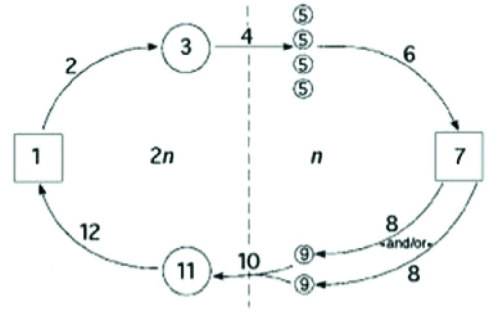 In the figure, which number represents the mature gametophyte?
Free
(Multiple Choice)
4.8/5  (68)
(68) Correct Answer: Verified
C
Two small, poorly drained lakes lie close to each other in a northern forest. The basins of both lakes are composed of the same geologic substratum. One lake is surrounded by a dense Sphagnum mat; the other is not. Compared to the pond with Sphagnum, the pond lacking the moss mat most likely has ________.
Free
(Multiple Choice)
4.8/5 (70)
(70) Correct Answer:Verified
VerifiedD
The following question refers to the generalized life cycle for plants shown in the figure. Each number within a circle or square represents a specific plant or plant part, and each number over an arrow represents meiosis, mitosis, or fertilization. 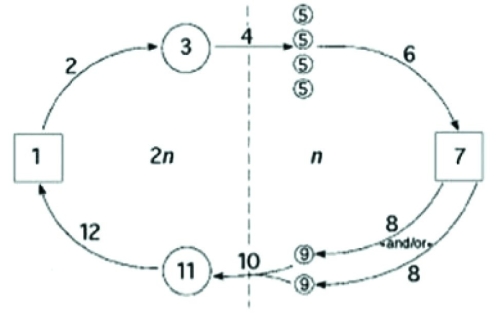 Which number represents a megaspore mother cell in the figure?
Free
(Multiple Choice)
4.9/5 (74)
(74) Correct Answer:Verified
VerifiedB
Use the following information to answer the question.
Big Bend National Park in Texas is mostly Chihuahuan desert, where rainfall averages about 25 centimeters per year. Yet, it is not uncommon when hiking in this extremely arid zone to encounter mosses and ferns. One such plant is called "flower of stone." It is not a flowering plant, nor does it produce seeds. Under arid conditions, its leaflike structures curl up. However, when it rains, it unfurls its leaves, which form a bright green rosette on the desert floor. Consequently, it is sometimes called the "resurrection plant." At first glance, it could be a fern, a true moss, or a spike moss.
Which of the following characteristics is (are) possessed in common by true mosses, ferns, and spike mosses, and therefore becomes useless at helping to determine to which of these groups "flower of stone" belongs?
(Multiple Choice)
4.9/5 (74)
(74) Which of the following describes a difference between the structures of spores and seeds?
(Multiple Choice)
4.9/5 (85)
(85) Which of the following characteristics of plants is absent in their closest relatives, the charophyte algae?
(Multiple Choice)
4.8/5 (70)
(70) Use the following information to answer the question.
Big Bend National Park in Texas is mostly desert, where rainfall averages about 25 centimeters per year. Yet, it is not uncommon when hiking in this extremely arid zone to encounter mosses and ferns.
What feature of both true mosses and ferns makes it most surprising that they can survive for many generations in dry deserts?
(Multiple Choice)
4.8/5 (70)
(70) Use the following information to answer the question.
Big Bend National Park in Texas is mostly desert, where rainfall averages about 25 centimeters per year. Yet, it is not uncommon when hiking in this extremely arid zone to encounter mosses and ferns.
Which of the following features is most important for true mosses and ferns to reproduce in the desert?
(Multiple Choice)
4.9/5 (78)
(78) Which of the following could occur after plants moved from the oceans to land?
(Multiple Choice)
4.9/5 (78)
(78) Which of the following claims about moss gametophytes is most consistent with the observation that they lack a cuticle and are 1-2 cells thick?
(Multiple Choice)
4.9/5 (75)
(75) Assuming that they all belong to the same plant, which of the following lists the structures from largest to smallest?
(Multiple Choice)
4.8/5 (72)
(72) A student encounters a pondweed that appears to be a charophyte. Which of the following features would best help the student determine whether the sample comes from a charophyte or from some other type of green alga?
(Multiple Choice)
4.8/5 (77)
(77) In plants, which of the following is a benefit of retaining the zygote on the living gametophyte?
(Multiple Choice)
4.8/5 (75)
(75) In which of the following structures of a plant are apical meristems found?
(Multiple Choice)
4.9/5 (79)
(79) Which of the following statements is accurate with regard to the life cycle of mosses?
(Multiple Choice)
4.9/5 (86)
(86) Which of the following is an accurate statement about the genus Sphagnum?
(Multiple Choice)
4.9/5 (82)
(82) What evidence do paleobotanists look for that indicates the movement of plants from water to land?
(Multiple Choice)
4.8/5 (71)
(71) The following question refers to the generalized life cycle for plants shown in the figure. Each number within a circle or square represents a specific plant or plant part, and each number over an arrow represents meiosis, mitosis, or fertilization. 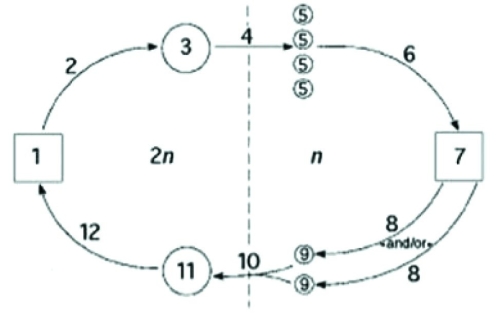 In the figure, which number represents an embryo?
 (Multiple Choice)
4.9/5 (82)
(82) You are hiking in a forest and come upon a mysterious plant, which you determine is either a lycophyte sporophyte or a monilophyte sporophyte. Which of the following characteristics would be most helpful in determining the correct classification of the plant?
(Multiple Choice)
4.8/5 (76)
(76) 
Filters
- Essay(0)
- Multiple Choice(0)
- Short Answer(0)
- True False(0)
- Matching(0)