



 Chat with AI
Exam 29: Nonvascular and Seedless Vascular Plants

Exam 1: Biology and Its Themes46 Questions
Exam 2: Atoms and Molecules61 Questions
Exam 3: The Chemistry of Water55 Questions
Exam 4: Carbon: the Basis of Molecular Diversity52 Questions
Exam 5: Biological Macromolecules and Lipids71 Questions
Exam 6: Energy and Life65 Questions
Exam 7: Cell Structure and Function66 Questions
Exam 8: Cell Membranes67 Questions
Exam 9: Cellular Signaling62 Questions
Exam 10: Cell Respiration68 Questions
Exam 11: Photosynthetic Processes64 Questions
Exam 12: Mitosis63 Questions
Exam 13: Sexual Life Cycles and Meiosis64 Questions
Exam 14: Mendelian Genetics65 Questions
Exam 15: Linkage and Chromosomes54 Questions
Exam 16: Nucleic Acids and Inheritance65 Questions
Exam 17: Expression of Genes70 Questions
Exam 18: Control of Gene Expression66 Questions
Exam 19: Dna Technology56 Questions
Exam 20: The Evolution of Genomes47 Questions
Exam 21: How Evolution Works60 Questions
Exam 22: Phylogenetic Reconstruction66 Questions
Exam 23: Microevolution65 Questions
Exam 24: Species and Speciation65 Questions
Exam 25: Macroevolution58 Questions
Exam 26: Introduction to Viruses54 Questions
Exam 27: Prokaryotes61 Questions
Exam 28: The Origin and Evolution of Eukaryotes66 Questions
Exam 29: Nonvascular and Seedless Vascular Plants72 Questions
Exam 30: Seed Plants64 Questions
Exam 31: Introduction to Fungi56 Questions
Exam 32: An Introduction to Animal Diversity58 Questions
Exam 33: Invertebrates58 Questions
Exam 34: Vertebrates66 Questions
Exam 35: Plant Structure and Growth68 Questions
Exam 36: Transport in Vascular Plants73 Questions
Exam 37: Plant Nutrition51 Questions
Exam 38: Reproduction of Flowering Plants59 Questions
Exam 39: Plant Signals and Behavior60 Questions
Exam 40: The Animal Body58 Questions
Exam 41: Chemical Signals in Animals62 Questions
Exam 42: Animal Digestive Systems58 Questions
Exam 43: Animal Transport Systems58 Questions
Exam 44: Animal Excretory Systems49 Questions
Exam 45: Animal Reproductive Systems64 Questions
Exam 46: Development in Animals68 Questions
Exam 47: Animal Defenses Against Infection65 Questions
Exam 48: Electrical Signals in Animals62 Questions
Exam 49: Neural Regulation in Animals69 Questions
Exam 50: Sensation and Movement in Animals68 Questions
Exam 51: An Overview of Ecology71 Questions
Exam 52: Behavioral Ecology64 Questions
Exam 53: Populations and Life History Traits73 Questions
Exam 54: Biodiversity and Communities71 Questions
Exam 55: Energy Flow and Chemical Cycling in Ecosystems80 Questions
Exam 56: Conservation and Global Ecology75 Questions
Select questions type


Which of the following symbiotic relationships would most likely allow bryophytes to live successfully in a bare, moist area?
(Multiple Choice)
5.0/5  (78)
(78) Use the following information to answer the question.
Big Bend National Park in Texas is mostly Chihuahuan desert, where rainfall averages about 25 centimeters per year. Yet, it is not uncommon when hiking in this extremely arid zone to encounter mosses and ferns. One such plant is called "flower of stone." It is not a flowering plant, nor does it produce seeds. Under arid conditions, its leaflike structures curl up. However, when it rains, it unfurls its leaves, which form a bright green rosette on the desert floor. Consequently, it is sometimes called the "resurrection plant." At first glance, it could be a fern, a true moss, or a spike moss.
Upon closer inspection of the leaves of "flower of stone," one can observe tiny, cone-like structures. Each cone-like structure emits spores of two different sizes. Further investigation also reveals that the roots of "flower of stone" branch only at the growing tip of the root, forming a Y-shaped structure. Consequently, "flower of stone" should be expected to possess which other characteristics?
(Multiple Choice)
4.8/5 (87)
(87) Which of the following statements correctly describes the colonization of terrestrial habitats by plants?
(Multiple Choice)
4.8/5 (73)
(73) Which of the following features of fertilization in plants are the same as in some of their algal ancestors?
(Multiple Choice)
4.7/5 (95)
(95) In an investigation of Sphagnum growth, researchers measured the growth of four different S. fuscum species (labeled a, ab, bc, and c in the figure) at four temperatures. The results of the investigation are represented in the graph. 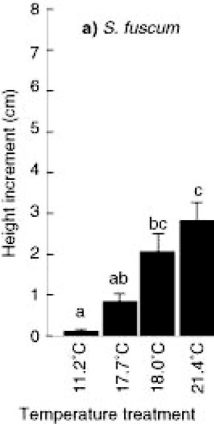 Which of the following claims is most consistent with the data?
 (Multiple Choice)
4.7/5 (78)
(78) Assuming equal spore production rates, what is a likely consequence in a bryophyte with both asexual and sexual reproduction versus one with only sexual reproduction?
(Multiple Choice)
4.8/5 (79)
(79) Suppose an efficient conducting system evolved in a moss that could transport water and other materials as high as a tall tree. Which of the following statements about "trees" of such a species would be true?
(Multiple Choice)
4.9/5 (86)
(86) The observation that both charophytes and green plants contain chlorophylls a and b is more consistent with which of the following claims?
(Multiple Choice)
4.7/5 (76)
(76) Which of the following is a similarity between bryophytes and seedless vascular plants?
(Multiple Choice)
4.7/5 (81)
(81) The following question refers to the generalized life cycle for plants shown in the figure. Each number within a circle or square represents a specific plant or plant part, and each number over an arrow represents meiosis, mitosis, or fertilization. 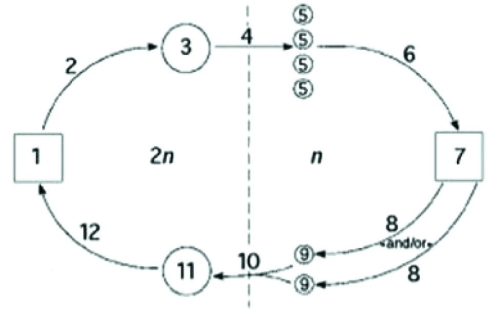 In the figure, the process labeled "6" involves ________.
 (Multiple Choice)
4.9/5 (78)
(78) Which of the following statements is correct regarding the life cycle of a fern?
(Multiple Choice)
4.9/5 (66)
(66) Which of the following characteristics is found in heterosporous plants?
(Multiple Choice)
4.9/5 (88)
(88) As global temperatures continue to rise, the water levels of some peatlands are expected to drop, exposing the peat to the air and causing it to decompose. Which of the following is most likely to result from this change in water levels?
(Multiple Choice)
4.8/5 (83)
(83) Which taxon includes organisms referred to as "embryophytes"?
(Multiple Choice)
4.8/5 (78)
(78) Use the following description to answer the question.
A biology student hiking in a forest discovers an erect, 15-centimeter-tall plant that bears microphylls and a strobili at its tallest point. When disturbed, the cone emits a dense cloud of brownish dust. Observing a sample with a magnifying glass reveals the dust to be composed of tiny spheres with a high oil content.
What type of plant has this student most likely discovered?
(Multiple Choice)
4.7/5 (88)
(88) Which of the following plant forms is best adapted to live in a forest with a temperate climate?
(Multiple Choice)
4.9/5 (71)
(71) Three of the following are evidence that charophytes are the closest algal relatives of plants. Select the exception.
(Multiple Choice)
4.8/5 (73)
(73) Which of the following organisms were most likely the direct ancestors of plants?
(Multiple Choice)
4.8/5 (85)
(85) Which of the following structures is present in a bryophyte at some point in their life cycles?
(Multiple Choice)
4.8/5 (88)
(88) A botanist discovers a new species of plant in a tropical rain forest. Investigation of its anatomy and life cycle shows the following characteristics: flagellated sperm, xylem with tracheids, separate gametophyte, sporophyte generations with the sporophyte dominant, and no seeds. To which of the following groups does this plant most likely belong?
(Multiple Choice)
4.9/5 (76)
(76) 
Filters
- Essay(0)
- Multiple Choice(0)
- Short Answer(0)
- True False(0)
- Matching(0)