



 Chat with AI
Exam 29: Nonvascular and Seedless Vascular Plants

Exam 1: Biology and Its Themes46 Questions
Exam 2: Atoms and Molecules61 Questions
Exam 3: The Chemistry of Water55 Questions
Exam 4: Carbon: the Basis of Molecular Diversity52 Questions
Exam 5: Biological Macromolecules and Lipids71 Questions
Exam 6: Energy and Life65 Questions
Exam 7: Cell Structure and Function66 Questions
Exam 8: Cell Membranes67 Questions
Exam 9: Cellular Signaling62 Questions
Exam 10: Cell Respiration68 Questions
Exam 11: Photosynthetic Processes64 Questions
Exam 12: Mitosis63 Questions
Exam 13: Sexual Life Cycles and Meiosis64 Questions
Exam 14: Mendelian Genetics65 Questions
Exam 15: Linkage and Chromosomes54 Questions
Exam 16: Nucleic Acids and Inheritance65 Questions
Exam 17: Expression of Genes70 Questions
Exam 18: Control of Gene Expression66 Questions
Exam 19: Dna Technology56 Questions
Exam 20: The Evolution of Genomes47 Questions
Exam 21: How Evolution Works60 Questions
Exam 22: Phylogenetic Reconstruction66 Questions
Exam 23: Microevolution65 Questions
Exam 24: Species and Speciation65 Questions
Exam 25: Macroevolution58 Questions
Exam 26: Introduction to Viruses54 Questions
Exam 27: Prokaryotes61 Questions
Exam 28: The Origin and Evolution of Eukaryotes66 Questions
Exam 29: Nonvascular and Seedless Vascular Plants72 Questions
Exam 30: Seed Plants64 Questions
Exam 31: Introduction to Fungi56 Questions
Exam 32: An Introduction to Animal Diversity58 Questions
Exam 33: Invertebrates58 Questions
Exam 34: Vertebrates66 Questions
Exam 35: Plant Structure and Growth68 Questions
Exam 36: Transport in Vascular Plants73 Questions
Exam 37: Plant Nutrition51 Questions
Exam 38: Reproduction of Flowering Plants59 Questions
Exam 39: Plant Signals and Behavior60 Questions
Exam 40: The Animal Body58 Questions
Exam 41: Chemical Signals in Animals62 Questions
Exam 42: Animal Digestive Systems58 Questions
Exam 43: Animal Transport Systems58 Questions
Exam 44: Animal Excretory Systems49 Questions
Exam 45: Animal Reproductive Systems64 Questions
Exam 46: Development in Animals68 Questions
Exam 47: Animal Defenses Against Infection65 Questions
Exam 48: Electrical Signals in Animals62 Questions
Exam 49: Neural Regulation in Animals69 Questions
Exam 50: Sensation and Movement in Animals68 Questions
Exam 51: An Overview of Ecology71 Questions
Exam 52: Behavioral Ecology64 Questions
Exam 53: Populations and Life History Traits73 Questions
Exam 54: Biodiversity and Communities71 Questions
Exam 55: Energy Flow and Chemical Cycling in Ecosystems80 Questions
Exam 56: Conservation and Global Ecology75 Questions
Select questions type


Compared to nonvascular plants, the ancient relatives of vascular plants ________.
(Multiple Choice)
4.8/5  (79)
(79) If the kingdom Plantae is someday expanded to include the charophytes (stoneworts), which of the following shared derived characteristics would be included in the revised kingdom?
(Multiple Choice)
4.9/5 (71)
(71) You find a green organism in a pond near your house and believe it is a plant, not an alga. Which of the following characteristics would best support your identification of the organism as a plant and not an alga?
(Multiple Choice)
4.9/5 (77)
(77) Which of the following statements correctly describes a characteristic of archegonia?
(Multiple Choice)
4.9/5 (70)
(70) Which of the following statements is correct regarding the structure of a fern?
(Multiple Choice)
4.8/5 (80)
(80) If bryophytes do not have vascular tissue, how can some mosses reach 60 centimeters tall?
(Multiple Choice)
4.8/5 (71)
(71) Which of the following is a common feature among liverworts, hornworts, and mosses?
(Multiple Choice)
4.9/5 (72)
(72) Dawsonia is a moss that can grow to 1 meter in height, which is not common among mosses. Which of the following structures is likely to be found in Dawsonia but not in most other mosses?
(Multiple Choice)
4.7/5 (68)
(68) Which of the following statements about stomata is correct?
(Multiple Choice)
4.9/5 (89)
(89) Suppose an efficient conducting system evolved in a moss that could transport water and other materials as high as a tall tree. Which of the following statements about "trees" of such a species would be accurate?
(Multiple Choice)
4.7/5 (68)
(68) Which of the following statements is most likely true of the cuticle in plant species lacking pores?
(Multiple Choice)
4.9/5 (57)
(57) Which of the following outcomes is most likely if animals had alternation of generations?
(Multiple Choice)
4.9/5 (76)
(76) A biology student hiking in a forest discovers a 15-centimeter-tall plant that bears microphylls and a strobili at its tallest point. When disturbed, the cone emits a dense cloud of brownish dust. A pocket magnifying glass reveals the dust to be composed of tiny spheres with a high oil content. Which of the following chemicals are most likely to be detected in substantial amounts upon chemical analysis of these small spheres?
(Multiple Choice)
4.7/5 (58)
(58) In an investigation of Sphagnum growth, researchers measured the growth of four different S. fuscum species (labeled a, ab, bc, and c in the figure) at four temperatures. The results of the investigation are represented in the graph. 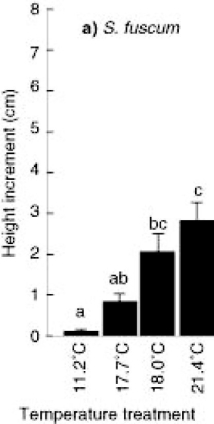 What would you expect to happen to the geographic range of S. fuscum as the average temperatures on Earth rise?
 (Multiple Choice)
4.9/5 (80)
(80) Which of the following statements about the zygotes of plants is most likely to be accurate?
(Multiple Choice)
4.7/5 (78)
(78) About 450 million years ago, the terrestrial landscape on Earth would most likely have had which of the following features?
(Multiple Choice)
4.9/5 (62)
(62) Which of the following is an accurate statement about plant reproduction?
(Multiple Choice)
4.9/5 (81)
(81) The evolution of vascular tissue in plants facilitated which of the following changes?
(Multiple Choice)
4.9/5 (97)
(97) A sample of mosses and ferns is comprised of which of the following?
(Multiple Choice)
4.9/5 (77)
(77) 
Filters
- Essay(0)
- Multiple Choice(0)
- Short Answer(0)
- True False(0)
- Matching(0)