



 Chat with AI
Exam 44: Animal Excretory Systems

Exam 1: Biology and Its Themes46 Questions
Exam 2: Atoms and Molecules61 Questions
Exam 3: The Chemistry of Water55 Questions
Exam 4: Carbon: the Basis of Molecular Diversity52 Questions
Exam 5: Biological Macromolecules and Lipids71 Questions
Exam 6: Energy and Life65 Questions
Exam 7: Cell Structure and Function66 Questions
Exam 8: Cell Membranes67 Questions
Exam 9: Cellular Signaling62 Questions
Exam 10: Cell Respiration68 Questions
Exam 11: Photosynthetic Processes64 Questions
Exam 12: Mitosis63 Questions
Exam 13: Sexual Life Cycles and Meiosis64 Questions
Exam 14: Mendelian Genetics65 Questions
Exam 15: Linkage and Chromosomes54 Questions
Exam 16: Nucleic Acids and Inheritance65 Questions
Exam 17: Expression of Genes70 Questions
Exam 18: Control of Gene Expression66 Questions
Exam 19: Dna Technology56 Questions
Exam 20: The Evolution of Genomes47 Questions
Exam 21: How Evolution Works60 Questions
Exam 22: Phylogenetic Reconstruction66 Questions
Exam 23: Microevolution65 Questions
Exam 24: Species and Speciation65 Questions
Exam 25: Macroevolution58 Questions
Exam 26: Introduction to Viruses54 Questions
Exam 27: Prokaryotes61 Questions
Exam 28: The Origin and Evolution of Eukaryotes66 Questions
Exam 29: Nonvascular and Seedless Vascular Plants72 Questions
Exam 30: Seed Plants64 Questions
Exam 31: Introduction to Fungi56 Questions
Exam 32: An Introduction to Animal Diversity58 Questions
Exam 33: Invertebrates58 Questions
Exam 34: Vertebrates66 Questions
Exam 35: Plant Structure and Growth68 Questions
Exam 36: Transport in Vascular Plants73 Questions
Exam 37: Plant Nutrition51 Questions
Exam 38: Reproduction of Flowering Plants59 Questions
Exam 39: Plant Signals and Behavior60 Questions
Exam 40: The Animal Body58 Questions
Exam 41: Chemical Signals in Animals62 Questions
Exam 42: Animal Digestive Systems58 Questions
Exam 43: Animal Transport Systems58 Questions
Exam 44: Animal Excretory Systems49 Questions
Exam 45: Animal Reproductive Systems64 Questions
Exam 46: Development in Animals68 Questions
Exam 47: Animal Defenses Against Infection65 Questions
Exam 48: Electrical Signals in Animals62 Questions
Exam 49: Neural Regulation in Animals69 Questions
Exam 50: Sensation and Movement in Animals68 Questions
Exam 51: An Overview of Ecology71 Questions
Exam 52: Behavioral Ecology64 Questions
Exam 53: Populations and Life History Traits73 Questions
Exam 54: Biodiversity and Communities71 Questions
Exam 55: Energy Flow and Chemical Cycling in Ecosystems80 Questions
Exam 56: Conservation and Global Ecology75 Questions
Select questions type


Use the following figure to answer the question. 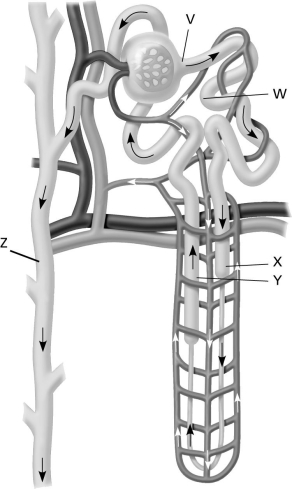 Which labeled structure identifies where passive water reabsorption takes place in the kidney?
Free
(Multiple Choice)
4.9/5  (69)
(69) Correct Answer: Verified
C
Which process does not display solute specificity?
Free
(Multiple Choice)
4.8/5 (84)
(84) Correct Answer:Verified
VerifiedC
Which of the following describes how antidiuretic hormone (ADH) and the renin-angiotensin-aldosterone system (RAAS) work together to maintaining osmoregulatory homeostasis?
Free
(Multiple Choice)
4.9/5 (72)
(72) Correct Answer:Verified
VerifiedA
Which statement describes an advantage to birds that secrete uric acid as their nitrogenous waste?
(Multiple Choice)
4.8/5 (75)
(75) In which of the following species should natural selection favor the highest proportion of juxtamedullary nephrons?
(Multiple Choice)
4.7/5 (63)
(63) African lungfish, which are often found in small, stagnant pools of fresh water, produce urea as a nitrogenous waste. What is an advantage of this adaptation?
(Multiple Choice)
4.8/5 (84)
(84) Which of the following is characteristic of juxtamedullary nephrons?
(Multiple Choice)
5.0/5 (88)
(88) An excretory system that is partly based on the filtration of fluid under high hydrostatic pressure is the ________.
(Multiple Choice)
4.9/5 (65)
(65) Which of the following stimuli is most likely to increase secretion of antidiuretic hormone (ADH)?
(Multiple Choice)
4.9/5 (75)
(75) If you are hiking through the desert for several days, drinking which of the following would best ensure proper hydration?
(Multiple Choice)
4.9/5 (82)
(82) Which of the following processes must freshwater fish undertake to maintain homeostasis?
(Multiple Choice)
4.7/5 (64)
(64) In animals, the catabolism of which molecules contributes most to the production of nitrogenous wastes?
(Multiple Choice)
4.7/5 (67)
(67) Urolithiasis is a medical condition in which minerals stick together in concentrated urine, forming kidney stones. Suppose that a patient is diagnosed with urolithiasis and through ultrasound it is found that a kidney stone is blocking urine flow in the ureter. The flow of urine to which structure will be most directly affected by the blockage?
(Multiple Choice)
4.9/5 (68)
(68) Materials are returned to the blood from the filtrate by which of the following processes?
(Multiple Choice)
4.8/5 (96)
(96) The body fluids of an osmoconformer would be ________ with its ________ environment.
(Multiple Choice)
4.8/5 (67)
(67) Which of the following animals generally has the lowest volume of urine production?
(Multiple Choice)
4.9/5 (82)
(82) The high osmolarity of the renal medulla is maintained by which of the following?
(Multiple Choice)
4.8/5 (67)
(67) Which option correctly associates the mechanism for osmoregulation or nitrogen removal with the appropriate animal?
(Multiple Choice)
4.9/5 (61)
(61) Which of the following occurs in processing of filtrate in the proximal and distal tubules?
(Multiple Choice)
5.0/5 (69)
(69) 
Filters
- Essay(0)
- Multiple Choice(0)
- Short Answer(0)
- True False(0)
- Matching(0)