



 Chat with AI
Exam 44: Animal Excretory Systems

Exam 1: Biology and Its Themes46 Questions
Exam 2: Atoms and Molecules61 Questions
Exam 3: The Chemistry of Water55 Questions
Exam 4: Carbon: the Basis of Molecular Diversity52 Questions
Exam 5: Biological Macromolecules and Lipids71 Questions
Exam 6: Energy and Life65 Questions
Exam 7: Cell Structure and Function66 Questions
Exam 8: Cell Membranes67 Questions
Exam 9: Cellular Signaling62 Questions
Exam 10: Cell Respiration68 Questions
Exam 11: Photosynthetic Processes64 Questions
Exam 12: Mitosis63 Questions
Exam 13: Sexual Life Cycles and Meiosis64 Questions
Exam 14: Mendelian Genetics65 Questions
Exam 15: Linkage and Chromosomes54 Questions
Exam 16: Nucleic Acids and Inheritance65 Questions
Exam 17: Expression of Genes70 Questions
Exam 18: Control of Gene Expression66 Questions
Exam 19: Dna Technology56 Questions
Exam 20: The Evolution of Genomes47 Questions
Exam 21: How Evolution Works60 Questions
Exam 22: Phylogenetic Reconstruction66 Questions
Exam 23: Microevolution65 Questions
Exam 24: Species and Speciation65 Questions
Exam 25: Macroevolution58 Questions
Exam 26: Introduction to Viruses54 Questions
Exam 27: Prokaryotes61 Questions
Exam 28: The Origin and Evolution of Eukaryotes66 Questions
Exam 29: Nonvascular and Seedless Vascular Plants72 Questions
Exam 30: Seed Plants64 Questions
Exam 31: Introduction to Fungi56 Questions
Exam 32: An Introduction to Animal Diversity58 Questions
Exam 33: Invertebrates58 Questions
Exam 34: Vertebrates66 Questions
Exam 35: Plant Structure and Growth68 Questions
Exam 36: Transport in Vascular Plants73 Questions
Exam 37: Plant Nutrition51 Questions
Exam 38: Reproduction of Flowering Plants59 Questions
Exam 39: Plant Signals and Behavior60 Questions
Exam 40: The Animal Body58 Questions
Exam 41: Chemical Signals in Animals62 Questions
Exam 42: Animal Digestive Systems58 Questions
Exam 43: Animal Transport Systems58 Questions
Exam 44: Animal Excretory Systems49 Questions
Exam 45: Animal Reproductive Systems64 Questions
Exam 46: Development in Animals68 Questions
Exam 47: Animal Defenses Against Infection65 Questions
Exam 48: Electrical Signals in Animals62 Questions
Exam 49: Neural Regulation in Animals69 Questions
Exam 50: Sensation and Movement in Animals68 Questions
Exam 51: An Overview of Ecology71 Questions
Exam 52: Behavioral Ecology64 Questions
Exam 53: Populations and Life History Traits73 Questions
Exam 54: Biodiversity and Communities71 Questions
Exam 55: Energy Flow and Chemical Cycling in Ecosystems80 Questions
Exam 56: Conservation and Global Ecology75 Questions
Select questions type


Studies of cricket Malpighian tubules revealed that potassium ions accumulated inside the tubule, moving against the potassium concentration gradient. Based on the information, which of the following is the best inference about the mechanism of potassium transport?
(Multiple Choice)
4.9/5  (78)
(78) Ammonia is likely to be the primary nitrogenous waste from organisms that evolved in which of the following habitats?
(Multiple Choice)
4.8/5 (75)
(75) Use the following figure to answer the question. 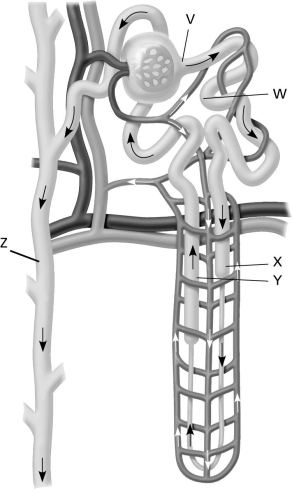 Which labeled structure is influenced by hormones to change the concentration of the urine?
 (Multiple Choice)
4.8/5 (95)
(95) Unlike most bony fishes, sharks maintain body fluids that are isoosmotic to seawater, so they are considered by many to be osmoconformers. Nonetheless, sharks osmoregulate at least partially by ________.
(Multiple Choice)
4.8/5 (76)
(76) Excretory organs known as Malpighian tubules are present in which of the following organisms?
(Multiple Choice)
4.8/5 (77)
(77) Nitrogenous waste from an unknown animal is collected and analyzed. The waste is sticky like glue or paste, and upon chemical analysis contains a molecule composed of two fused rings. The waste is most likely from which of the following animals?
(Multiple Choice)
4.8/5 (62)
(62) Which answer best describes the formation of urea in mammals?
(Multiple Choice)
4.9/5 (83)
(83) An increase in protein kinase A activity in all cells of the collecting duct cells will most likely have which effect on kidney function?
(Multiple Choice)
4.9/5 (77)
(77) Which of the following is an advantage of excreting nitrogenous wastes as urea rather than as ammonia?
(Multiple Choice)
4.8/5 (80)
(80) Use the following figure to answer the question. 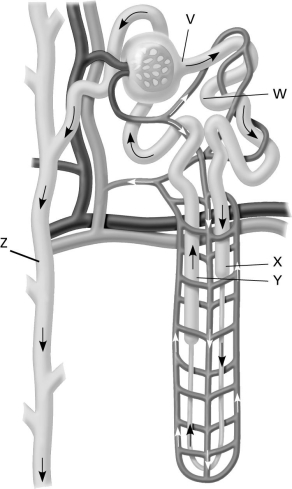 Which labeled structure identifies where filtration take place in the kidney?
 (Multiple Choice)
4.8/5 (71)
(71) Use the following figure to answer the question. 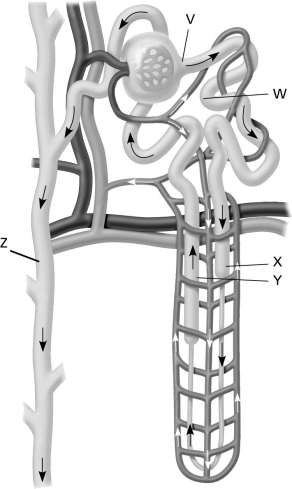 Which labeled structure identifies where selective secretion of toxins and drugs take place?
 (Multiple Choice)
4.8/5 (70)
(70) Which of the following best explains the death of a freshwater fish that had been placed accidentally in saltwater?
(Multiple Choice)
5.0/5 (84)
(84) Which of the following best describes the role of transport epithelia in osmoregulation of marine fish with bony skeletons?
(Multiple Choice)
4.8/5 (80)
(80) Which statement best explains the relatively high metabolic rate of kidneys compared to the other body organs?
(Multiple Choice)
4.8/5 (75)
(75) Compared to the seawater around them, most marine invertebrates are ________.
(Multiple Choice)
4.7/5 (77)
(77) Which of the following can trigger osmoregulatory adjustment via the atrial natriuretic peptide system?
(Multiple Choice)
4.8/5 (72)
(72) Salmon eggs hatch in fresh water. The fish then migrate to the ocean (a hyperosmotic solution) and, after several years of feeding and growing, return to fresh water to breed. Which statement best explains how these organisms make the transition from fresh water to ocean water and back to fresh water?
(Multiple Choice)
4.8/5 (79)
(79) Which of the following will likely occur in a human who has no access to fresh water but is forced to drink seawater instead?
(Multiple Choice)
4.8/5 (82)
(82) The loop of Henle dips into the renal cortex. Which statement best explains the advantage of this feature for osmoregulation in terrestrial vertebrates?
(Multiple Choice)
4.9/5 (80)
(80) 
Filters
- Essay(0)
- Multiple Choice(0)
- Short Answer(0)
- True False(0)
- Matching(0)