



 Chat with AI
Exam 36: Transport in Vascular Plants

Exam 1: Biology and Its Themes46 Questions
Exam 2: Atoms and Molecules61 Questions
Exam 3: The Chemistry of Water55 Questions
Exam 4: Carbon: the Basis of Molecular Diversity52 Questions
Exam 5: Biological Macromolecules and Lipids71 Questions
Exam 6: Energy and Life65 Questions
Exam 7: Cell Structure and Function66 Questions
Exam 8: Cell Membranes67 Questions
Exam 9: Cellular Signaling62 Questions
Exam 10: Cell Respiration68 Questions
Exam 11: Photosynthetic Processes64 Questions
Exam 12: Mitosis63 Questions
Exam 13: Sexual Life Cycles and Meiosis64 Questions
Exam 14: Mendelian Genetics65 Questions
Exam 15: Linkage and Chromosomes54 Questions
Exam 16: Nucleic Acids and Inheritance65 Questions
Exam 17: Expression of Genes70 Questions
Exam 18: Control of Gene Expression66 Questions
Exam 19: Dna Technology56 Questions
Exam 20: The Evolution of Genomes47 Questions
Exam 21: How Evolution Works60 Questions
Exam 22: Phylogenetic Reconstruction66 Questions
Exam 23: Microevolution65 Questions
Exam 24: Species and Speciation65 Questions
Exam 25: Macroevolution58 Questions
Exam 26: Introduction to Viruses54 Questions
Exam 27: Prokaryotes61 Questions
Exam 28: The Origin and Evolution of Eukaryotes66 Questions
Exam 29: Nonvascular and Seedless Vascular Plants72 Questions
Exam 30: Seed Plants64 Questions
Exam 31: Introduction to Fungi56 Questions
Exam 32: An Introduction to Animal Diversity58 Questions
Exam 33: Invertebrates58 Questions
Exam 34: Vertebrates66 Questions
Exam 35: Plant Structure and Growth68 Questions
Exam 36: Transport in Vascular Plants73 Questions
Exam 37: Plant Nutrition51 Questions
Exam 38: Reproduction of Flowering Plants59 Questions
Exam 39: Plant Signals and Behavior60 Questions
Exam 40: The Animal Body58 Questions
Exam 41: Chemical Signals in Animals62 Questions
Exam 42: Animal Digestive Systems58 Questions
Exam 43: Animal Transport Systems58 Questions
Exam 44: Animal Excretory Systems49 Questions
Exam 45: Animal Reproductive Systems64 Questions
Exam 46: Development in Animals68 Questions
Exam 47: Animal Defenses Against Infection65 Questions
Exam 48: Electrical Signals in Animals62 Questions
Exam 49: Neural Regulation in Animals69 Questions
Exam 50: Sensation and Movement in Animals68 Questions
Exam 51: An Overview of Ecology71 Questions
Exam 52: Behavioral Ecology64 Questions
Exam 53: Populations and Life History Traits73 Questions
Exam 54: Biodiversity and Communities71 Questions
Exam 55: Energy Flow and Chemical Cycling in Ecosystems80 Questions
Exam 56: Conservation and Global Ecology75 Questions
Select questions type


Which structure or compartment is separate from the apoplastic transport route?

Free
(Multiple Choice)
4.7/5  (85)
(85) Correct Answer: Verified
B
Movement of phloem sap from a source to a sink ________.
Free
(Multiple Choice)
4.8/5 (78)
(78) Correct Answer:Verified
VerifiedB
A plant developed a mineral deficiency after being treated with a fungicide. What is the most probable cause of the deficiency?
Free
(Multiple Choice)
4.9/5 (86)
(86) Correct Answer:Verified
VerifiedB
A water molecule could move all the way through a plant from soil to root to leaf to air and pass through a living cell only once. This living cell would be a part of which structure?
(Multiple Choice)
4.8/5 (71)
(71) Which one of the following does not correctly match the form with its function?
(Multiple Choice)
4.9/5 (81)
(81) Arrange the following five events in an order that explains the mass flow of materials in the phloem.
1) Water diffuses into the sieve tubes.
2) Leaf cells produce sugar by photosynthesis.
3) Solutes are actively transported into sieve tubes.
4) Sugar is transported from cell to cell in the leaf.
5) Sugar moves down the stem.
(Multiple Choice)
4.9/5 (76)
(76) How does the same cell differ if it is a flaccid cell compared to a turgid cell?
(Multiple Choice)
4.9/5 (80)
(80) Under which of the following conditions would guttation be most likely to occur?
(Multiple Choice)
4.8/5 (60)
(60) Several tomato plants are growing in a small garden plot. If soil water potential were to drop significantly on a hot, summer afternoon, which of the following would most likely occur?
(Multiple Choice)
4.9/5 (81)
(81) The opening of stomata involves which of the following processes?
(Multiple Choice)
5.0/5 (88)
(88) Which of the following best explains decreased photosynthesis in wilted leaves?
(Multiple Choice)
4.7/5 (91)
(91) Pressure data, measured from one of the vascular tissue types connecting leaf to root in a 11 m tall tree, is presented in the graph below. 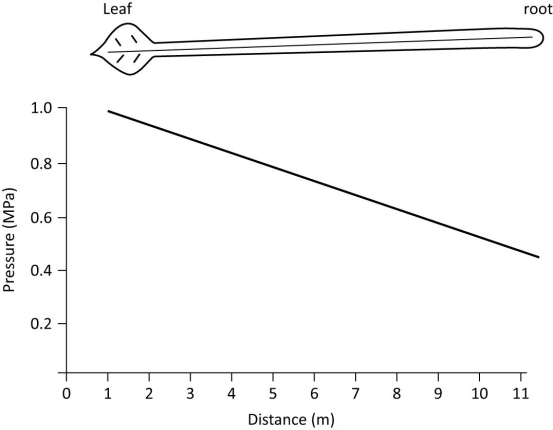 Which of the following is the most appropriate title for this graph?
 (Multiple Choice)
4.8/5 (76)
(76) Xerophytes employ a number of different strategies to survive in very dry environments. The following table summarizes average stomatal densities from desert plants with four different ecological strategies.
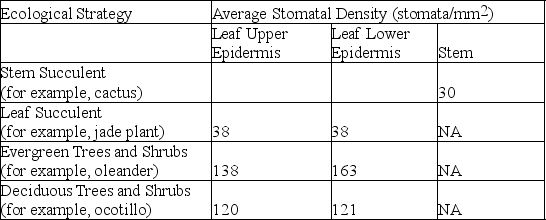 Based on the data, plants adopting which ecological strategy are most likely to have stomata sunken below the epidermis or in crypts?
 (Multiple Choice)
4.8/5 (61)
(61) Plants adapted to arid environments are described as which of the following?
(Multiple Choice)
4.9/5 (92)
(92) Which of the following best predicts the movement of water across biological membranes?
(Multiple Choice)
4.7/5 (80)
(80) Which of the following are important components of long-distance transport process in xylem?
I. the cohesion of water molecules
II. a negative water potential
III. the active transport of solutes
IV. bulk flow from source to sink
(Multiple Choice)
4.9/5 (79)
(79) Compared to a cell with few aquaporins in its membrane, a cell containing many aquaporins will have which of the following?
(Multiple Choice)
4.9/5 (86)
(86) If you place a flaccid plant cell in pure water, which of the following will occur?
(Multiple Choice)
4.9/5 (93)
(93) 
Filters
- Essay(0)
- Multiple Choice(0)
- Short Answer(0)
- True False(0)
- Matching(0)