



 Chat with AI
Exam 36: Transport in Vascular Plants

Exam 1: Biology and Its Themes46 Questions
Exam 2: Atoms and Molecules61 Questions
Exam 3: The Chemistry of Water55 Questions
Exam 4: Carbon: the Basis of Molecular Diversity52 Questions
Exam 5: Biological Macromolecules and Lipids71 Questions
Exam 6: Energy and Life65 Questions
Exam 7: Cell Structure and Function66 Questions
Exam 8: Cell Membranes67 Questions
Exam 9: Cellular Signaling62 Questions
Exam 10: Cell Respiration68 Questions
Exam 11: Photosynthetic Processes64 Questions
Exam 12: Mitosis63 Questions
Exam 13: Sexual Life Cycles and Meiosis64 Questions
Exam 14: Mendelian Genetics65 Questions
Exam 15: Linkage and Chromosomes54 Questions
Exam 16: Nucleic Acids and Inheritance65 Questions
Exam 17: Expression of Genes70 Questions
Exam 18: Control of Gene Expression66 Questions
Exam 19: Dna Technology56 Questions
Exam 20: The Evolution of Genomes47 Questions
Exam 21: How Evolution Works60 Questions
Exam 22: Phylogenetic Reconstruction66 Questions
Exam 23: Microevolution65 Questions
Exam 24: Species and Speciation65 Questions
Exam 25: Macroevolution58 Questions
Exam 26: Introduction to Viruses54 Questions
Exam 27: Prokaryotes61 Questions
Exam 28: The Origin and Evolution of Eukaryotes66 Questions
Exam 29: Nonvascular and Seedless Vascular Plants72 Questions
Exam 30: Seed Plants64 Questions
Exam 31: Introduction to Fungi56 Questions
Exam 32: An Introduction to Animal Diversity58 Questions
Exam 33: Invertebrates58 Questions
Exam 34: Vertebrates66 Questions
Exam 35: Plant Structure and Growth68 Questions
Exam 36: Transport in Vascular Plants73 Questions
Exam 37: Plant Nutrition51 Questions
Exam 38: Reproduction of Flowering Plants59 Questions
Exam 39: Plant Signals and Behavior60 Questions
Exam 40: The Animal Body58 Questions
Exam 41: Chemical Signals in Animals62 Questions
Exam 42: Animal Digestive Systems58 Questions
Exam 43: Animal Transport Systems58 Questions
Exam 44: Animal Excretory Systems49 Questions
Exam 45: Animal Reproductive Systems64 Questions
Exam 46: Development in Animals68 Questions
Exam 47: Animal Defenses Against Infection65 Questions
Exam 48: Electrical Signals in Animals62 Questions
Exam 49: Neural Regulation in Animals69 Questions
Exam 50: Sensation and Movement in Animals68 Questions
Exam 51: An Overview of Ecology71 Questions
Exam 52: Behavioral Ecology64 Questions
Exam 53: Populations and Life History Traits73 Questions
Exam 54: Biodiversity and Communities71 Questions
Exam 55: Energy Flow and Chemical Cycling in Ecosystems80 Questions
Exam 56: Conservation and Global Ecology75 Questions
Select questions type


A plant cell with a Cs of -0.65 MPa maintains a constant volume when bathed in a solution that has a Cs of -0.30 MPa and is in an open container. The cell has a ________.
(Multiple Choice)
4.9/5  (76)
(76) Most of the water absorbed by a plant is used for what purpose?
(Multiple Choice)
4.8/5 (77)
(77) Photosynthesis ceases when leaves wilt, mainly because ________.
(Multiple Choice)
4.7/5 (77)
(77) Plasmodesmata can change in number and, when dilated, can provide a passageway for which of the following?
(Multiple Choice)
4.9/5 (86)
(86) Water potential is generally most negative in which of the following parts of a plant?
(Multiple Choice)
4.8/5 (78)
(78) Which of the following is another term for solute potential in a cell?
(Multiple Choice)
4.9/5 (61)
(61) If Ψ P = 0.3 MPa and ΨS = -0.45 MPa what will be the resulting Ψ?
(Multiple Choice)
4.7/5 (78)
(78) Given that early land plants most likely share a common ancestor with green algae, the earliest land plants most likely belonged to which of the following categories?
(Multiple Choice)
4.8/5 (85)
(85) The value for Ψ in root tissue was found to be -0.15 MPa If the root tissue were placed in a 0.1 M solution of sucrose (Ψ = -0.23 MPa) the net water flow will be in which of the following directions?
(Multiple Choice)
4.9/5 (77)
(77) In the pressure-flow mechanism, loading of sucrose from companion cells to sieve-tube elements requires which of the following?
(Multiple Choice)
4.8/5 (80)
(80) Based on the figure, at what time of day is the concentration of the hormone ABA most likely to be highest? 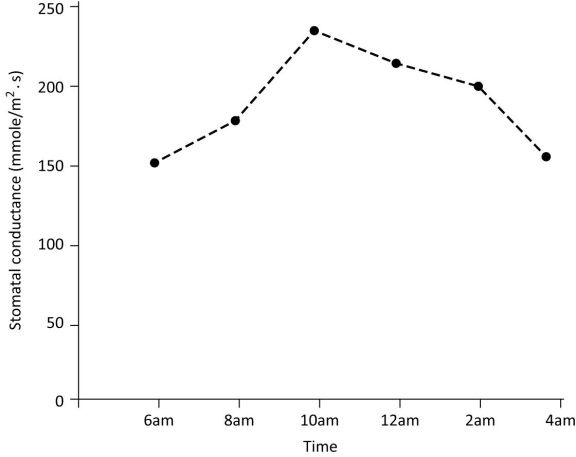
(Multiple Choice)
4.8/5 (88)
(88) Which of the following best describes why water flows into the source end of a sieve tube?
(Multiple Choice)
4.9/5 (84)
(84) The flux of which one of the following ions plays a dominant role in adjusting the turgor of guard cells during the opening and closing of stomata?
(Multiple Choice)
4.7/5 (94)
(94) Compared with a cell with few aquaporin proteins in its membrane, a cell containing many aquaporin proteins will ________.
(Multiple Choice)
4.9/5 (82)
(82) The water lost during transpiration is a negative side effect of the plant's requirement for gas exchange. Which of the following is a positive effect of this water loss?
(Multiple Choice)
4.8/5 (83)
(83) What is the function of proton pumps localized in the plant plasma membrane?
(Multiple Choice)
4.8/5 (74)
(74) The apoplast in plant tissues may include which of the following?
(Multiple Choice)
4.8/5 (83)
(83) Which of the following contribute to the surface area available for water absorption from the soil by a plant root system?
I. root hairs
II. endodermis
III. mycorrhizae
IV. branching
(Multiple Choice)
4.9/5 (74)
(74) Which of the following is a net sugar source for a deciduous angiosperm tree?
(Multiple Choice)
5.0/5 (81)
(81) 
Filters
- Essay(0)
- Multiple Choice(0)
- Short Answer(0)
- True False(0)
- Matching(0)