



 Chat with AI
Exam 36: Transport in Vascular Plants

Exam 1: Biology and Its Themes46 Questions
Exam 2: Atoms and Molecules61 Questions
Exam 3: The Chemistry of Water55 Questions
Exam 4: Carbon: the Basis of Molecular Diversity52 Questions
Exam 5: Biological Macromolecules and Lipids71 Questions
Exam 6: Energy and Life65 Questions
Exam 7: Cell Structure and Function66 Questions
Exam 8: Cell Membranes67 Questions
Exam 9: Cellular Signaling62 Questions
Exam 10: Cell Respiration68 Questions
Exam 11: Photosynthetic Processes64 Questions
Exam 12: Mitosis63 Questions
Exam 13: Sexual Life Cycles and Meiosis64 Questions
Exam 14: Mendelian Genetics65 Questions
Exam 15: Linkage and Chromosomes54 Questions
Exam 16: Nucleic Acids and Inheritance65 Questions
Exam 17: Expression of Genes70 Questions
Exam 18: Control of Gene Expression66 Questions
Exam 19: Dna Technology56 Questions
Exam 20: The Evolution of Genomes47 Questions
Exam 21: How Evolution Works60 Questions
Exam 22: Phylogenetic Reconstruction66 Questions
Exam 23: Microevolution65 Questions
Exam 24: Species and Speciation65 Questions
Exam 25: Macroevolution58 Questions
Exam 26: Introduction to Viruses54 Questions
Exam 27: Prokaryotes61 Questions
Exam 28: The Origin and Evolution of Eukaryotes66 Questions
Exam 29: Nonvascular and Seedless Vascular Plants72 Questions
Exam 30: Seed Plants64 Questions
Exam 31: Introduction to Fungi56 Questions
Exam 32: An Introduction to Animal Diversity58 Questions
Exam 33: Invertebrates58 Questions
Exam 34: Vertebrates66 Questions
Exam 35: Plant Structure and Growth68 Questions
Exam 36: Transport in Vascular Plants73 Questions
Exam 37: Plant Nutrition51 Questions
Exam 38: Reproduction of Flowering Plants59 Questions
Exam 39: Plant Signals and Behavior60 Questions
Exam 40: The Animal Body58 Questions
Exam 41: Chemical Signals in Animals62 Questions
Exam 42: Animal Digestive Systems58 Questions
Exam 43: Animal Transport Systems58 Questions
Exam 44: Animal Excretory Systems49 Questions
Exam 45: Animal Reproductive Systems64 Questions
Exam 46: Development in Animals68 Questions
Exam 47: Animal Defenses Against Infection65 Questions
Exam 48: Electrical Signals in Animals62 Questions
Exam 49: Neural Regulation in Animals69 Questions
Exam 50: Sensation and Movement in Animals68 Questions
Exam 51: An Overview of Ecology71 Questions
Exam 52: Behavioral Ecology64 Questions
Exam 53: Populations and Life History Traits73 Questions
Exam 54: Biodiversity and Communities71 Questions
Exam 55: Energy Flow and Chemical Cycling in Ecosystems80 Questions
Exam 56: Conservation and Global Ecology75 Questions
Select questions type


The graph below shows daily water potential in the xylem of a woody plant. Which of the following statements is best supported using the data? 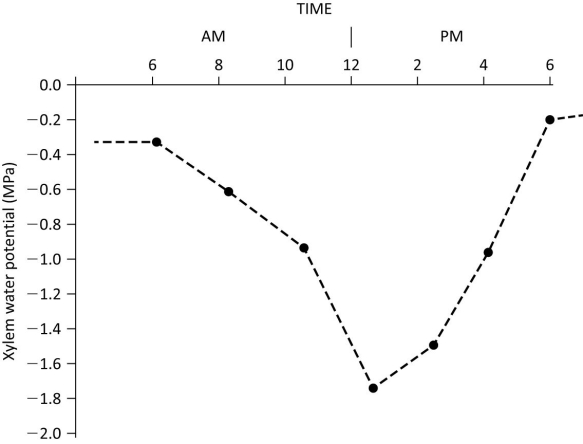
(Multiple Choice)
4.8/5  (76)
(76) Long-distance transport in phloem requires which of the following processes?
I. a positive water potential
II. active transport through parenchyma cells
III. cohesion between water molecules
IV. evaporation of water molecules
(Multiple Choice)
4.9/5 (81)
(81) A student examined a leaf and observed that it was dark green, thin, had stoma on the lower surface only, and had a total surface area of more than two square meters. In which environment was the leaf most likely growing?
(Multiple Choice)
4.8/5 (85)
(85) Which of the following would tend to increase transpiration?
(Multiple Choice)
4.9/5 (73)
(73) Which one of the following statements about the transport of nutrients in phloem is correct?
(Multiple Choice)
4.8/5 (80)
(80) The value for Ψ in root tissue was found to be -0.15 MPA. Which of the following best describes water flow if the root tissue was placed it in a 0.1 M solution of sucrose (Ψ = -0.23 MPa)?
(Multiple Choice)
4.7/5 (96)
(96) Which one of the following played a critical role in water absorption necessary for the successful colonization of land by plants?
(Multiple Choice)
4.8/5 (74)
(74) The leaf area index is described by which of the following ratios?
(Multiple Choice)
4.8/5 (74)
(74) Which of the following supports the finding that sugar translocation in phloem is an active (energy-requiring) process?
(Multiple Choice)
4.8/5 (81)
(81) Which of the following terms describes the physical property that predicts the direction of water flow in plants?
(Multiple Choice)
4.8/5 (92)
(92) Ignoring all other factors, what weather conditions would result in the fastest delivery of water and minerals to the leaves of an oak tree?
(Multiple Choice)
4.8/5 (84)
(84) Which of the following would be least likely to affect osmosis in plants?
(Multiple Choice)
4.7/5 (75)
(75) Which of following ions play the primary role in basic transport processes in plant cells?
(Multiple Choice)
4.9/5 (85)
(85) Which of the following does not contribute to forming the curved upper surface of water inside a narrow tube such as a tracheid or vessel?
(Multiple Choice)
4.7/5 (78)
(78) What is the overall charge on the cytoplasmic side of a plant cell plasma membrane?
(Multiple Choice)
4.7/5 (71)
(71) If isolated plant cells with a water potential averaging -0.5 MPa are placed into a solution with a water potential of -0.3 MPa which of the following would be the most likely outcome?
(Multiple Choice)
4.9/5 (80)
(80) The phyllotaxy of mature shoots can be described by a phyllotactic fraction where the numerator indicates the number of times you must go around the stem to get to another leaf directly above (or below) the starting leaf and the denominator indicates the number of leaves passed through to get back in-line with the starting leaf. These two numbers can also be used to calculate the angle between successive leaves. The most common patterns are summarized in the table below.
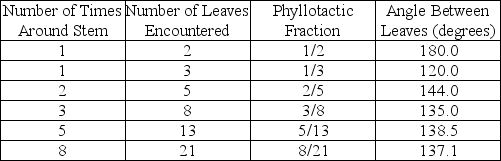 What is an advantage to plants as the numbers of leaves passed through increase?
 (Multiple Choice)
5.0/5 (74)
(74) Which of the following experimental procedures would most likely reduce transpiration while allowing the normal growth of a plant?
(Multiple Choice)
4.8/5 (94)
(94) Which of the following is an adaptation that enhances the uptake of water and minerals by roots?
(Multiple Choice)
4.8/5 (65)
(65) 
Filters
- Essay(0)
- Multiple Choice(0)
- Short Answer(0)
- True False(0)
- Matching(0)