



 Chat with AI
Exam 38: Reproduction of Flowering Plants

Exam 1: Biology and Its Themes46 Questions
Exam 2: Atoms and Molecules61 Questions
Exam 3: The Chemistry of Water55 Questions
Exam 4: Carbon: the Basis of Molecular Diversity52 Questions
Exam 5: Biological Macromolecules and Lipids71 Questions
Exam 6: Energy and Life65 Questions
Exam 7: Cell Structure and Function66 Questions
Exam 8: Cell Membranes67 Questions
Exam 9: Cellular Signaling62 Questions
Exam 10: Cell Respiration68 Questions
Exam 11: Photosynthetic Processes64 Questions
Exam 12: Mitosis63 Questions
Exam 13: Sexual Life Cycles and Meiosis64 Questions
Exam 14: Mendelian Genetics65 Questions
Exam 15: Linkage and Chromosomes54 Questions
Exam 16: Nucleic Acids and Inheritance65 Questions
Exam 17: Expression of Genes70 Questions
Exam 18: Control of Gene Expression66 Questions
Exam 19: Dna Technology56 Questions
Exam 20: The Evolution of Genomes47 Questions
Exam 21: How Evolution Works60 Questions
Exam 22: Phylogenetic Reconstruction66 Questions
Exam 23: Microevolution65 Questions
Exam 24: Species and Speciation65 Questions
Exam 25: Macroevolution58 Questions
Exam 26: Introduction to Viruses54 Questions
Exam 27: Prokaryotes61 Questions
Exam 28: The Origin and Evolution of Eukaryotes66 Questions
Exam 29: Nonvascular and Seedless Vascular Plants72 Questions
Exam 30: Seed Plants64 Questions
Exam 31: Introduction to Fungi56 Questions
Exam 32: An Introduction to Animal Diversity58 Questions
Exam 33: Invertebrates58 Questions
Exam 34: Vertebrates66 Questions
Exam 35: Plant Structure and Growth68 Questions
Exam 36: Transport in Vascular Plants73 Questions
Exam 37: Plant Nutrition51 Questions
Exam 38: Reproduction of Flowering Plants59 Questions
Exam 39: Plant Signals and Behavior60 Questions
Exam 40: The Animal Body58 Questions
Exam 41: Chemical Signals in Animals62 Questions
Exam 42: Animal Digestive Systems58 Questions
Exam 43: Animal Transport Systems58 Questions
Exam 44: Animal Excretory Systems49 Questions
Exam 45: Animal Reproductive Systems64 Questions
Exam 46: Development in Animals68 Questions
Exam 47: Animal Defenses Against Infection65 Questions
Exam 48: Electrical Signals in Animals62 Questions
Exam 49: Neural Regulation in Animals69 Questions
Exam 50: Sensation and Movement in Animals68 Questions
Exam 51: An Overview of Ecology71 Questions
Exam 52: Behavioral Ecology64 Questions
Exam 53: Populations and Life History Traits73 Questions
Exam 54: Biodiversity and Communities71 Questions
Exam 55: Energy Flow and Chemical Cycling in Ecosystems80 Questions
Exam 56: Conservation and Global Ecology75 Questions
Select questions type


Which of the following is a true statement about asexual reproduction in plants?

Free
(Multiple Choice)
4.8/5  (80)
(80) Correct Answer: Verified
C
If pollen from a plant with the S1S2 genotype is recognized and allowed to germinate on the stigma of the same plant with the S1S2 genotype, the plant is mostly likely ________.
Free
(Multiple Choice)
4.7/5 (75)
(75) Correct Answer:Verified
VerifiedA
The following question is based on information from M. C. Cavalcante et al., Pollination requirements and the foraging behavior of potential pollinators of cultivated Brazil nut (Bertholletia excelsa Bonpl.) trees in central Amazon rainforest, Psyche 2012, article ID 978019, 9 pages (2012).
Https://doi.org/10.1155/2012/978019.
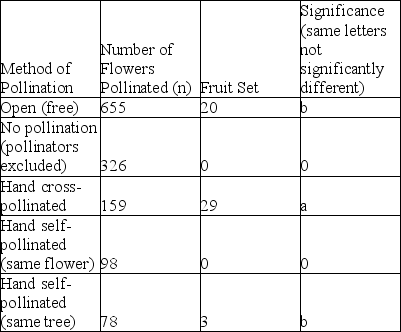
A study was done to test the hypothesis that Brazil nut flowers are self-incompatible. Which set of experiments from the table below suggests that there is genetic variation between flowers on the same tree?
Free
(Multiple Choice)
4.8/5 (77)
(77) Correct Answer:Verified
VerifiedD
Which of the following is a potential advantage of introducing apomixis into hybrid crop species?
(Multiple Choice)
4.9/5 (81)
(81) Which of the following statements regarding flowering plants is correct?
(Multiple Choice)
4.8/5 (84)
(84) Which of the following best describes how sperm cells are formed in plants?
(Multiple Choice)
4.8/5 (88)
(88) Which of these human activities is not part of the development of crop plants from wild relatives?
(Multiple Choice)
4.7/5 (68)
(68) Cottonwood, aspen, willow trees are dioecious and have flowers without petals that appear before the leaves are out in the spring. Based on these observations, what is their likely pollination strategy?
(Multiple Choice)
4.9/5 (72)
(72) Resistance to the herbicide Roundup™ is one of the earliest, and most common, traits engineered into crop plants. Which of the following best explains how many common weeds are becoming Roundup™ resistant?
(Multiple Choice)
4.8/5 (78)
(78) Over human history, which process has been most important in improving the features of plants that have long been used by humans as staple foods?
(Multiple Choice)
5.0/5 (77)
(77) Which of these processes occurs earliest when seed germination begins?
(Multiple Choice)
4.8/5 (75)
(75) Asexual reproduction can produce offspring more quickly than sexual reproduction; yet most plants reproduce sexually in nature. Which of the following best explains why sexual reproduction is more prevalent?
(Multiple Choice)
4.8/5 (84)
(84) The Brazil nut tree, Bertholletia excelsa (2n = 34) produces tough-walled fruits, each containing 8-25 seeds (Brazil nuts). When you eat a Brazil nut, which is composed primarily of endosperm, how many chromosomes are in most of the cells you are eating?
(Multiple Choice)
4.7/5 (76)
(76) Which of the following occurs during the alternation of generations in plants?
(Multiple Choice)
4.9/5 (75)
(75) In which of the following pairs of structures are the two terms equivalent?
(Multiple Choice)
4.9/5 (85)
(85) Some plant species produce male and female individuals in which the males have an XY genotype and the females have an XX genotype. After double fertilization, what would be the genotypes of the embryos and endosperm nuclei?
(Multiple Choice)
4.8/5 (70)
(70) Which of the flowers diagramed below is most likely to be self-compatible? 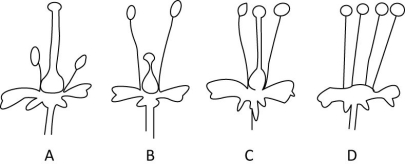
(Multiple Choice)
4.7/5 (71)
(71) 
Filters
- Essay(0)
- Multiple Choice(0)
- Short Answer(0)
- True False(0)
- Matching(0)