



 Chat with AI
Exam 38: Reproduction of Flowering Plants

Exam 1: Biology and Its Themes46 Questions
Exam 2: Atoms and Molecules61 Questions
Exam 3: The Chemistry of Water55 Questions
Exam 4: Carbon: the Basis of Molecular Diversity52 Questions
Exam 5: Biological Macromolecules and Lipids71 Questions
Exam 6: Energy and Life65 Questions
Exam 7: Cell Structure and Function66 Questions
Exam 8: Cell Membranes67 Questions
Exam 9: Cellular Signaling62 Questions
Exam 10: Cell Respiration68 Questions
Exam 11: Photosynthetic Processes64 Questions
Exam 12: Mitosis63 Questions
Exam 13: Sexual Life Cycles and Meiosis64 Questions
Exam 14: Mendelian Genetics65 Questions
Exam 15: Linkage and Chromosomes54 Questions
Exam 16: Nucleic Acids and Inheritance65 Questions
Exam 17: Expression of Genes70 Questions
Exam 18: Control of Gene Expression66 Questions
Exam 19: Dna Technology56 Questions
Exam 20: The Evolution of Genomes47 Questions
Exam 21: How Evolution Works60 Questions
Exam 22: Phylogenetic Reconstruction66 Questions
Exam 23: Microevolution65 Questions
Exam 24: Species and Speciation65 Questions
Exam 25: Macroevolution58 Questions
Exam 26: Introduction to Viruses54 Questions
Exam 27: Prokaryotes61 Questions
Exam 28: The Origin and Evolution of Eukaryotes66 Questions
Exam 29: Nonvascular and Seedless Vascular Plants72 Questions
Exam 30: Seed Plants64 Questions
Exam 31: Introduction to Fungi56 Questions
Exam 32: An Introduction to Animal Diversity58 Questions
Exam 33: Invertebrates58 Questions
Exam 34: Vertebrates66 Questions
Exam 35: Plant Structure and Growth68 Questions
Exam 36: Transport in Vascular Plants73 Questions
Exam 37: Plant Nutrition51 Questions
Exam 38: Reproduction of Flowering Plants59 Questions
Exam 39: Plant Signals and Behavior60 Questions
Exam 40: The Animal Body58 Questions
Exam 41: Chemical Signals in Animals62 Questions
Exam 42: Animal Digestive Systems58 Questions
Exam 43: Animal Transport Systems58 Questions
Exam 44: Animal Excretory Systems49 Questions
Exam 45: Animal Reproductive Systems64 Questions
Exam 46: Development in Animals68 Questions
Exam 47: Animal Defenses Against Infection65 Questions
Exam 48: Electrical Signals in Animals62 Questions
Exam 49: Neural Regulation in Animals69 Questions
Exam 50: Sensation and Movement in Animals68 Questions
Exam 51: An Overview of Ecology71 Questions
Exam 52: Behavioral Ecology64 Questions
Exam 53: Populations and Life History Traits73 Questions
Exam 54: Biodiversity and Communities71 Questions
Exam 55: Energy Flow and Chemical Cycling in Ecosystems80 Questions
Exam 56: Conservation and Global Ecology75 Questions
Select questions type


The vast number and variety of flowering plant species is probably related to which of the following?
(Multiple Choice)
4.9/5  (85)
(85) Which of the following flower parts develops into the pulp of a fleshy fruit?
(Multiple Choice)
4.7/5 (93)
(93) Which of the following is the correct order of floral organs from the outside to the inside of a complete flower?
(Multiple Choice)
4.7/5 (87)
(87) What is the typical ploidy of endosperm cells in an angiosperm seed?
(Multiple Choice)
5.0/5 (86)
(86) Farmers traditionally kept some of the seeds from their best plants in one season to plant the following year. Now that farmers mostly plant hybrid seed this practice is no longer effective because ________.
(Multiple Choice)
4.8/5 (70)
(70) Which of the following is necessary for a generative cell in a pollen grain to produce two sperm cells?
(Multiple Choice)
4.8/5 (85)
(85) Which of the following pollinating agents is correctly matched with the type of plant it helps pollinate?
(Multiple Choice)
4.9/5 (81)
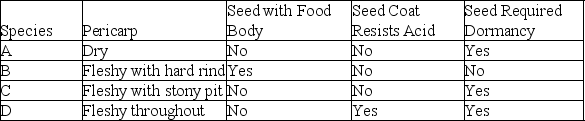
(81) Based on the table below, which species has fruits adapted for dispersal by fruit-eating animals (frugivores)?
(Multiple Choice)
4.8/5 (82)
(82) Which of the following best describes double fertilization in flowering plants?
(Multiple Choice)
4.9/5 (92)
(92) Which of the following best describes a selective advantage of retaining the gametophyte within the living sporophyte of land plants?
(Multiple Choice)
4.9/5 (74)
(74) Which of the following is the strongest environmental argument against the introduction of genetically modified crops?
(Multiple Choice)
4.8/5 (96)
(96) Arrange the following structures from largest to smallest, assuming that they belong to two generations of the same angiosperm.
1) ovary
2) ovule
3) egg
4) carpel
5) embryo sac
(Multiple Choice)
4.9/5 (89)
(89) A hypothetical dye stains sporophyte tissue blue and gametophyte tissue red. What would a researcher most likely observe if a section through the center of a seed was stained with this dye?
(Multiple Choice)
4.9/5 (75)
(75) "Golden Rice" is a GM crop designed to enhance which of the following traits?
(Multiple Choice)
4.9/5 (64)
(64) Which of the following is the best argument for pursuing plant biotechnology?
(Multiple Choice)
4.8/5 (78)
(78) A summer occupation in maize-growing regions is detasseling the maize: removing unwanted male flowers so that female flowers on the same plant are pollinated by the desired pollen for the hybrid maize. Which of the following best describes maize plant flowers?
(Multiple Choice)
5.0/5 (80)
(80) Which of the following statements about fruit ripening is an example of positive feedback?
(Multiple Choice)
4.9/5 (77)
(77) Which of the following are potential benefits of producing genetically modified crops?
I. create crops that can grow on land previously unsuitable for agriculture
II. create crops with better potential for biofuel production
III. create crops with better nutritional attributes
IV. increase crop yield
(Multiple Choice)
4.9/5 (83)
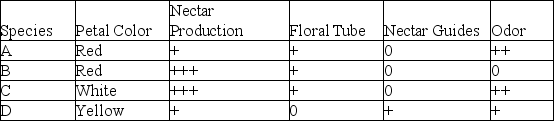
(83) The table below shows some of the floral characteristics of four different flower species. Which species, A, B, C, or D, is most likely pollinated by a bat?
(Multiple Choice)
4.9/5 (87)
(87) In a typical angiosperm, what is the sequence of structures encountered by the tip of a growing pollen tube on its way to the egg?
(Multiple Choice)
4.7/5 (79)
(79) 
Filters
- Essay(0)
- Multiple Choice(0)
- Short Answer(0)
- True False(0)
- Matching(0)